


Think a single social post can’t sink your business? Think again.
A single unlicensed photo, a sloppy comparison, or an angry ex-employee’s claim can trigger lawsuits that cost tens of thousands.
Advertising liability insurance shields small businesses from those ad-related legal fights, paying for defense and settlements up to your policy limits.
But it’s not a catch-all, intentional IP theft, prior knowledge, and contract disputes are usually excluded, so you must check the fine print and pick limits that match real worst-case costs.
Overview of Advertising Liability Insurance for Small Businesses

Advertising liability insurance protects businesses from lawsuits that stem from their marketing and promotional work. It covers claims like libel, slander, copyright infringement, trademark violations, and misusing someone’s ideas or images in ads. For small businesses running social media campaigns, placing online ads, or handing out printed flyers, even an honest mistake in your marketing can trigger expensive legal trouble.
You might see this called “personal and advertising injury coverage.” Sometimes it’s bundled into a commercial general liability policy. Sometimes it’s sold separately as an add-on. Here’s what catches people off guard: standard general liability insurance doesn’t automatically cover every advertising claim, especially if your business revolves around marketing or creating content. A lot of small business owners think their basic liability policy has them covered for all customer complaints. It often doesn’t, unless you specifically asked for it or verified it’s there.
Small businesses run into advertising risks through pretty much every marketing channel. Instagram posts, Google Ads, storefront signs, email newsletters. A single copyright claim from a stock photo agency or a defamation accusation from a competitor you mentioned in a comparison ad can cost tens of thousands in legal fees. And that’s even if the claim turns out to be nonsense.
What you’re typically covered for:
- Using someone else’s copyrighted photo or music in a social media ad by accident
- Making defamatory statements about a competitor in your promotional materials
- Using a person’s image or face without their permission (violating their right of publicity)
- Creating a slogan or tagline that steps on another business’s registered trademark
What Advertising Liability Insurance Covers

This insurance pays for legal defense costs, settlements, and judgments when someone accuses your business of causing harm through your advertising. The policy usually covers libel (written defamation), slander (spoken defamation), copyright infringement, trademark infringement, invasion of privacy, and stealing advertising ideas. These protections apply whether the problem happened in a digital ad, a printed brochure, a TV commercial, or a social media post.
Coverage kicks in when someone files a claim or lawsuit saying your marketing content hurt them financially, damaged their reputation, or violated their intellectual property. The insurer pays for lawyers, court costs, expert witnesses, and any settlement or judgment up to your policy limit. This matters because defending even a ridiculous claim can run $20,000 or more in legal fees before it gets tossed out.
The scope is broader than most small business owners expect. It’s not just paid ads. It also includes organic content marketing, blog posts where you mention competitors, product packaging with creative imagery, and promotional emails to customers. If a claim comes from how you marketed your product or service (rather than the product itself), advertising liability insurance is what responds.
| Claim Type | Example Scenario | What Insurance Pays |
|---|---|---|
| Copyright Infringement | You used a Getty Images photo in a Facebook ad without buying the license. Getty sues for $15,000. | Legal defense costs, settlement payment, and licensing fee damages up to policy limit. |
| Libel / Defamation | Your blog post incorrectly claims a competitor’s product contains harmful ingredients. They sue for damage to reputation. | Attorney fees, court costs, and awarded damages if you lose or settle. |
| Trademark Infringement | Your new company slogan is too similar to a registered trademark owned by another business in your industry. | Defense costs and settlement to stop using the slogan and pay compensatory damages. |
| Invasion of Privacy | You post a customer testimonial video on your website without getting a signed release. The customer demands it be removed and sues for unauthorized use of their likeness. | Legal fees and settlement payment, including any statutory damages for privacy violation. |
| Misappropriation of Advertising Ideas | A marketing consultant claims you used their campaign concept without permission or payment after they pitched it in a meeting. | Defense costs and settlement or judgment if the claim is proven. |
Common Exclusions and Limitations

Advertising liability insurance doesn’t cover every possible marketing related claim. Most policies exclude intentional wrongdoing. If you knowingly stole someone’s copyrighted image or deliberately published false information about a competitor, coverage gets denied. The insurer also won’t pay if you knew about the potential claim before you bought the policy. That’s called “prior acts” or “prior knowledge” exclusions. If you got a cease and desist letter about trademark infringement two months before buying coverage, any lawsuit from that same issue won’t be covered.
Breach of contract claims are typically excluded too. If a client sues you for not delivering promised marketing results or missing a campaign deadline, advertising liability insurance won’t respond. That’s covered by professional liability or errors and omissions insurance instead. Patent infringement is almost always excluded as well, since patent disputes need specialized coverage and involve complex technical and legal issues way beyond what standard advertising injury policies handle.
What’s usually excluded:
- Intentionally violating intellectual property rights or deliberately defaming someone
- Claims or incidents that happened before the policy’s retroactive date or that you knew about before purchasing coverage
- Breach of contract disputes with clients or vendors
- Patent infringement allegations
- False or misleading product performance claims (like “this supplement cures cancer”), which fall under product liability or are uninsurable due to fraud concerns
Which Small Businesses Need Advertising Liability Protection

Any business that actively promotes itself through paid or organic marketing faces exposure to advertising injury claims. Digital marketing agencies, social media managers, graphic design firms, and content creators face the highest risk. Their entire operation revolves around producing promotional material for clients. A single client campaign that accidentally uses an unlicensed font or a competitor’s trademarked phrase can trigger a lawsuit against both the agency and the client. The agency ends up covering its own defense costs.
Retailers, e-commerce stores, and service businesses running frequent online ads or maintaining active social media accounts also need this coverage. These businesses may not think of themselves as “marketing companies,” but they publish promotional content daily and face the same infringement and defamation risks as professional agencies. A local bakery posting a customer photo on Instagram without permission, or an online clothing store using a competitor’s product image in a comparison chart, can get sued under the same legal theories that apply to ad agencies.
Who’s at high risk:
- Digital marketing agencies, advertising firms, and media production companies
- E-commerce retailers running Google Ads, Facebook campaigns, or influencer partnerships
- Professional bloggers, podcasters, and content creators who monetize through sponsorships or affiliate links
- Consulting firms and service providers that publish case studies, white papers, or comparison content naming competitors
Cost of Advertising Liability Insurance
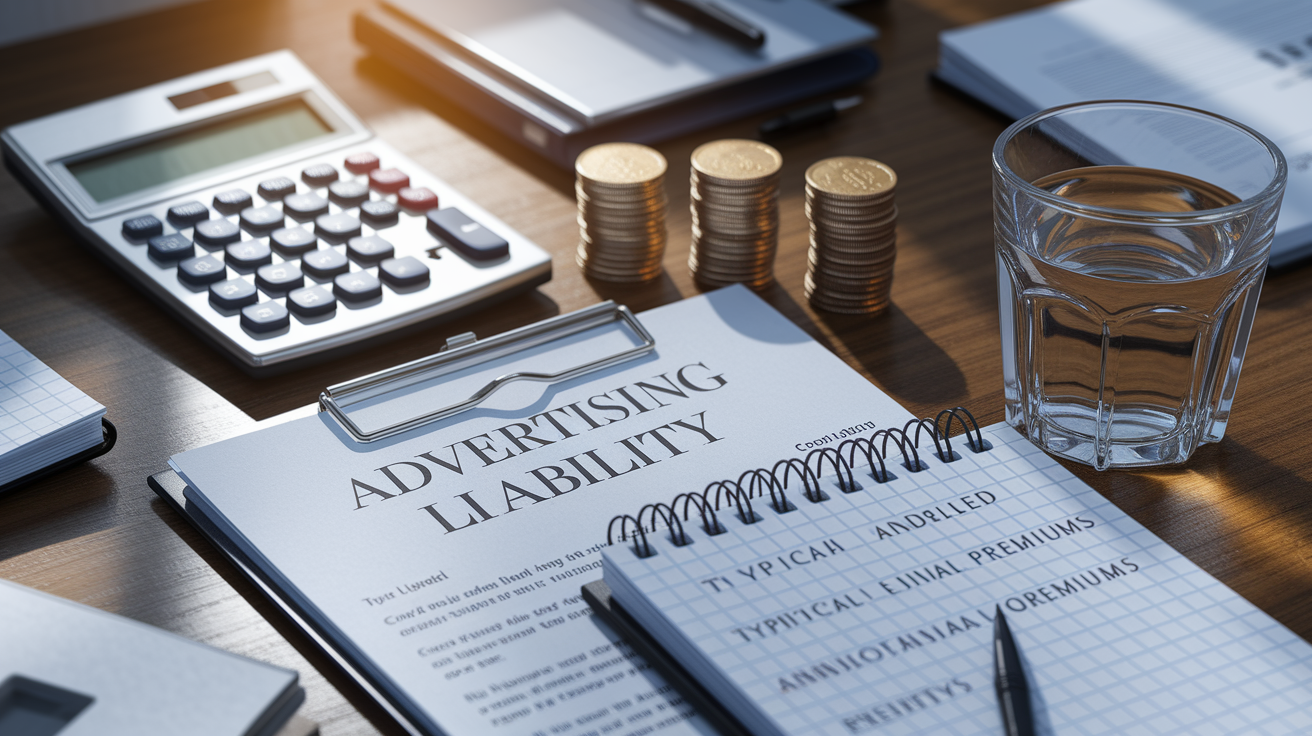
Annual premiums for advertising liability insurance typically run from $300 to $1,000 for small businesses. The final cost depends on several factors. Businesses with higher marketing activity, larger ad budgets, and more frequent content publication pay more because they have greater exposure to potential claims. A freelance graphic designer posting occasional portfolio updates might pay $350 per year. A digital agency managing daily social media campaigns for twenty clients might pay $2,500 annually for the same base coverage.
Industry classification and revenue also drive pricing. Insurers consider certain industries, like marketing agencies and media production firms, to be higher risk because their entire business model revolves around creating advertising content. A business generating $200,000 in annual revenue will generally pay less than one earning $2 million, since higher revenue correlates with larger campaigns and more exposure to third party intellectual property. Claims history matters too. If your business has been sued for copyright infringement in the past, expect significantly higher premiums or even difficulty finding coverage.
The coverage limit you select directly affects cost. Most small businesses start with $1 million per occurrence and $2 million aggregate. That’s the minimum many commercial clients require in service contracts. If a client demands higher limits, like $5 million or $10 million, your premium increases accordingly. Some insurers also offer “per claim” deductibles ranging from $0 to $2,500. Choosing a higher deductible can lower your annual premium but increases your out of pocket cost if a claim gets filed.
| Business Type | Typical Annual Premium |
|---|---|
| Freelance graphic designer or copywriter (revenue under $100,000) | $300 – $500 |
| Small marketing agency or social media management firm (revenue $100,000 – $500,000) | $600 – $1,200 |
| E-commerce retailer or service business with active online advertising (revenue $200,000 – $1,000,000) | $400 – $800 |
| Mid-size advertising agency or media production company (revenue over $1,000,000) | $1,500 – $3,000+ |
Advertising Liability Insurance vs. General Liability Insurance

General liability insurance covers bodily injury and property damage claims. A customer slipping on a wet floor in your office or your employee accidentally damaging a client’s equipment during a service call. Advertising liability addresses non-physical harms that arise specifically from your marketing and promotional activities. The confusion happens because advertising injury coverage is technically a component of “personal and advertising injury” coverage, which is often included as a section within a standard commercial general liability policy.
Here’s the critical issue. Many general liability policies exclude or severely limit advertising injury protection for businesses whose primary activity is marketing, advertising, or media production. Insurers build these exclusions into standard CGL forms because they view ad agencies and content creators as having fundamentally different (and higher) risk profiles than a plumber or a retail shop. If you run a marketing agency and assume your CGL policy covers copyright claims, you might discover at claim time that the coverage was excluded in the fine print or capped at a limit far too low to cover defense costs.
Key differences:
- General liability pays for physical injuries and property damage. Advertising liability pays for reputational harm, intellectual property violations, and privacy claims stemming from ads.
- CGL is required or expected for nearly all businesses. Advertising liability is essential only for businesses that actively market products or services.
- Advertising injury coverage may be included in a CGL policy or require a separate endorsement, depending on your industry and the insurer’s underwriting rules.
- If your business is classified as a marketing, advertising, or media firm, you’ll likely need a standalone advertising liability policy or a specialized package because standard CGL forms exclude your core exposure.
Real-World Examples of Advertising Liability Claims

A small online boutique hired a freelance photographer to shoot product images and posted them on Instagram and the store’s website. Three months later, the boutique received a cease and desist letter from a stock photo agency claiming one background image in the photos was lifted from their catalog without a license. The agency demanded $12,000 in licensing fees and threatened a copyright lawsuit. The boutique’s advertising liability policy covered the legal consultation and negotiated a $6,500 settlement. Without it, they’d have faced a court battle that could have cost $30,000 in attorney fees.
A local coffee shop posted a humorous comparison chart on Facebook showing its cold brew next to a competitor’s product, with a caption saying the competitor’s brew “tastes like dishwater.” The competing café filed a defamation lawsuit, arguing the post damaged their reputation and caused a measurable drop in sales. Even though the coffee shop owner believed the comment was obvious hyperbole, the insurer had to pay $18,000 in legal defense costs before the case was dismissed. Without advertising liability coverage, the shop owner would have paid that bill out of pocket.
A digital marketing agency created a social media campaign for a client using what they thought was a royalty free music clip. The clip turned out to be a copyrighted song with a soundalike intro. The original artist’s label sent a demand letter for $25,000 and filed suit against both the client and the agency. The agency’s advertising liability policy paid the defense costs and a negotiated settlement. But the client’s policy didn’t include advertising injury coverage, leaving the client exposed for their share of the claim.
Three common claim scenarios:
- Using a stock photo, graphic, or music file without verifying the license terms or mistakenly believing “free for personal use” means “free for commercial use”
- Publishing a blog post, ad, or social media comment that a competitor interprets as defamatory or factually false
- Launching a campaign with a slogan, logo, or design element that’s confusingly similar to another brand’s registered trademark
How to Purchase Advertising Liability Insurance

Start by confirming whether advertising injury coverage is already included in your existing commercial general liability or business owner’s policy. Request a copy of your policy declarations page and the full policy form, then search for the section titled “Personal and Advertising Injury.” If that section exists, read the definition and exclusions carefully. Many standard forms exclude advertising injury for businesses whose operations are primarily marketing or media related. If you find an exclusion or if your policy has no advertising injury section at all, you need to purchase standalone coverage or add an endorsement.
Next, decide whether to work with an insurance broker, contact insurers directly, or use an online platform. Brokers specializing in media and advertising risks can identify carriers that underwrite advertising liability for your industry and help you compare coverage terms, exclusions, and limits. Direct to insurer and online platforms are faster and sometimes cheaper, but they may offer only package policies that don’t allow customization of advertising injury limits or may automatically exclude higher risk business types.
When evaluating options, confirm the coverage limit and whether it applies per claim, per occurrence, or as an aggregate annual cap. Most commercial clients require at least $1 million per occurrence and $2 million aggregate. Ask whether the policy includes prior acts coverage (also called retroactive coverage) or only covers claims arising from marketing activities that occur after your policy start date. If you’ve been in business for years and want protection for past campaigns, you need a policy with a retroactive date matching your business start date or earlier.
Steps to evaluate and get a policy:
- Review your current general liability or BOP policy to see if advertising injury coverage is included and whether it applies to your business classification.
- If coverage is excluded or absent, request quotes for standalone advertising liability insurance or a media liability endorsement from at least two insurers or brokers.
- Compare coverage limits, exclusions (especially “prior acts” and “intentional acts” language), deductibles, and premium costs across quotes.
- Verify that the policy covers both digital and traditional advertising, including social media, email marketing, print ads, and any other channels you use.
- Purchase the policy, save a digital copy of the declarations page and full policy form, and set a calendar reminder 60 days before renewal to review limits and update coverage if your marketing activity has grown.
Final Words
You learned what advertising liability insurance covers, common exclusions, who’s most at risk, typical costs, and how it compares to general liability.
Watch for the fine print—intentional acts, patent claims, and prior-known incidents often create coverage gaps. Check limits, endorsements, and the insurer’s claims handling before you sign.
With the right limits and written confirmation, advertising liability insurance for small business can turn a costly marketing mistake into a manageable claim. That’s coverage that actually helps.
FAQ
Q: How much does a $1,000,000 liability insurance policy cost?
A: The cost of a $1,000,000 liability insurance policy is typically $300–$1,500 per year for small businesses, depending on industry, payroll, claims history, and marketing or operational risk.
Q: What does advertising liability insurance cover?
A: Advertising liability insurance covers claims like libel, slander, copyright and trademark infringement, invasion of privacy, and misappropriation arising from ads, social posts, websites, and printed marketing materials.
Q: How much is $20 million public liability insurance?
A: The cost of $20 million public liability insurance is usually several thousand to tens of thousands per year, varying by industry, revenue, payroll, claims history, and whether it’s issued as an umbrella policy.
Q: Is media liability the same as E&O?
A: Media liability is not the same as E&O. Media liability covers content claims like defamation, privacy, and IP, while errors and omissions covers professional mistakes or bad advice; check policy wording for overlap.