





Renewal came in higher and the insurer told you it was an “industry-wide adjustment”? Don’t accept that.
Call your agent, demand the exact reason code, and rerun every discount. That’s step one.
This post walks you through quick, practical moves that actually cut your premium: same-day checks, competing quotes, deductible edits, bundling, billing changes, and credit fixes.
Do them right and you can often reverse or erase a rate hike within one billing cycle.
Here’s how to start today.
Immediate Actions to Lower Insurance After a Rate Increase

The second your renewal notice shows up with a higher premium, you need to figure out exactly why it happened and when it kicks in. Call your insurer’s customer service line or your agent and ask for a detailed premium breakdown. Don’t accept vague answers like “industry-wide adjustment.” You want specific reason codes: “claim on 01/15/2025” or “one speeding citation on 02/03/2025.” Most insurers can pull that breakdown the same day, though written explanations might take up to seven business days. While you’re on the phone, ask the rep to rerun all available discounts and confirm every endorsement on your policy. You’re hunting for quick fixes. Outdated driver info, unapplied discounts, add-ons you forgot about.
Shopping for competing quotes is your second same-day move. Get at least three quotes within 24 to 72 hours. These price checks trigger soft credit pulls, which won’t touch your credit score. If you’ve got good credit and a clean driving record, you might find a carrier willing to price you 5% to 30% lower than your renewal. While you’re gathering quotes, ask your current insurer if they can adjust your deductibles, remove optional coverages, or extend accident forgiveness. A lot of insurers process policy edits within one to 30 days, so a coverage change today can show up on your next billing cycle.
If your insurer can’t justify the increase or refuses to run a rate review, tell them you’re actively shopping and set a deadline. “I need a revised quote by [date] or I’m moving my policy.” Use specific numbers and competing offers when you negotiate. Something like, “I have a quote for $950 per year. Can you match that by [date]?” Concrete targets and deadlines force faster internal approvals.
Six rapid actions to take in the first 72 hours:
Verify the exact reason for the increase and the effective date. Request a full discount inventory and ask the agent to rerun eligibility. Obtain three to five competing quotes online or through an independent agent. Remove optional add-ons like roadside assistance or rental reimbursement if you already have overlapping coverage. Ask for a telematics pre-check to see if usage-based pricing could lower your rate. Prepare a short phone or email script with your target premium and deadline.
Comparing Insurance Quotes to Reverse a Rate Hike

Shopping around after a rate increase carries almost no downside. Getting multiple quotes doesn’t obligate you to switch, and plenty of shoppers find a carrier willing to price them 5% to 30% lower even when their current insurer refuses to budge. The catch? All quotes need to use identical coverage limits, deductibles, and endorsements. A quote that looks $300 cheaper but includes half your current liability limit may cost you more in practice if you ever file a claim or cause serious damage. When you request quotes, provide the same coverages line by line. Ask each agent or online tool to match your current policy exactly, then adjust from that baseline.
Regional carriers and smaller insurers often offer lower base rates than national brands because they price risk differently or keep overhead lower. Request at least one quote from a regional company or through an independent agent who can access multiple carriers at once. Quotes typically arrive within 24 to 72 hours. Lock in the new rate by making your first payment and activating the policy, then cancel the old coverage. Never the other way around.
| Coverage Element | Why It Must Match When Comparing |
|---|---|
| Liability limits (e.g., 100/300/100) | Lower limits reduce premium but expose you to full lawsuit damages above the limit. High limits protect assets and future income. |
| Collision and comprehensive deductibles | A $1,000 deductible costs less per month but requires $1,000 out-of-pocket after a claim. Mismatched deductibles distort total-cost comparisons. |
| Optional coverages (rental, roadside, gap) | Dropping rental reimbursement from one quote but not another creates an artificial price difference. Compare identical endorsements first, then decide what to remove. |
| Uninsured/underinsured motorist coverage | Some states require it, others make it optional. Leaving it off one quote may save money but leave you exposed if an uninsured driver hits you. |
| Medical payments or PIP | State minimums vary. One carrier may include higher medical coverage by default, inflating the quote while offering better protection after an accident. |
Adjusting Deductibles and Coverage Levels After a Rate Increase

Raising your deductible is one of the fastest ways to cut your premium, often within one billing cycle. Increasing your collision and comprehensive deductibles from $250 to $500 typically reduces those coverages by 5% to 15%. Moving from $500 to $1,000 can lower premiums by 10% to 30%. If you pay $1,200 per year with a $500 deductible, raising it to $1,000 might drop your annual cost to $840 to $1,080. That’s an estimated savings of $120 to $360. The trade-off is simple. You pay more out of pocket when a claim happens. Before you make the change, make sure you can cover the higher deductible from savings or an emergency fund. If your vehicle’s older and worth less than ten times your annual premium, consider dropping collision and comprehensive altogether and self-insuring minor damage.
Removing or suspending optional coverages generates immediate savings with minimal risk if you already have overlapping protection. Roadside assistance typically costs $5 to $15 per month, but your cell phone provider, credit card, or auto club membership may already include towing and battery service. Rental reimbursement runs $8 to $20 per month. If you own a second vehicle or can borrow a car after an accident, that coverage may be redundant. Accidental death supplements and medical payment add-ons often cost $2 to $10 per month and duplicate benefits from your health or life insurance. Review your current endorsements line by line and cancel anything that duplicates existing coverage. Most insurers process these edits within one to 30 days, and the savings appear on your next billing statement.
Check with your insurer before finalizing any coverage reductions. Some lenders require minimum collision and comprehensive deductibles on financed or leased vehicles. Confirm that your lender’s requirements permit the higher deductible or the removal of optional endorsements. If you’re unsure, ask your agent to email written confirmation that the new coverage satisfies your loan agreement. That documentation protects you if the lender later objects.
Five deductible and coverage edits that lower premiums quickly:
Increase collision deductible from $250 to $500 or from $500 to $1,000. Increase comprehensive deductible to match your collision deductible. Remove roadside assistance if you already subscribe to an auto club or credit card roadside service. Drop rental reimbursement if you own a second vehicle or can arrange transportation without a rental car. Eliminate medical payment or accidental death endorsements if your health and life insurance already cover those risks.
Bundling Tactics to Lower Insurance After a Rate Increase

Bundling your auto policy with homeowners or renters insurance often saves 5% to 25% on your combined premium. Some carriers also discount when you add multiple vehicles to a single auto policy or include life insurance in the bundle. If your auto premium is $1,200 and your homeowners premium is $900, a 10% bundle discount on both policies would save $210 per year. That’s enough to offset or reverse a modest rate increase. Ask your current insurer whether bundling’s available and request a detailed quote showing the discount line by line. Then compare that bundled quote against separate policies from different carriers. Sometimes, two specialized insurers (one for auto, one for home) still produce a lower total cost than a multipolicy discount from a single company.
Switching to pay-in-full or semiannual billing can add another 3% to 10% savings. Insurers charge fees or interest when they allow monthly installments, so paying the full annual or six-month premium up front eliminates those fees. If you can afford the lump sum without straining your budget, this is one of the easiest ways to lower your effective rate. Enrolling in auto-pay and paperless billing typically adds 1% to 5% in additional discounts. These small savings stack quickly. A $1,200 annual premium with a 5% pay-in-full discount and a 3% paperless discount drops to roughly $1,104, a net savings of $96 per year.
Four bundling and billing changes that reduce premiums:
Combine auto and homeowners or renters insurance through one carrier. Add multiple vehicles to a single auto policy if you insure more than one car. Pay the full annual or six-month premium up front to avoid installment fees. Enroll in auto-pay and paperless billing for a combined 1% to 5% discount.
Credit Score Improvements That Lower Insurance After a Hike

Most insurers use credit-based insurance scores to price policies, and improving your credit score by 50 to 100 points can reduce your premium by an estimated 5% to 20%. Insurers look at payment history, outstanding balances, length of credit history, and recent credit applications. Paying bills on time, keeping credit card balances below 30% of your limit, and avoiding unnecessary new credit accounts all improve your score over time. Request a free credit report from each of the three major bureaus and correct any errors. An incorrect late payment or outdated account can inflate your perceived risk and your premium.
Credit improvements take time to affect your rate. After you fix errors or pay down balances, expect 30 to 90 days before your insurer re-evaluates your underwriting tier and adjusts your premium. Some insurers automatically rescore at each renewal, while others require you to request a manual review. Call your agent and ask whether they can run a new credit check mid-term. If your score’s improved significantly, the insurer may reduce your rate before the next renewal date.
Four states prohibit or restrict the use of credit in insurance pricing: California, Hawaii, Massachusetts, and Michigan. If you live in one of those states, credit score improvements won’t lower your auto or home insurance premium. In all other states, credit-based scoring is a standard underwriting factor, and improving your credit is one of the most reliable long-term strategies to reduce insurance costs.
Using Telematics and Pay‑Per‑Mile Programs to Offset Rate Increases

Telematics programs monitor your driving behavior (speed, braking, acceleration, time of day, and mileage) and adjust your premium based on actual risk. Safe drivers can reduce their premiums by 5% to 30% after three to six months of monitored driving. Most telematics programs use a smartphone app or a plug-in device that connects to your vehicle’s diagnostic port. Enrollment’s usually free, and some insurers offer an immediate participation discount of 5% to 10% just for signing up, with additional savings applied after the monitoring period ends.
Pay-per-mile insurance charges a low base rate plus a per-mile fee, making it ideal for drivers who log fewer miles than average. Many insurers define low mileage as 7,500 miles per year or less. If you work from home, drive only on weekends, or own a second vehicle that sits idle most of the time, pay-per-mile pricing can cut your annual premium by 20% to 50% compared to traditional pricing. The catch? Your savings disappear if your mileage increases. Plan a long road trip and your per-mile charges will spike. Before enrolling, estimate your annual mileage and compare the total cost (base rate plus estimated per-mile charges) against your current premium.
Four scenarios where telematics or pay-per-mile programs make sense:
You drive fewer than 7,500 miles per year and can verify mileage with odometer photos or service records. You work from home or have a very short commute (under five miles each way). You own a second or seasonal vehicle that you drive only a few months per year. You maintain safe driving habits (gradual braking, speed near posted limits, and minimal night driving) and are confident a telematics program will confirm low risk.
Negotiating with Your Insurer After a Rate Increase

Negotiation works best when you have competing quotes in hand and a clear target premium. Insurers often have internal flexibility to apply loyalty adjustments, extend accident forgiveness, or rerun discount eligibility if you demonstrate that you’re actively shopping and willing to leave. Prepare before you call or email. Gather your current policy documents, write down your driving history (accidents, violations, claims), and collect at least three competing quotes with identical coverages. Then reach out to your agent or the customer service department with a specific request. “My renewal increased by 30%, and I have quotes for $950 per year. Can you match that by [date]?”
Negotiation typically involves requesting reason codes for the increase, asking the insurer to inventory all available discounts, checking whether accident forgiveness applies, and demonstrating that you’ve received lower offers elsewhere. Some insurers will waive the first accident surcharge or extend a loyalty discount if you’ve been with the company for three or more years. Others will re-evaluate your underwriting tier if you can prove that the reason for the increase (such as a disputed claim or an incorrect mileage estimate) was an error. Set a deadline for the insurer’s response, usually seven to ten business days, and be prepared to switch if they can’t meet your target.
Phone Script
When you call, state your name, policy number, and the specific increase amount. Ask for the exact reason codes and request that the representative run all available discounts before you review competing quotes. Use a calm, direct tone and provide a concrete target premium and deadline. Something like, “Hello, my name is [Your Name], policy [#]. My renewal increased by 30% effective [date]. Can you explain the exact reason and run any discounts I qualify for? I’m getting three quotes and prefer to stay, but need a rate under $950 per year. What can you do?”
Four key points to cover in your phone negotiation:
Request a detailed reason for the increase, including specific dates of claims or violations. Ask the agent to rerun all discount eligibility and confirm that every available discount’s been applied. Mention your competing quotes and provide a specific target premium you need to stay. Set a clear deadline for a revised offer, typically seven to ten business days.
Email Script
Email negotiation creates a written record and often prompts faster internal approvals because the request is documented. Use a clear subject line and include your policy number, the percentage increase, and a request for itemized reasons and discount options. Something like, “Subject: Request to Review Renewal Increase – Policy [#]. My renewal shows a 30% increase effective [date]. Please itemize the reason(s), list all discounts or credits available, and advise if accident forgiveness or a loyalty adjustment applies. I have competing quotes of $950 and need a competitive offer by [date, e.g., 10 business days].”
Four elements to include in your email:
Policy number and the exact percentage or dollar amount of the increase. Request for a line-by-line breakdown of the increase and a full discount inventory. Reference to competing quotes with specific dollar amounts. A clear deadline for the insurer’s response.
Correcting Policy Errors to Bring Premiums Back Down
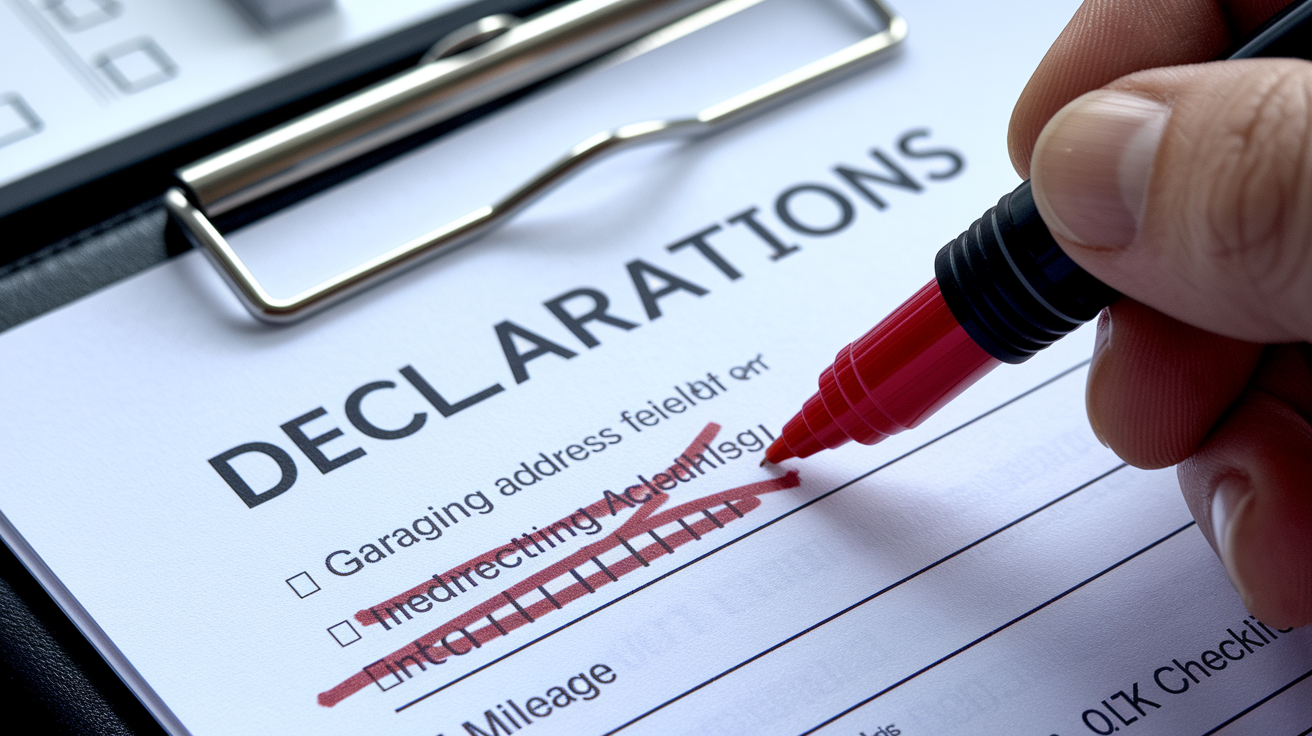
Incorrect information on your policy can inflate your premium by 10% to 50% or more. Common errors include wrong garaging addresses (the zip code where your car’s parked overnight), outdated annual mileage estimates, or driver information that lists a high-risk household member who no longer lives with you or drives your vehicle. Insurers price risk based on location, mileage, and driver history, so even small mistakes can trigger higher rates. Review your policy declarations page line by line and compare every detail (vehicle identification numbers, driver names, addresses, annual mileage) against your actual situation.
If you find an error, contact your insurer immediately and provide documentation. If your garaging address is listed as a high-risk urban zip code but you actually park in a suburban neighborhood, submit a utility bill or lease agreement showing your correct address. If your annual mileage is listed as 15,000 miles but you drive only 6,000 miles per year, provide odometer photos or service records as proof. Most insurers adjust errors mid-term, often within one to 30 days, and the corrected premium applies to your next billing cycle. Sometimes, insurers will refund the overcharge retroactively to the date the error began.
Strategies for Lowering Auto Insurance After a Rate Increase

Defensive driving courses can reduce your auto premium by 5% to 15% and typically take effect within seven to 30 days after you submit your completion certificate to the insurer. Many states require insurers to honor defensive driving discounts for drivers who complete an approved course, and some states mandate the discount for drivers over age 55. Check your state’s insurance department website for a list of approved courses and ask your insurer whether they accept online or in-person formats. The course usually costs $20 to $50 and takes four to eight hours to complete, making it one of the fastest ways to offset a rate increase if you qualify.
Accident forgiveness prevents the first at-fault accident from raising your premium. Some insurers offer it automatically after three to five years of claims-free driving, while others sell it as an optional endorsement for $40 to $100 per year. If your rate increased because of a recent accident and you don’t have accident forgiveness, ask your insurer whether you can add it retroactively or whether it’ll apply to future accidents. If you already have accident forgiveness and your rate still increased after a claim, confirm that the insurer applied the benefit correctly. Errors happen, and a simple phone call can reverse an incorrect surcharge.
Removing a high-risk driver from your policy can drop your rate significantly, but it only works if that driver no longer lives with you or has regular access to your vehicle. If your adult child moved out and now carries their own insurance, notify your insurer and provide proof of the new living arrangement. Surcharges for accidents and violations typically last three to five years, so if a high-risk driver remains on your policy, you’ll pay elevated rates until the surcharge period expires. In some cases, excluding a driver from your policy (signing a form that prohibits them from driving your car) can also reduce your premium, though the excluded driver will have no coverage if they do drive your vehicle.
Three auto-focused actions that lower premiums after a rate increase:
Complete a state-approved defensive driving course and submit the certificate to your insurer within seven to 30 days. Add or confirm accident forgiveness if you’ve maintained a claims-free record for three to five years. Remove or exclude high-risk drivers who no longer live with you or who can be covered under a separate policy.
Strategies for Lowering Home Insurance After a Rate Increase

Raising your home insurance deductible from $500 to $2,000 can save 10% to 30% on your annual premium. The trade-off’s simple. You pay the first $2,000 of repair costs after a covered loss, so this strategy works best if you have an emergency fund large enough to cover the higher deductible. If your premium is $1,200 per year with a $500 deductible, increasing to a $2,000 deductible might drop your cost to $840 to $1,080, a savings of $120 to $360 annually. Check your mortgage lender’s requirements before raising your deductible. Some lenders cap the maximum deductible at $1,000 or $2,500.
Home security upgrades can reduce your premium by 5% to 20%. Monitored alarm systems, deadbolt locks, smoke alarms, carbon monoxide detectors, and fire extinguishers all qualify for discounts at most insurers. Some companies also offer credits for smart home devices such as water leak sensors or video doorbells. Wind and hail mitigation (roof straps, impact-resistant shingles, storm shutters) can lower premiums by an additional 5% to 15% in high-wind states. Before you invest in upgrades, ask your insurer for a list of qualifying devices and estimated savings. Many insurers require proof of installation, such as a receipt or a certificate from a licensed contractor, before they apply the discount.
| Home Upgrade | Typical Savings % |
|---|---|
| Monitored burglar alarm or smart security system | 5%–20% |
| Smoke alarms, carbon-monoxide detectors, fire extinguishers | 5%–10% |
| Deadbolt locks and reinforced doors | 2%–5% |
| Wind/hail mitigation (roof straps, impact shingles, storm shutters) | 5%–15% |
Strategies for Lowering Health Insurance After a Rate Increase
Switching from a traditional PPO or HMO to a high-deductible health plan paired with a health savings account can reduce your monthly premium by 10% to 40%. HDHPs charge lower premiums in exchange for higher deductibles, often $1,500 to $3,000 for individuals or $3,000 to $6,000 for families. The HSA allows you to save pre-tax dollars to cover medical expenses, and many employers contribute to employee HSAs, further lowering your out-of-pocket costs. This strategy works best if you’re generally healthy, rarely visit the doctor, and can afford the higher deductible if a major medical event occurs.
Confirming that your current providers are in-network and switching to a plan that includes them can save immediately. Out-of-network care often costs two to five times more than in-network care, and some plans refuse to cover out-of-network services altogether. If your rate increased because your plan’s network changed, compare alternative plans from the same insurer or from competing carriers that include your preferred doctors and hospitals. Special enrollment windows (triggered by life events such as marriage, birth, job loss, or moving to a new state) allow you to switch plans outside the annual open enrollment period, usually within 60 days of the qualifying event.
Three health insurance actions that reduce premiums after a hike:
Switch to an HDHP with an HSA if you’re healthy, have low annual medical costs, and can cover the higher deductible. Verify that your doctors and hospitals are in-network and switch to a plan that includes them if your current plan no longer does. Check for subsidy eligibility during special enrollment windows if your income’s changed or a qualifying life event’s occurred within the past 60 days.
When to Switch Insurers After a Rate Increase
Switching can begin immediately once you’ve activated a new policy with a different insurer. The key rule? Never cancel your old coverage before the new policy’s active. Any gap in coverage, even a single day, can trigger higher premiums for years because insurers classify uninsured drivers as high-risk. Start by obtaining at least three quotes with identical coverages, then select the best offer and make your first payment. The new insurer will issue a declarations page and proof of insurance, usually within 24 to 72 hours. Once you receive that documentation and confirm the effective date, call your old insurer and request cancellation effective the same date your new policy begins.
Some insurers charge mid-term cancellation fees, typically $25 to $100, if you cancel before your renewal date. Ask your old insurer whether a cancellation fee applies and factor that cost into your savings calculation. If you save $300 per year by switching but pay a $50 cancellation fee, your net savings in the first year is $250. In many cases, the new insurer will handle the cancellation for you. Provide your old policy number and effective date, and the new carrier will notify your old insurer on your behalf. Confirm that the cancellation went through by requesting written confirmation from both insurers.
Timing your switch to align with your renewal date avoids cancellation fees and simplifies the process. If your renewal’s 30 to 60 days away and you receive a rate increase notice, shop for quotes immediately and bind a new policy to start on your renewal date. That way, your old policy expires naturally, no cancellation fee applies, and you avoid any risk of a coverage gap. If you find a significantly better rate mid-term (like a 20% to 30% savings), switching immediately may still be worthwhile even after paying a cancellation fee.
Four steps to switch insurers safely after a rate increase:
Obtain at least three quotes with identical coverages and select the best offer. Make your first payment and confirm the new policy’s effective date and coverage details. Once the new policy’s active, call your old insurer and request cancellation effective the same date. Request written confirmation of cancellation from both insurers and verify there’s no coverage gap.
For more detail on the switching process and timing strategies, see “Should I Switch Car Insurance After a Rate Increase?”
Final Words
Start by verifying the reason for the hike and asking for a detailed premium breakdown. Try quick fixes: remove add-ons, rerun discounts, or request a rate review.
Then shop apples-to-apples quotes, raise deductibles only if you can afford it, consider bundling or telematics, and correct policy errors. Negotiate with competing quotes on hand.
Do three things now: confirm the cause, get 3–5 quotes, and ask for every discount. Follow these steps to learn how to lower insurance after rate increase and keep protection you can rely on.
FAQ
Q: What can you do to make your insurance rates go down?
A: To make your insurance rates go down, confirm the increase reason, request all discounts, raise deductibles, drop unnecessary add‑ons, get 3–5 quotes, and negotiate a rate review with your insurer.
Q: What is the 50% rule in insurance?
A: The 50% rule in insurance is a common guideline where repair or rebuilding costs above 50% of a property’s value can trigger different coverage or rebuild requirements; check your specific policy and state rules.
Q: Is $500 a month a lot for insurance?
A: Whether $500 a month is a lot for insurance depends on the type and coverage: it’s high for a single auto policy, average for family health plans, and reasonable for comprehensive packages—compare apples to apples.
Q: How much does a $1,000,000 insurance policy cost?
A: The cost of a $1,000,000 policy depends on type and personal risk: typical ranges — umbrella liability $150–$400/year; term life $200–$1,500+/year depending on age, health, and policy length.