




Think a $1,000,000 policy keeps your ads safe? Think again.
Advertising injury claims, like copyright suits, defamation, and privacy hits, can burn six figures in defense fees before a single settlement.
That means limits matter as much as premiums.
This guide explains how per-occurrence and aggregate limits work, which common limits fit different businesses, the key traps that eat your coverage, and three things to check on your declarations page before you sign.
Read on so you don’t get caught short when a claim lands.
Understanding Advertising Liability Coverage Limits

Advertising liability coverage limits define the maximum dollar amount your insurer will pay for claims arising from your advertising activities. Libel, slander, copyright or trademark infringement in your ads, misappropriation of ideas, and invasion of privacy caused by your promotional materials.
These limits sit inside most Commercial General Liability (CGL) policies as part of Coverage B, often labeled “Personal and Advertising Injury.” The coverage applies when your ad injures someone else’s reputation, intellectual property, or privacy rights.
Per occurrence vs aggregate: Your policy declares two key numbers. The per‑occurrence limit caps what the insurer pays for a single claim. If your policy shows $1,000,000 per occurrence, that’s the ceiling for defense costs plus any settlement or judgment in one lawsuit.
The aggregate limit caps the total the insurer will pay for all covered claims during the policy period, typically one year. A $2,000,000 aggregate means once you’ve used $2,000,000 across any number of claims, the policy stops paying. Even if your per‑occurrence limit hasn’t been exhausted on individual claims.
Defense costs matter: Most CGL policies pay defense costs from within your limit, not in addition to it. A $500,000 settlement plus $200,000 in legal fees consumes $700,000 of your per‑occurrence limit, leaving $300,000 available if your limit is $1,000,000.
Understanding these mechanics is crucial because advertising injury claims can generate steep legal bills before you ever reach a settlement. A single copyright dispute can burn through six figures in defense expenses alone. And if you run multiple campaigns across digital, print, and broadcast channels, you face exposure to simultaneous claims that exhaust your aggregate quickly.
Common Coverage Limit Amounts and How Insurers Structure Them
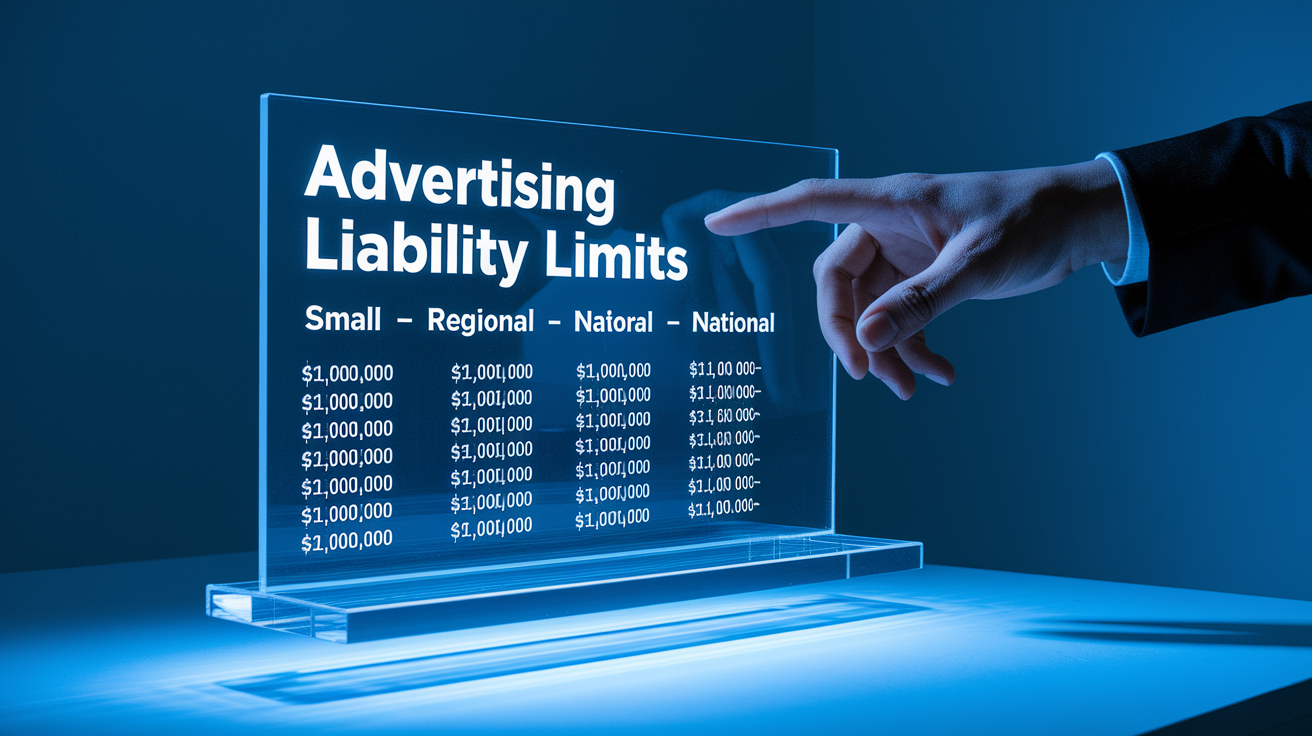
Most small‑business CGL policies bundle advertising liability into a combined limit structure. The market standard for small operations is $1,000,000 per occurrence and $2,000,000 aggregate.
Mid‑size businesses and regional advertisers commonly carry $2,000,000 per occurrence and $3,000,000 or $4,000,000 aggregate. National brands, agencies, and companies with broad digital footprints often purchase $5,000,000 per occurrence or higher, especially when client contracts require it.
Some carriers now fold advertising injury into a broader “Liability and Medical Expenses” limit instead of listing it separately on your declarations page. Check your dec page carefully. If you see “Personal & Advertising Injury: EXCLUDED,” your policy has stripped this coverage entirely, and you’ll need a standalone media liability or errors‑and‑omissions policy.
| Business Size | Typical Per‑Occurrence Limit | Typical Aggregate Limit |
|---|---|---|
| Small local (under $1M revenue) | $1,000,000 | $2,000,000 |
| Regional (under $10M revenue) | $2,000,000 | $4,000,000 |
| National or high‑profile | $5,000,000+ | $10,000,000+ |
Insurers also offer umbrella or excess liability policies that layer additional millions on top of your primary limits. Umbrella coverage is more cost‑efficient than raising your primary policy to $10,000,000 per occurrence and often broadens the scope slightly, covering exposures excluded by the underlying CGL.
When shopping, confirm whether your advertising injury limit is shared with your general liability limit or segregated. Verify any sublimits. Some policies cap intellectual‑property claims at $250,000 or $500,000 even when your overall limit is higher.
Realistic Claim Scenarios Illustrating Limit Application

Scenario 1: Single copyright claim. A coffee roaster launched a new bag design in early 2020. By August, the business had grown to two employees. A national competitor sued, claiming the roaster’s use of the term “Gibraltar” infringed a registered trademark. Defense costs ran $120,000 before settlement discussions began. The parties settled for $450,000. Total cost: $570,000. A $1,000,000 per‑occurrence policy covered the full amount and left $430,000 available for other claims, subject to the aggregate.
Scenario 2: Multiple claims erode the aggregate. A regional e‑commerce retailer faced three separate lawsuits in one policy year: a defamation claim over a comparative ad ($300,000 defense + settlement), a privacy claim from posting customer before‑and‑after photos without consent ($250,000), and a copyright dispute over stock images ($180,000). Total: $730,000. The insurer paid all three under a $1,000,000 per‑occurrence / $2,000,000 aggregate policy, but only $1,270,000 of aggregate remained. When a fourth claim arrived (a $600,000 allegation of trade‑dress infringement), the insurer paid the remaining $1,270,000 and the retailer paid the final $330,000 out of pocket.
Scenario 3: Defense costs inside limits. A small agency was sued for misappropriating a competitor’s ad concept. Legal fees reached $80,000 in the first six months. The case settled for $200,000. Because defense costs were paid from within the $1,000,000 limit, the insurer paid $280,000 total, leaving $720,000 per‑occurrence capacity. But the aggregate had been reduced by the same $280,000.
These examples show how quickly costs accumulate and why per‑occurrence limits matter less than your ability to sustain multiple claims within the aggregate period.
Industry‑Specific Risk Factors Affecting Recommended Limits

Media, advertising, and publishing businesses face the highest exposure. Agencies, broadcasters, and digital publishers generate continuous content, increasing the likelihood of libel, copyright infringement, and idea‑misappropriation claims. These businesses should carry $5,000,000+ limits or purchase dedicated media liability policies that offer broader intellectual‑property protection.
E‑commerce and retail operations run comparative ads, influencer campaigns, and user‑generated content. All of which create privacy, defamation, and IP risks. Retailers using social media heavily or running national campaigns should consider $2,000,000–$5,000,000 limits.
Tech platforms and SaaS companies publish marketing content, host user forums, and license third‑party images or code. Standard CGL policies often exclude chat rooms, bulletin boards, and some online‑platform activities, pushing these businesses toward technology errors‑and‑omissions (E&O) coverage instead of (or alongside) traditional advertising liability.
Healthcare, finance, and legal services face heightened defamation and privacy risks when advertising. A single claim alleging false or misleading statements about a competitor’s credentials or outcomes can trigger costly litigation. These industries commonly require $2,000,000+ limits and should review endorsements that exclude privacy breaches, such as the CG2413 endorsement, which can eliminate coverage for before‑and‑after photos, testimonial videos, and social posts containing identifiable individuals.
Franchises and multi‑location brands experience compounded exposure: one national campaign can trigger claims in multiple jurisdictions simultaneously, exhausting limits faster than single‑location businesses.
How Coverage Limits Influence Premium Costs

Raising your per‑occurrence limit from $1,000,000 to $2,000,000 typically increases your premium by 20%–40%, depending on your industry, revenue, claims history, and advertising volume.
Doubling limits does not double premium. The insurer’s marginal cost to add capacity decreases at higher tiers, so moving from $2,000,000 to $5,000,000 might add only 30%–50% to your base premium.
Underwriting factors that drive pricing:
• Annual revenue and advertising spend: Higher revenue and larger ad budgets signal greater exposure.
• Media channels used: Broadcast, national digital campaigns, and influencer partnerships increase risk more than local print ads.
• Claims history: One prior advertising injury claim can raise your premium 25%–100% and shrink available carrier options.
• Territory: National or international reach costs more than state or regional exposure.
• Excluded activities: If your CGL excludes media/publishing businesses or applies the CG2413 privacy exclusion, you’ll pay separately for media E&O or cyber liability to cover those gaps.
Buying an umbrella policy to layer $5,000,000 over a $1,000,000 primary limit often costs less than raising the primary limit to $6,000,000 directly. The umbrella may cover exposures the CGL excludes.
Premium efficiency flips when you reach very high limits. Above $10,000,000, expect steeper pricing and narrower carrier appetite.
Risks of Insufficient Advertising Liability Limits

When your limits fall short, you pay the difference. Defense costs, settlements, and judgments come from business funds or personal assets if you operate as a sole proprietor or partnership.
Defense cost overruns: Even if a claim is meritless, mounting a defense to dismissal or summary judgment can cost $50,000–$150,000. If your limit is already partially consumed by earlier claims against your aggregate, you may fund defense out of pocket before trial.
Aggregate exhaustion: Multiple smaller claims can zero out your aggregate mid‑policy‑year. A retailer facing three $400,000 claims in nine months exhausts a $2,000,000 aggregate and then operates uninsured for the final quarter, exposed to any new claim.
Reputational and operational harm: Protracted litigation distracts management, disrupts marketing campaigns, and damages brand reputation. All uninsured consequences. Running out of coverage mid‑dispute forces difficult settlement decisions under financial pressure.
Contractual non‑compliance: Many client agreements and venue contracts require proof of $2,000,000 or $5,000,000 in advertising liability coverage. Falling below that threshold after a claim can trigger contract termination or fee clawbacks.
Market consequences: Insufficient limits signal weak risk management to investors, lenders, and acquisition targets. Buyers conducting due diligence often walk away when they discover thin liability coverage.
Umbrella policies mitigate some risk but typically require you to maintain specified underlying limits (commonly $1,000,000 or $2,000,000 on the primary CGL) or the umbrella won’t drop down to cover a claim.
Choosing the Right Advertising Liability Coverage Limits for Your Business

Start by inventorying your advertising footprint: annual ad spend, number of campaigns, media channels (digital, broadcast, print, outdoor, influencer), geographic reach, and volume of third‑party content (stock photos, licensed music, user‑generated material).
Match limits to realistic worst‑case scenarios. Model two or three claims occurring within one policy year. Include defense costs. Assume $75,000–$200,000 per claim for IP or defamation litigation. Add settlement or judgment exposure, $250,000 to $1,000,000 for mid‑tier disputes, $1,000,000+ for high‑profile or class‑action cases. Sum those figures and compare to your aggregate limit.
Check client and contract requirements. If you’re an agency, review your client service agreements. Many require $2,000,000 or $5,000,000 limits. Venue and event contracts often mandate $5,000,000 general aggregate. Missing these thresholds disqualifies you from the engagement.
Assess your use of exclusion‑prone content. If your campaigns include customer testimonials, before‑and‑after photos, drone footage, or social‑media posts featuring identifiable individuals, verify that your policy does not carry the CG2413 privacy exclusion. If it does, either negotiate removal or purchase cyber/media liability coverage to fill the gap.
Weigh business size and asset exposure. A $500,000 annual‑revenue business with $100,000 in retained earnings can often tolerate $1,000,000 limits and accept some residual risk. A $10,000,000 revenue business with investor capital, debt covenants, and brand value should carry $5,000,000+ to protect enterprise value.
Consider layering umbrella or excess coverage. If your budget limits primary‑policy increases, buy a $1,000,000 or $2,000,000 primary limit and layer a $5,000,000 umbrella on top. Verify the umbrella covers advertising injury and does not require separate media‑liability underlying coverage.
For media, tech, and publishing businesses: Don’t rely solely on CGL advertising liability. Obtain a dedicated Media Liability, Advertising E&O, or Technology E&O policy with limits of $2,000,000–$10,000,000. These policies are written on a claims‑made basis, cover broader IP exposures, and often include coverage for content you published before the policy period if you purchase prior‑acts coverage.
Red flag: If your declarations page shows “Personal & Advertising Injury: EXCLUDED,” your CGL provides zero advertising liability coverage. Secure standalone coverage immediately or negotiate reinstatement of the coverage with your carrier.
Final Words
You saw how advertising liability coverage limits set the most an insurer will pay for ad-related claims – per-occurrence vs aggregate – and why industry, ad volume, and legal risk matter.
We ran through typical limits, real claim scenarios, premium trade-offs, and red flags where coverage falls short.
Before you buy: check per-occurrence and aggregate numbers, ask about umbrella options, and get written confirmation on what counts as “advertising injury.”
With advertising liability coverage limits explained, you can choose limits that match your risk and budget – and avoid surprise bills.
FAQ
Q: What do three-number liability limits like 250/500/100 or 100/300/100 mean?
A: Three-number limits like 250/500/100 mean $250,000 bodily injury per person, $500,000 total bodily injury per accident, and $100,000 property damage—those are the insurer’s maximum payouts for each type of loss.
Q: What does $100k/$300k/$100k mean?
A: The $100k/$300k/$100k limit means $100,000 bodily injury per person, $300,000 total bodily injury per accident, and $100,000 property damage—higher per-accident protection than lower-limit policies.
Q: What does it mean if the coverage limits are $50,000 / $100,000?
A: Limits listed as $50,000/$100,000 usually mean $50,000 bodily injury per person and $100,000 per accident; in other policies two numbers can also mean per-occurrence and aggregate—check your declarations page.
Q: Is 30-60-25 enough coverage?
A: The 30/60/25 split meets many state minimums but often isn’t enough to protect assets—$30k per person, $60k per accident, $25k property damage. Consider higher limits or an umbrella if you have savings, home, or business exposure.