




Think full coverage means you’re covered for everything? Think again.
Insurance policies have exclusions, specific facts that make a claim get denied.
Some look small on paper but cost thousands at claim time.
This post walks through the most common exclusions, DUI, racing, commercial use, unlisted drivers, wear and tear, and more, so you know which situations will leave you paying out of pocket.
Read on to learn what to check now, what endorsements can fix, and the red flags that really matter.
Overview of What Auto Insurance Coverage Exclusions Mean for Drivers
Auto insurance exclusions are the parts of your policy that say “we won’t pay for this.” They’re different from limits. Limits cap how much you get paid. Exclusions shut the door entirely.
Insurers use them to avoid paying for stuff that’s predictable, preventable, or better covered somewhere else. They also block fraud. Can’t claim you accidentally torched your own car. Can’t get paid for damage you caused on purpose or while breaking the law.
From the insurer’s side, exclusions keep premiums stable. Most people don’t drive for DoorDash or enter drag races, so the company prices policies assuming you won’t either. When someone does, the exclusion kicks in.
You’ll find exclusions scattered everywhere. Declarations page, definitions section, the actual exclusions section (sometimes called “What Is Not Covered”), and any endorsements you added or turned down. The language is legal. Words like “intentional,” “business use,” “racing,” and “named driver” aren’t casual. They’re contract terms, and one misread word can cost you thousands.
Most denials come down to six buckets:
- Intentional acts or deliberate damage
- Illegal activities (DUI, using the car in a crime)
- Non-covered uses (commercial, rideshare, racing)
- Non-eligible drivers (unlicensed, excluded by name, no permission)
- Non-covered vehicle types (motorcycles, ATVs, racing cars)
- Maintenance problems (wear, tear, mechanical failure)
Knowing which exclusions live in your policy, and which ones you can remove by adding coverage or switching to a commercial plan, is how you avoid finding out you’re uninsured after the accident already happened.
Breakdown of Auto Insurance Coverage Exclusions by Coverage Type

Not every coverage excludes the same things. Liability, collision, comprehensive, medical payments, and uninsured/underinsured motorist (UM/UIM) all work differently, so the exclusions attached to each reflect what that coverage was built to do.
Liability pays other people for harm you cause. That’s the whole point. So it excludes damage to your own vehicle and any claim you file for yourself. Collision and comprehensive cover your car, but they won’t pay for gradual deterioration, mechanical failure, or anything that isn’t sudden and accidental.
State law shapes exclusions too. Some states won’t let insurers exclude family members from liability policies. Others allow it. UM/UIM exclusions depend on whether your state uses add-on, no-fault, or traditional tort rules. Medical payments and PIP exclusions often hinge on whether workers’ comp or another policy is supposed to pay first, and those rules vary.
Liability
Liability pays third parties. Other drivers, pedestrians, passengers in other vehicles. It never pays you. Never covers damage to your own car. Common exclusions: intentional acts, business or commercial use without the right policy, punitive damages (in many states), and any loss already covered by another contract or warranty. Some policies also exclude claims by family members living with you, though certain states ban that exclusion.
Collision
Collision pays for damage to your vehicle when it hits another object or rolls over. Exclusions are narrower but still critical. Wear and tear, rust, mechanical failure, and electrical breakdown never count. Racing, stunts, and organized competition are out. If you own multiple vehicles but only listed one, collision on the unlisted car may get denied under an owned-but-unlisted clause. Excluded or unpermitted drivers are common collision exclusions too. If someone you barred from your policy takes the wheel and crashes, collision may refuse to pay.
Comprehensive
Comprehensive covers non-collision perils. Theft, vandalism, fire, hail, hitting an animal, certain natural disasters. It excludes mechanical breakdown, normal deterioration, and depending on the policy, specific catastrophic events like nuclear accidents, war, or government seizure. Some policies also exclude flood or earthquake damage unless you add an endorsement. Personal belongings inside the vehicle (phones, laptops, luggage) are almost always excluded. Those items fall under homeowners or renters insurance.
UM/UIM & MedPay
Uninsured and underinsured motorist coverage steps in when the at-fault driver has no insurance or too little. Common exclusions: hit-and-run accidents where the other driver is never identified (in some states), family-member claims, and any injury that should be covered by workers’ compensation. Medical payments (MedPay) or PIP covers medical bills for you and your passengers, but exclusions often include injuries during business use, while racing or performing stunts, when the driver lacked permission to use the vehicle, when the vehicle was being used as a residence, or when an employee was injured while working (workers’ comp takes over).
Coverage structure drives exclusion logic. Liability protects third parties and excludes the insured’s own losses. Physical damage coverage (collision and comprehensive) protects the vehicle but excludes gradual, predictable wear. UM/UIM and MedPay fill gaps left by uninsured drivers or medical bills, but they defer to other primary coverage like workers’ comp or employer-provided insurance when those apply. Understanding which type of coverage you’re relying on tells you where to look for the relevant exclusions.
Common Auto Insurance Coverage Exclusions and Why They Occur

Auto policies exclude specific situations to limit exposure to high-risk, preventable, or fraudulent claims, and to keep premiums predictable for most drivers. Some exclusions are universal. Others vary by insurer and state. All of them can mean the difference between a covered accident and full personal liability.
The following list covers the most common exclusions found across liability, collision, comprehensive, and medical-payment coverages. Each exclusion exists for a reason. Either the behavior is illegal, the loss is covered elsewhere, the damage is gradual and predictable, or the insurer underwrote the policy assuming standard personal use.
Intentional or criminal acts: If you deliberately use your vehicle to harm people or property, or if an accident occurs while committing a crime, coverage is void. No insurer pays for premeditated damage.
Driving under the influence (DUI) or gross negligence: Many policies deny claims when the driver was intoxicated or showed extreme recklessness, and some states allow insurers to exclude punitive damages awarded in DUI cases.
Racing, speed contests, stunts, or competitive driving: Any organized race, drag strip event, or stunt performance is excluded. If the vehicle was being used for prearranged racing when the crash occurred, the claim will be denied.
Business, commercial, or rideshare use without an endorsement: Personal policies assume personal use. Driving for Uber, Lyft, DoorDash, or pizza delivery without a rideshare or commercial endorsement typically voids coverage entirely.
Unlicensed, excluded, or unpermitted drivers: If the driver had no valid license, was specifically excluded by name on the policy, or took the vehicle without the owner’s permission, collision and liability may both deny.
Wear and tear, mechanical breakdown, and maintenance problems: Policies cover sudden, accidental losses. Gradual deterioration, rust, engine failure, transmission problems, and neglected maintenance are never covered.
Personal property inside the vehicle: Stolen phones, laptops, purses, or luggage are excluded from auto policies. Homeowners or renters insurance is the primary source for personal belongings.
Custom parts and aftermarket equipment: Modifications like custom rims, audio systems, lift kits, or performance upgrades are excluded unless you purchase a custom-parts endorsement specifying the coverage amount.
Catastrophic events: Nuclear accidents, war, government seizure, and confiscation are standard exclusions. Some policies also exclude certain natural disasters unless comprehensive or a specific endorsement applies.
Punitive damages, fines, and penalties: If a court awards punitive damages or you face fines for illegal conduct, the policy likely excludes those amounts. Some states require punitive coverage. Most don’t.
These exclusions exist to separate predictable, controllable losses from true accidents, to enforce legal boundaries (no coverage for crimes), and to prevent moral hazard (no payout if you damage your own vehicle on purpose). They also make sure specialized risks like commercial driving or custom equipment are underwritten separately at appropriate premiums.
Auto Insurance Coverage Exclusions for Specific Vehicle Uses and Vehicle Types
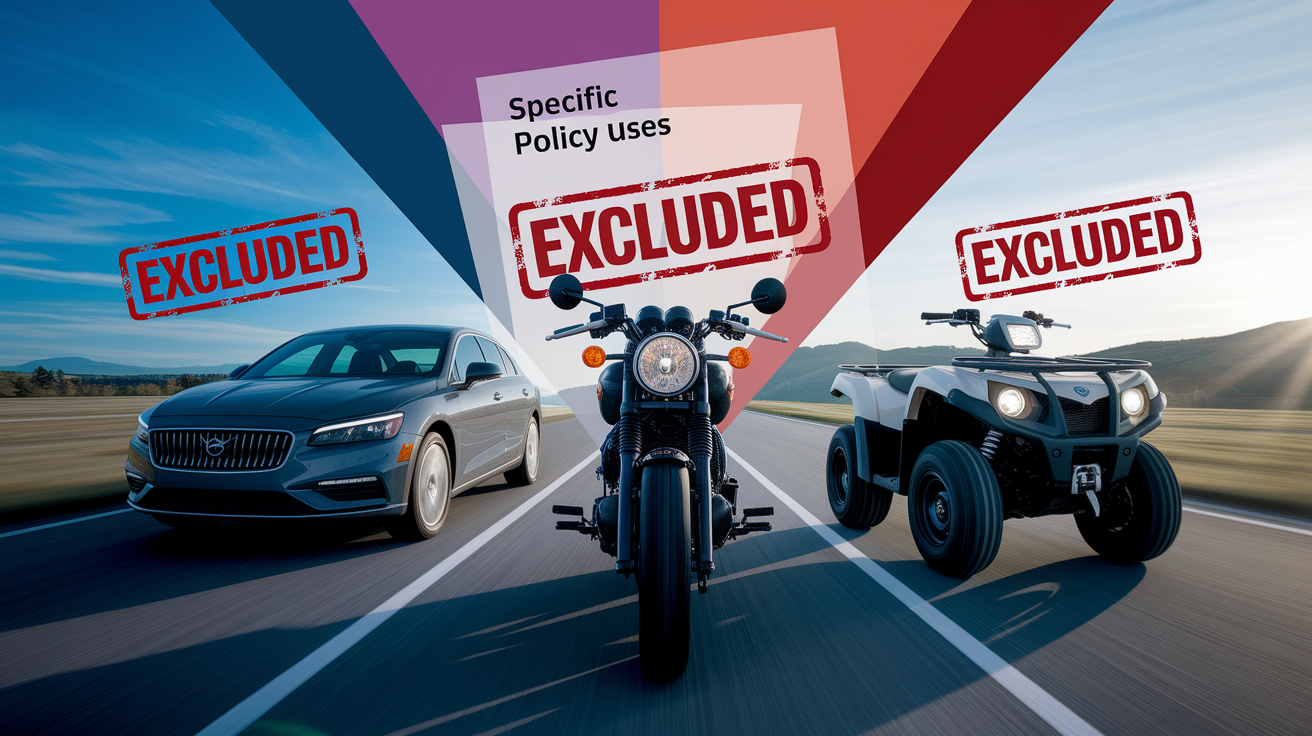
How you use your vehicle and what kind of vehicle you drive can trigger exclusions even when you carry full coverage. Personal auto policies are written and priced for personal, everyday use. Commuting, errands, family trips. When the use changes or the vehicle doesn’t fit the standard four-wheel passenger-car template, coverage often disappears.
Business and commercial use is one of the most common exclusion triggers. If you drive your personal car to deliver food, transport passengers for hire, or make sales calls as part of your job, your personal policy may deny any claim that arises during that activity. The insurer underwrote the policy assuming private use, and business use introduces higher frequency and severity of loss. Similarly, rideshare driving (Uber, Lyft, delivery apps) creates gaps. The rideshare company’s coverage applies only while you’re actively transporting a passenger or en route to pick one up, and your personal policy excludes commercial exposure unless you add a rideshare endorsement.
Vehicle type also matters. Standard policies assume you’re insuring a car, truck, or SUV with four wheels and a roof. If you own or use a vehicle that doesn’t fit that profile, you may need specialty coverage or face outright denial. Even vehicles you own but didn’t list on your policy can be excluded if the insurer has an owned-but-unlisted clause. Your 2002 Volvo might be insured, but if you buy a 2010 Prius and forget to add it, a claim on the Prius could be denied entirely.
Commonly excluded vehicle categories:
Vehicles with fewer than four wheels: Motorcycles, scooters, and three-wheelers require separate motorcycle policies.
Racing vehicles or vehicles used in organized competition: Track days, autocross, drag racing, and timed events void coverage.
Commercial vehicles and fleets: Delivery vans, taxis, and fleet trucks need commercial auto insurance, not personal policies.
Off-road vehicles: ATVs, dirt bikes, and snowmobiles are excluded unless you carry specialty recreational-vehicle insurance.
Owned-but-unlisted vehicles: Any vehicle you own and failed to list on the declarations page may be excluded from collision, comprehensive, and sometimes liability.
If your vehicle use or vehicle type doesn’t match the assumptions in your policy, you’re driving without coverage. The fix is straightforward. Add the correct endorsement, switch to a commercial policy, or purchase specialty coverage before the accident happens.
Real-World Scenarios Showing How Auto Insurance Coverage Exclusions Deny Claims
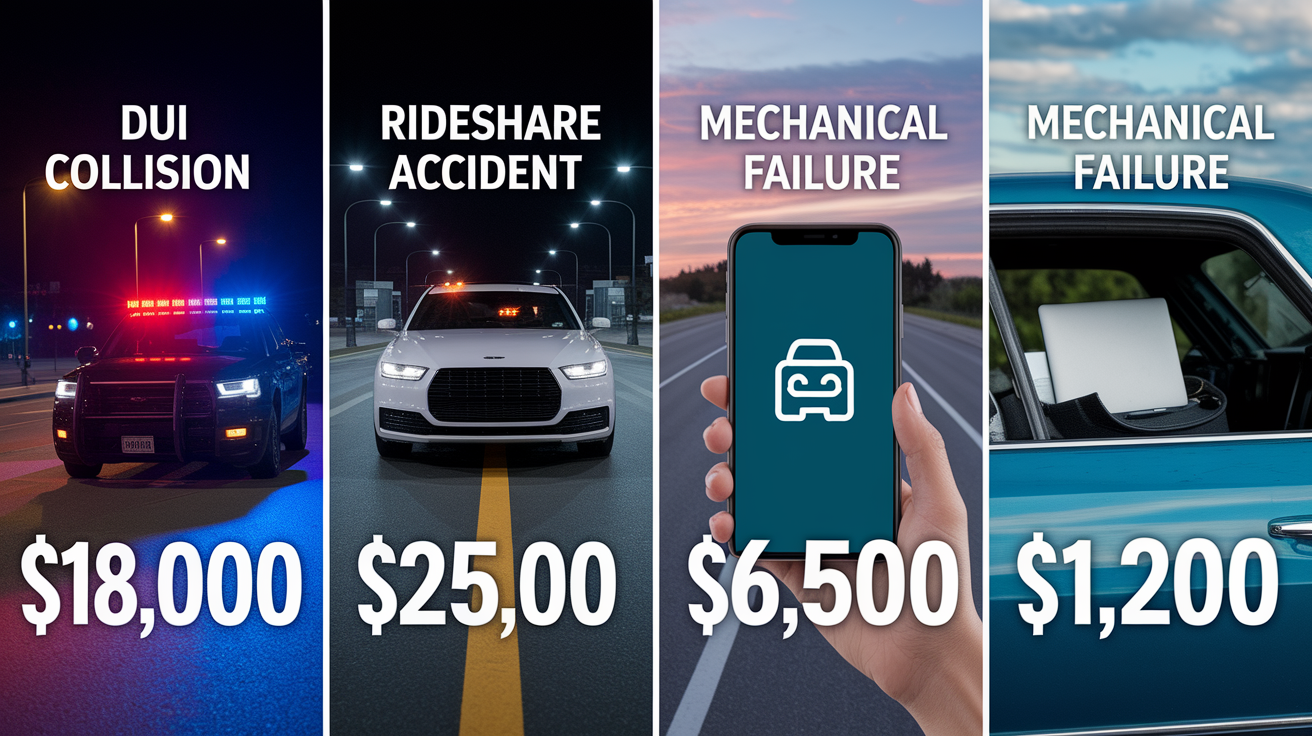
Exclusions sound abstract until they show up in a denial letter weeks after an accident. The following four scenarios are drawn from common claim patterns and include the dollar amounts drivers faced when coverage was denied.
DUI collision with $18,000 in damage: Driver crashes into a parked car while intoxicated. The repair estimate is $18,000, and the policy carries a $1,000 collision deductible. The insurer denies the entire claim under the DUI exclusion. The driver pays $18,000 out of pocket, faces criminal charges, and loses the vehicle unless they can pay for repairs in cash.
Rideshare accident causing $25,000 third-party injury: Driver is logged into a rideshare app but hasn’t yet accepted a trip when another driver runs a red light and hits them. The injured party sues for $25,000 in medical bills and lost wages. The rideshare company’s coverage doesn’t apply (no active trip), and the driver’s personal policy denies under the commercial-use exclusion. The driver is personally liable for the full $25,000.
Mechanical failure leading to crash and $6,500 in repairs: Driver’s transmission fails on the highway, causing loss of control and a collision with a guardrail. The repair bill is $6,500. The insurer denies under the mechanical-breakdown exclusion, classifying the crash as maintenance-related rather than sudden and accidental. The driver pays $6,500 plus towing and storage fees.
Theft of $1,200 laptop from locked vehicle: Driver’s laptop is stolen during a smash-and-grab break-in. The auto policy denies the claim under the personal-property exclusion. If the driver carries renters or homeowners insurance with a $500 deductible, they recover $700 after the deductible. Without it, they’re out $1,200.
Exclusions triggered denial in each case because the policy language drew a bright line. Intoxication, commercial use, gradual failure, and personal belongings all fell outside what the insurer agreed to cover. The denials weren’t judgment calls. They were contract terms. In every scenario, the driver either didn’t read the exclusions section, assumed coverage applied, or didn’t purchase the endorsement that would have filled the gap. The cost of that assumption ranged from $700 to $25,000, and in the DUI and rideshare cases, the driver also faced legal liability or criminal penalties on top of the denied claim.
Optional Coverages and Endorsements That Remove Auto Insurance Coverage Exclusions

Many exclusions can be removed or reduced by purchasing specific endorsements or switching to the correct type of policy. These add-ons cost money, but they convert excluded perils into covered ones, often for far less than the out-of-pocket cost of a single denied claim.
The table below matches common exclusions to the coverage fix that removes them:
| Exclusion | Coverage Fix |
|---|---|
| Business or rideshare use | Rideshare endorsement ($100–$300/year) or commercial auto policy |
| Custom parts and aftermarket equipment | Custom parts/equipment endorsement (coverage up to specified amount, raises premium) |
| Gap between loan balance and actual cash value | Gap insurance ($20–$75/month or one-time finance charge) |
| Broken glass or windshield damage | Glass coverage or comprehensive with $0 glass deductible |
| Rental car while yours is in the shop | Rental reimbursement ($15–$30/month, pays daily rate up to limit) |
| Towing and roadside assistance | Roadside/towing coverage ($5–$15/month, covers towing up to dollar limit per event) |
Rideshare and commercial-use endorsements are critical for anyone who drives for income. A rideshare endorsement costs a fraction of what a single denied $25,000 injury claim would, and it bridges the gap between personal coverage and the rideshare company’s policy. Commercial auto policies cost more but are mandatory if you use your vehicle primarily for business. Delivery, sales calls, hauling equipment.
Gap insurance pays the difference between your vehicle’s actual cash value and the loan or lease balance if the car is totaled. Standard collision and comprehensive pay only ACV, which accounts for depreciation. If you owe $18,000 but the vehicle is worth $14,000, gap insurance covers the $4,000 shortfall. Without it, you’re still making payments on a car you no longer own.
Custom-parts endorsements let you declare aftermarket modifications (lift kits, custom wheels, audio systems, performance parts) and insure them for a specified amount. Without the endorsement, those parts are excluded, and you’ll receive only the value of factory equipment if the vehicle is totaled or stolen. Glass coverage or a $0 glass deductible removes the exclusion on windshield and window damage, which is otherwise subject to your full comprehensive deductible in many policies.
Rental reimbursement and roadside assistance are inexpensive add-ons that cover predictable expenses. Rental reimbursement pays a daily rate (often $30–$50 per day) while your car is being repaired after a covered loss. Roadside covers towing, jump-starts, lockouts, and flat-tire changes up to a set dollar limit per incident. These endorsements don’t remove exclusions in the legal sense, but they fill common gaps in what a base policy pays for.
Before you buy, confirm the endorsement’s effective date, coverage cap, and any new exclusions the endorsement itself introduces. Get the terms in writing, and update your declarations page every time you add or remove coverage.
How to Find Auto Insurance Coverage Exclusions in Your Policy

Reading your policy line-by-line is the only reliable way to know what’s excluded. Denial letters cite policy sections and page numbers. If you don’t know where those sections are, you can’t verify the insurer’s claim or mount a challenge.
Read the declarations page first: This lists your coverages, limits, deductibles, named drivers, listed vehicles, and endorsements. Note effective dates and any endorsements coded with numbers or abbreviations. Those codes correspond to added or removed coverages.
Find and read the exclusions section for each coverage: Liability, collision, comprehensive, MedPay, and UM/UIM each have their own exclusion clauses. Look for headings like “What Is Not Covered” or “Exclusions.” Scan for keywords: intentional, business use, racing, named driver, punitive, unlisted, residence.
Read the definitions section: Terms like “insured,” “business,” “residence,” “your covered auto,” and “bodily injury” are defined here. A single word in a definition can determine whether an exclusion applies.
Review all endorsements and their effective dates: Endorsements modify the base policy. Some add coverage (rideshare, custom parts). Others remove it (named-driver exclusion). Check that endorsements are current and match what you requested.
Check for named-driver exclusions and territory limits: If you excluded a household member by name, any accident they cause may void all coverage. Territory clauses specify where the policy applies. Most U.S. policies cover the U.S., Canada, and sometimes Mexico with an extension, but exclude coverage outside those areas.
Compare your actual use and vehicle to policy assumptions: If you use your vehicle for business, rideshare, or delivery and your policy doesn’t include a commercial or rideshare endorsement, you’re driving excluded. If you own multiple vehicles, confirm all are listed.
Ask for written confirmation and keep documentation: When adding coverage or asking about exclusions, request written answers. Save emails, letters, policy PDFs, photos of your vehicle, receipts for custom parts, and records of every conversation with your agent or insurer.
Exclusions are contract terms. The insurer will hold you to them. The only defense is to know what they say before you file a claim.
What to Do if a Claim Is Denied Due to an Auto Insurance Coverage Exclusion

A denial isn’t always the final word. Insurers make mistakes, misread policy language, or apply exclusions incorrectly. Even when the exclusion is valid, you have options to challenge the decision, recover partial payment, or seek coverage from another source.
Start by requesting the denial in writing with specific policy citations. The letter should reference the exact exclusion clause, policy section, page number, and effective date. If the insurer cites an exclusion verbally but won’t provide written documentation, file a formal request and note the date and representative’s name. Written denials create a paper trail for appeals and regulatory complaints.
Gather all supporting evidence. Photos of the accident scene, police reports, repair estimates, medical bills, witness statements, and any correspondence with the insurer before the denial. If the exclusion hinges on a factual dispute (for example, whether you were using the vehicle for business at the time of the accident), evidence that contradicts the insurer’s version can overturn the denial.
The steps to challenge a denial:
File an internal appeal with the insurer: Most companies have a formal appeals process. Submit your written objection, attach supporting documents, and request reconsideration. Cite the policy language and explain why the exclusion doesn’t apply or was misinterpreted.
Contact your state insurance regulator: If the internal appeal fails or the insurer refuses to respond, file a complaint with your state’s insurance department. Regulators can investigate, mediate disputes, and sometimes force insurers to pay valid claims.
Consider small claims court or hiring an attorney: When the denied amount exceeds $5,000–$10,000, legal action may be worth the cost. Small claims court is faster and cheaper for amounts under the state’s small-claims cap (often $5,000–$10,000). For larger claims, an attorney can file a bad-faith lawsuit if the insurer violated claims-handling rules or denied coverage unreasonably.
Check for alternative coverage sources: If your auto policy excludes the claim, check whether homeowners or renters insurance (for personal property), workers’ compensation (for on-the-job injuries), or the at-fault driver’s policy (for liability claims) might cover it instead.
Document everything and preserve your rights: Keep copies of all correspondence, take timestamped photos, and send letters via certified mail. Many states impose deadlines for filing complaints or lawsuits, so act quickly.
Even valid exclusions can sometimes be negotiated. Insurers may offer partial payment to avoid regulatory scrutiny or bad press, especially if the exclusion language is ambiguous or if you’ve been a long-term customer with no prior claims. The key is to respond immediately, demand specifics, and escalate through every available channel before accepting a denial as final.
Final Words
Check your policy now: open the declarations, definitions, and exclusions sections.
You learned how exclusions work, how they differ by coverage and vehicle use, which common clauses cause denials, real-cost examples, endorsements that close gaps, and clear steps to find and appeal a denial.
Keep a short checklist, ask for written answers, and add needed endorsements. Do that and you’ll cut the chance of surprise bills and be ready when a real claim tests your auto insurance coverage exclusions.
FAQ
Q: What are exclusions in car insurance? Which of the following are common exclusions found in a personal auto policy? What are examples of insurance exclusions?
A: Exclusions in car insurance are policy clauses that list situations not covered. Common examples include intentional acts, DUI or racing, business or rideshare without endorsement, wear and tear, mechanical breakdowns, personal belongings, unlisted vehicles, and punitive damages.
Q: What not to say to the insurance adjuster?
A: Don’t tell the insurance adjuster you were at fault, guess facts, accept blame, give a recorded statement without checking, or sign forms you don’t understand—ask for written answers and consult counsel for serious claims.