





Think exclusions are just tricks insurers use to dodge claims?
They’re actually rules that keep premiums from exploding by carving out uninsurable or predictable losses.
This post explains why policies have exclusions, where they hide in your contract, and the six practical reasons—catastrophic risk, maintenance, duplicate coverage, intentional acts, needed underwriting, and business exposures—that drive them, plus what those exclusions mean for your wallet, who should avoid a given policy, and three quick checks to stop nasty surprises at claim time.
Core Reasons Insurance Policies Include Exclusions

Exclusions define what a policy won’t cover. You’ll find them tucked into cause-of-loss forms, coverage-specific sections, or blocks labeled “Exclusions” inside the contract itself. A lot of people see exclusions as insurer tricks. They’re not, really. They serve practical purposes that affect both carriers and the people buying coverage.
Insurers use exclusions to manage extreme risks, prevent uninsurable losses, encourage property upkeep, keep premiums affordable, and make sure exposures land in the right coverage bucket. Without exclusions, carriers would face financial collapse, you’d pay premiums nobody could sustain, and the risk pool would buckle under uncapped liabilities. Think of exclusions as boundaries that keep the contract focused on specific, quantifiable risks. Data from January 2024 backs this up: policyholders commonly pay “hundreds or even thousands of dollars” annually in premiums, while a single covered loss can cost “tens of thousands of dollars.” Exclusions keep those two numbers from blowing apart.
Six core reasons insurers write exclusions into policy language:
Another policy better handles the risk. A commercial general liability (CGL) policy excludes employee injuries because workers’ compensation is designed for that exposure. Earthquake damage is excluded from standard homeowners policies because standalone earthquake policies exist.
Catastrophic or widespread losses are financially uninsurable. Think nuclear release affecting entire populations, pandemics, war, or large-scale natural disasters that would overwhelm any single insurer’s reserves.
Intentional or expected losses undermine the insurance contract. Insurers can’t pay for deliberate harm, self-inflicted injuries, or foreseeable outcomes. Coverage applies only when losses are accidental and unexpected.
Carriers will cover the risk if given more information and premium. Some exclusions can be removed through endorsements. Higher limits for law-and-ordinance coverage or custom equipment riders for modified vehicles, for instance. But only after closer underwriting and increased cost.
Insurers carve back narrow exceptions to control exposure. By excluding coverage broadly first, then writing limited exceptions (like collapse exclusions with narrow “however” carve-backs or contractual liability with defined exceptions), carriers tightly manage claim severity.
Business or speculative risks fall outside pure insurance. Policies cover pure risk (random, unpredictable events like fire), not speculative ventures, investment losses, or entrepreneurial gambles.
How Insurance Exclusions Work Inside a Policy

Exclusions aren’t buried fine print. They occupy specific policy sections, usually after the insuring agreement and before conditions. In standard ISO forms, you’ll find them in the “Exclusions” heading or woven into cause-of-loss pages. Proprietary insurer forms vary, but most follow the same pattern: grant coverage broadly in one section, then carve it back with exclusions.
Carriers use a two-step method to limit exposure. First, they remove broad coverage categories entirely. Then they add back narrow exceptions, sometimes introduced with “however” or “but this exclusion does not apply to,” that the insurer is willing to accept under controlled conditions. That approach makes drafting simpler and claim outcomes more predictable. Collapse might be excluded, for instance, but a policy could carve back coverage for sudden collapse caused by hidden structural failure. That “carve-back” exception requires investigation and proof, which helps control claim volume and severity.
| Clause Type | Meaning | Example |
|---|---|---|
| Broad exclusion | Removes all coverage for a category or peril | “We do not cover mold, fungus, or bacteria of any kind.” |
| Carve-back exception | Restores narrow coverage within an otherwise excluded category | “However, we will cover mold if it results from water discharged from a plumbing system, if the discharge was sudden and accidental.” |
| Ambiguous or contested wording | Language that requires legal interpretation or claim investigation | Exclusion for “expected or intended injury” when self-defense may be involved |
Common Types of Insurance Exclusions and Real-World Examples

Exclusions differ by coverage line. Homeowners policies exclude perils like flood and earthquake because separate programs exist. Auto policies exclude business use unless you buy commercial auto or rideshare endorsements. Health and disability often exclude pre-existing conditions during waiting periods. Understanding these patterns helps you spot where your policy stops and where you need to buy more coverage.
Most standard exclusions fit predictable categories. Property policies exclude slow damage. Wear-and-tear, foundation cracks, pest infestations, gradual leaks. Insurers don’t cover maintenance. Liability policies exclude intentional harm, because you can’t transfer responsibility for deliberate acts. Many policies exclude business operations because personal policies aren’t priced or designed for commercial exposures. Flood and earthquake sit outside standard homeowners forms because frequency and severity demand specialized risk models, separate premium pricing, and often government-backed reinsurance.
Ten common exclusions you’ll see across policies:
Flood. Requires separate federal National Flood Insurance Program (NFIP) or private flood coverage. Standard homeowners policies exclude rising water entirely.
Earthquake. Almost always excluded from homeowners. Separate earthquake policies are available in high-risk zones and priced accordingly.
Mold and fungus. Excluded or capped at low dollar limits unless the mold results from a sudden covered peril like a burst pipe. Gradual humidity damage and hidden mold from long-term leaks are not covered.
Sewer and drain backup. Commonly excluded. Water backup endorsements can add coverage for overflow, backflow, or sump-pump failure.
Wear-and-tear, gradual deterioration, and maintenance. Insurers don’t pay for normal aging, rust, corrosion, or deferred upkeep. Pipes, roofs, and HVAC systems eventually fail, and replacing them is the owner’s responsibility.
Intentional acts and criminal behavior. No coverage for harm you cause on purpose, injuries you expect, or damage during commission of a crime.
Business operations and professional liability. Homeowners and personal auto exclude business use. You need a business owners policy (BOP), commercial auto, or professional liability (E&O) coverage.
Auto: racing, competitive events, and high-performance driving. Auto policies exclude damage or liability while your vehicle is used in timed contests, drag races, or track days.
Auto: driving under the influence. Insurers may deny vehicle damage coverage if you’re impaired. They may also cancel or non-renew the policy.
Custom parts and aftermarket equipment. Auto policies often exclude custom wheels, lifted suspensions, performance modifications, and high-end stereos unless you schedule them with an endorsement.
Exclusions for Catastrophic, Uninsurable, or High-Severity Risks
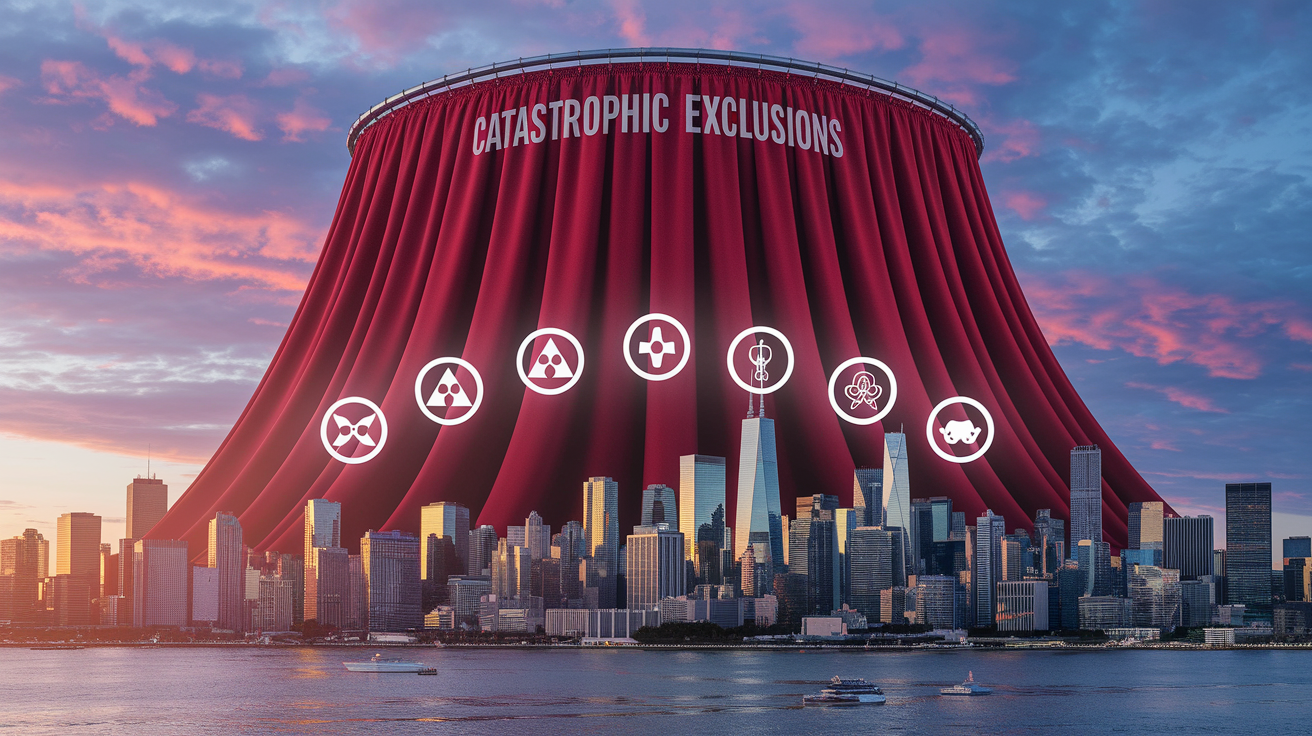
Catastrophic risks are those that affect large populations at once and generate claims far beyond an insurer’s collected premiums and reserves. Insurers exclude these perils not to dodge responsibility, but because covering them would bankrupt the carrier and destabilize the broader insurance market. When a single event, like a nuclear release or a category 5 hurricane, triggers thousands of simultaneous claims, the math no longer works. That’s when exclusions protect the pool of policyholders who need day-to-day coverage for smaller, independent losses.
Reinsurance structures influence which perils standard policies exclude. If reinsurers won’t accept catastrophic exposure, primary insurers must exclude it. For perils like earthquake and flood, government-backed programs or specialty markets exist precisely because private carriers can’t sustain the exposure at affordable rates. When you see exclusions for war, terrorism (in some cases), nuclear incidents, or pandemics, you’re seeing the boundary between insurable risk and systemic risk that requires government intervention or alternative risk transfer.
Five catastrophic exclusions that appear across most policies:
Nuclear hazard or radiation release
War, invasion, or hostile military action
Earthquake (standard homeowners)
Flood from rising water or overflow (standard homeowners)
Pandemic or communicable disease (often excluded or limited in business interruption and liability forms)
Maintenance, Wear-and-Tear, and Gradual Damage Exclusions

Insurers exclude gradual deterioration because insurance is designed to cover sudden, accidental events, not the predictable aging of property. If carriers paid for normal wear, premiums would have to cover continuous replacement cycles. New roofs every 20 years, new HVAC systems, repainting, re-paving. The product would become unaffordable. Maintenance exclusions also create an incentive for owners to perform upkeep, which reduces the severity and frequency of losses across the entire pool.
Here’s how wear-and-tear exclusions work in practice. Replacing an old, corroded pipe is not covered because the pipe’s failure was gradual and foreseeable. But if that old pipe suddenly bursts and water damages your drywall, cabinets, and flooring, the resulting water damage may be covered, even though the pipe itself is not. The insurer pays for the sudden loss, not the deferred maintenance. Similarly, foundation cracks from settling, termite damage, and mold from long-term humidity are all excluded because they develop slowly and are preventable through routine inspection and upkeep.
Exclusions Due to Intentional, Fraudulent, or Criminal Conduct

Insurers cannot and will not pay for harm you cause on purpose. Covering intentional acts would create moral hazard. Policyholders could profit from deliberate damage. It would undermine the legal foundation of the insurance contract, which requires losses to be accidental and unexpected. Fraud prevention is one of the four core reasons exclusions exist, and intentional-act exclusions are the clearest expression of that principle.
Claims involving self-defense, disputed intent, or unclear causation can become legal battles. Was the injury expected or unexpected? Did the insured intend the harm, or was it accidental? Those determinations often require detailed investigation, witness statements, police reports, and sometimes court rulings. In a few contested cases, the burden of proof shifts depending on state law and policy language, but the baseline rule is firm: deliberate, malicious acts have no coverage and no market remedy.
Four examples of excluded intentional or criminal conduct:
Setting a trap on your property that injures a trespasser
Starting a fire for insurance fraud
Assault or battery
Damage caused while committing a felony
When Coverage Belongs in Another Policy

Some exclusions exist because another policy is designed to handle the exposure. Insurers allocate risk across specialized products to match pricing, underwriting, and claims handling to the peril. When a commercial general liability (CGL) policy excludes employee bodily injury, that’s not a coverage gap. It’s a handoff to the employer’s workers’ compensation policy, which is built for workplace injuries and includes wage replacement, medical benefits, and statutory protections.
Cross-policy allocation also appears in personal lines. A broken car window after a theft is covered under your auto comprehensive policy, but the stolen laptop taken from the car is covered under your homeowners or renters personal property coverage. If a vehicle crashes into your house, your homeowners policy normally pays your claim, then your insurer seeks reimbursement (subrogation) from the at-fault driver’s auto liability carrier. Flood and earthquake are separate programs because standard property forms can’t sustain the exposure. The National Flood Insurance Program and standalone earthquake policies exist for exactly that reason.
| Policy Type | Excluded Peril | Where Coverage Actually Exists |
|---|---|---|
| Commercial General Liability (CGL) | Employee bodily injury | Workers’ Compensation |
| Auto Comprehensive | Stolen personal property taken from vehicle | Homeowners or Renters personal property |
| Homeowners | Flood from rising water | National Flood Insurance Program (NFIP) or private flood policy |
| Homeowners | Earthquake | Standalone earthquake policy |
| Personal Homeowners | Business operations liability | Business Owners Policy (BOP) or commercial liability |
Underwriting Logic Behind Exclusions

Standard insurance forms are built for the “average” consumer. Carriers use data, actuarial models, and historical claims to price policies for typical risks. Standard homes, typical drivers, common occupations. When an applicant brings unusual exposures, a home-based manufacturing operation, a heavily modified vehicle, a property in a wildfire zone, the standard form may not cover those risks at all, or may exclude them until the insurer can gather more information, adjust pricing, and decide whether to accept the exposure.
Exclusions allow insurers to maintain financial stability and competitive pricing for the majority of policyholders. Carriers exclude broad, high-cost perils first, then selectively add back narrow exceptions or endorsements for applicants willing to pay the extra premium. Reinsurance treaties also dictate exclusions. If a reinsurer won’t accept earthquake or flood exposure, the primary carrier must exclude it or find alternative reinsurance. The result is a layered system where baseline policies remain affordable and specialized coverage costs more because it targets higher-severity risks.
How Endorsements and Riders Add Coverage Back

Some exclusions can be reversed or softened by adding endorsements or riders to the policy. These are paid amendments that modify coverage terms, raise limits, or remove specific exclusions. Standard homeowners policies exclude sewer and drain backup, for example, but you can buy a water backup endorsement that adds coverage for overflow, backflow, or sump-pump failure. Personal articles floaters can schedule high-value jewelry, fine art, or collectibles that exceed the policy’s built-in sub-limits, often as low as $2,500 for electronics or firearms.
Endorsements cost extra because they increase the insurer’s exposure. A water backup rider might add $50 to $150 to your annual premium, depending on location and coverage limit. Employment practices liability (EPL) endorsements can remedy wrongful-termination exposures excluded from standard CGL forms, but they require additional underwriting and premium. Not every exclusion has a remedy. Intentional acts, for instance, remain uninsurable no matter how much you’re willing to pay.
Five steps to request or negotiate endorsements that remove exclusions:
Review your declarations page and identify sub-limits or excluded perils that matter to your situation.
Ask your agent which endorsements are available to cover those gaps. Water backup, scheduled personal property, business use, earthquake, umbrella liability.
Request quotes for each endorsement and compare the added premium to the potential out-of-pocket loss.
Provide any additional underwriting information the carrier needs. Appraisals for valuables, details about home-based business operations, vehicle modification receipts.
Add the endorsements that offer the best value and document the carrier’s offer in writing if you decline optional coverage. This protects you and your agent if a claim arises later.
How Exclusions Impact Claims and Claim Denials

Exclusions are the most common reason insurers deny claims. Sometimes the denial is correct. The policy truly doesn’t cover the loss. Other times, the carrier misinterprets which policy applies, miscategorizes the peril, or overlooks a carve-back exception buried in the exclusion language. Understanding how exclusions operate during claims helps you challenge incorrect denials and speeds payment when coverage exists.
When a claim is denied, you have options. Review your declarations page and the full policy language to confirm whether the exclusion actually applies. Discuss the loss with your agent, who can clarify which policy should respond and help you file with the correct carrier. If the insurer’s interpretation seems wrong, file a written appeal and cite the relevant policy language or state law. Public adjusters and attorneys can help with complex disputes, and your state department of insurance can investigate complaints and mediate disagreements.
Four common denial scenarios caused by exclusions:
Wear-and-tear misapplication. Insurer denies water damage from a burst pipe by citing the maintenance exclusion, even though sudden water discharge to contents is typically covered.
Cross-policy confusion. Auto insurer denies a stolen laptop claim that should be filed under homeowners. Consumer doesn’t know to file a second claim.
Intentional vs accidental dispute. Injury during self-defense is denied as an intentional act. Policyholder contests whether the harm was expected or intended.
Sub-limit surprise. Policyholder files a $5,000 electronics claim, but the policy’s sub-limit is $2,500. The “exclusion” is actually a capped limit, not a full denial, but feels like a denial to the consumer.
How Consumers Can Review, Compare, and Avoid Problematic Exclusions
Only 3 in 10 Americans review their insurance policies annually, which means most people don’t know what’s excluded until a claim is denied. Proactive review and comparison shopping are your best defenses against coverage gaps. Start by reading the declarations page, the one or two page summary that lists limits, deductibles, and endorsements. Then ask your agent for the full policy document and spend time on the exclusions section.
Compare quotes from multiple insurers, and ask precise questions about exclusions that matter to your situation. Does the policy exclude water backup? Is there a sub-limit on jewelry or firearms? Does home-based business activity void liability coverage? What endorsements are available, and how much do they cost? Carriers have different appetites for risk, different proprietary forms, and different pricing for endorsements. One insurer may exclude mold entirely. Another may cap it at $10,000 but offer a $50,000 mold endorsement for an extra $75 per year.
Conduct an annual policy review, especially when you switch carriers or move from standard ISO forms to proprietary insurer language. New exclusions or reduced sub-limits may appear without obvious notification. Keep maintenance records. Roof inspections, plumbing repairs, HVAC service. These help distinguish sudden covered losses from neglect. Consider umbrella liability and specialty policies like flood, earthquake, or commercial auto to cover risks that standard forms exclude. If your agent offers additional coverage and you decline it, ask for written documentation of the offer. That record protects both you and the agent if a claim surfaces later.
Eight-item checklist for reviewing and comparing exclusions:
Read the full exclusions section, not just the declarations page.
Confirm coverage or exclusion for flood, earthquake, mold, and water backup.
Check sub-limits for electronics, jewelry, firearms, and collectibles.
Ask whether home-based business or professional activities are covered or excluded.
Compare available endorsements and their costs across at least three insurers.
Verify whether auto policy excludes ridesharing, delivery, or business use.
Keep written records of maintenance and repairs to support future claims.
Request and save written confirmation if you decline optional coverage your agent recommends.
Final Words
You saw the main reasons exclusions exist: they spell out what a policy won’t pay, limit catastrophic or intentional losses, push maintenance responsibility to the insured, and steer certain perils into separate policies. That’s how insurers keep premiums affordable and predictable.
Read your declarations and exclusions, ask about endorsements and sub-limits, and compare a few quotes.
If you still wonder why do insurance policies have exclusions, remember they’re a financial filter, not a trap, and with the right riders and questions you can fill the gaps.
FAQ
Q: Why do exclusions exist in insurance, and why are some situations excluded from coverage?
A: Exclusions exist in insurance to limit catastrophic or uninsurable risks, prevent payment for deliberate acts, encourage maintenance, keep premiums affordable, and assign certain perils to the correct policy.
Q: What are examples of insurance exclusions?
A: Examples of insurance exclusions include wear-and-tear, mold and gradual damage, flood and earthquake (often separate policies), intentional or criminal acts, business use of vehicles, racing, DUI-related losses, and sewer backup.
Q: Does a plan exclusion mean the loss is not covered?
A: A plan exclusion usually means the policy won’t pay for that loss unless you buy an endorsement, the peril is covered by a different policy, or you successfully challenge the denial with evidence.