





Think insurers can only raise rates by a fixed percent each year? Think again.
There’s no single national cap; how much your premium can jump depends on where you live, what kind of policy you have, and what the insurer filed with your state regulator.
Some states block big increases up front.
Others let insurers start charging and check later.
This post lays out the real limits, typical yearly ranges by insurance type, the common gotchas that cause big spikes, and the three checks you should do before your next renewal.
No universal cap exists — increases depend on state rules and insurer rate filings

There’s no single nationwide limit on how much an insurer can raise your premium in a year.
How much your rate jumps depends on three things: where you live, what type of insurance you’re buying, and what the insurer filed with your state regulator. Some states make insurers get approval before raising anything. Others let them file and start charging the new rate right away. Either way, big increases usually require the insurer to prove the math to a regulator.
In prior-approval states, the insurer can’t touch your rate until the state insurance department says yes. In file-and-use states, they file the new number and start using it immediately or after a short wait. Regulators check it later. Which system your state uses changes how fast an increase hits and how much scrutiny it gets upfront.
Most states look harder when increases cross a threshold, often somewhere between 10 and 20%. But that’s not a cap. If the insurer can justify a 30% hike with claims data or catastrophe losses, regulators might approve it. The real question isn’t “Can they raise it this much?” It’s “Can they prove the new rate matches the risk?”
Short answer: your premium can go up by any amount the state allows and the insurer can defend. Practical answer: typical increases fall into predictable ranges by product type, and the wild ones show up in specific situations. After you file a claim. After a hurricane. When an insurer reprices a whole book of business.
Typical annual increase ranges differ sharply by insurance type

Auto insurance commonly rises about 3 to 15% year over year for drivers with clean records in stable markets. In 2024, many carriers filed increases in that range. But localized spikes of 15 to 30% or more happen when an insurer adjusts rates in a high-claim ZIP code, after you file an at-fault accident, or when they reprice a product line statewide.
Homeowners insurance typically ticks up 2 to 12% annually in states without major catastrophe exposure. In hurricane zones, wildfire corridors, or after an insurer exits and re-enters a market, increases of 15 to 50% have landed in a single renewal. A coastal Florida homeowner might see a 40% jump after a bad hurricane season. An inland Ohio policyholder might see 5%.
Renters insurance sees steadier, smaller moves, roughly 0 to 10% annually for most people. Since renters policies cover your stuff and liability but not the building, catastrophe losses and building-cost inflation hit less directly. Rate moves track local crime, water-damage claims, and liability trends.
Health insurance (individual and employer-sponsored) typically posts annual increases in the 3 to 10% range, though plan changes, large claims in a small group, or market repricing can push things higher. ACA marketplace premiums swing widely by state and year. Some states saw double-digit decreases in certain years. Others saw double-digit increases. Employer groups with stable claims may see sub-5% renewals. Groups with big claims or few people can see 15 to 25% jumps.
Flood insurance through the National Flood Insurance Program historically moved in smaller steps, but Risk Rating 2.0 (introduced in 2021) allows increases up to 18% per year on individual policies until they hit the “full-risk rate.” Private flood policies can move faster. Annual changes of 10 to 100%+ happen in high-risk coastal zones or after reinsurance repricing.
Life insurance premiums on term policies usually stay flat for the level-term period (10, 20, or 30 years). At the end of that term, if you renew without re-underwriting, the new annual premium can jump 200 to 500% or more because you’re older and the policy converts to an annually renewable structure. Permanent life policies with fixed premiums don’t increase unless you adjust the death benefit or add riders. Universal life policies with flexible premiums can see cost-of-insurance charges rise over time, especially if cash value doesn’t keep pace.
| Insurance Type | Typical Annual Increase (Stable Conditions) | High-End or Extreme Scenarios |
|---|---|---|
| Auto | 3–15% | 15–30%+ after claims, major local loss trends, or statewide repricing |
| Homeowners | 2–12% | 15–50%+ in catastrophe zones or after carrier exits/re-entries |
| Renters | 0–10% | Rarely exceeds 15% unless tied to large local liability or theft trends |
| Health (Individual/Small Group) | 3–10% | 15–25%+ for small groups with large claims or market repricing |
| Flood (NFIP) | Up to 18% annually under Risk Rating 2.0 | Private flood can see 10–100%+ in high-risk zones |
| Term Life (during level term) | 0% (fixed premium) | 200–500%+ at term-end renewal without re-underwriting |
These ranges reflect industry patterns through 2024. Your mileage varies based on insurer algorithms, state regulation, and your personal risk factors.
What drives premium increases and how much each factor moves the number

Claim frequency and severity are the main levers. More accidents in your ZIP code mean higher rates for everyone there. Bigger repair bills (because parts cost more or modern cars pack $3,000 sensors into every bumper) mean higher payouts and higher premiums. Insurers price to expected losses plus overhead and profit. When losses go up, rates follow.
Catastrophe losses hit homeowners and renters hardest. A single hurricane season can burn through an insurer’s annual profit and force double-digit rate filings across an entire state. The 2023 hail storms in Minnesota caused over $1 billion in damage and triggered rate increases that hit policyholders the next year. Wildfire exposure in California and Colorado, hurricane exposure in Florida and Louisiana, and severe storms in the Great Plains all create rate pressure that shows up at renewal.
Inflation and replacement costs flow directly into premiums. When a new car that cost $30,000 in 2020 costs $40,000 in 2024, the insurer’s potential payout on a total loss rises 33%. When lumber, roofing, and labor costs jump 20% in two years, rebuilding costs 20% more, and the premium rises to match. Auto replacement costs climbed 45% over four years ending in 2023, while overall U.S. inflation rose about 15% in the same period. That gap explains why auto insurance climbed faster than most other household costs.
Reinsurance costs are the insurer’s insurance. When global reinsurance prices spike after a bad hurricane season or reinsurers exit certain markets, primary insurers pay more to protect their balance sheets and pass that cost to you. Reinsurance repricing hit property markets hard in 2022 and 2023, contributing to homeowners rate increases in catastrophe-exposed states.
Underwriting changes or portfolio repricing happen when an insurer decides its current rates don’t match its current risk. They might discover they’ve been underpricing a certain vehicle type, age group, or area. When they correct it, policyholders in that segment see bigger increases (sometimes 20 to 40%) even if their individual record hasn’t changed. The insurer’s catching up, not punishing you.
Consumer factors modify your individual rate within the insurer’s approved base rate. Your driving record, claims history, miles driven, credit-based insurance score (where allowed), age, vehicle type, ZIP code, coverage limits, and deductibles all adjust your premium. An at-fault accident can raise your auto rate 20 to 50% at renewal, depending on the insurer and state. A homeowners claim can add 10 to 25%. Multiple claims in a short window can double your premium or trigger non-renewal.
Credit-based insurance scores (where legal) influence rates significantly. Improving your credit can lower your premium roughly 10 to 30%, depending on the insurer. A drop in credit can raise it by a similar margin. Not all states allow credit scoring for insurance. California, Hawaii, Massachusetts, and Michigan either ban it or restrict it heavily.
Mileage and usage matter for auto insurance. Switching from a 15,000-mile-per-year commute to a 5,000-mile work-from-home pattern can cut your premium about 10 to 20% if you update your insurer. Telematics programs that monitor your actual driving can reduce premiums roughly 5 to 30% for safe, low-mileage drivers, or raise them for drivers who brake hard, speed, or drive late at night.
Location is one of the strongest rating factors. Moving from a low-crime suburban ZIP code to a high-theft urban core can raise your auto premium 30 to 60%. Moving from a coastal flood zone to an inland area can cut your homeowners premium 20 to 50%. Insurers price every ZIP code (sometimes every block) differently based on claims history, weather exposure, and local loss trends.
State regulation shapes how fast and how high rates can move

States fall into two main camps: prior-approval and file-and-use.
In prior-approval states, the insurer submits a rate filing to the state insurance department and can’t implement the new rate until the regulator approves it. The review can take weeks or months. Regulators check the actuarial justification, loss data, expense assumptions, and profit margin. If the filing doesn’t pass, the insurer revises and resubmits. This slows down rate changes and gives regulators more control over the size of increases.
In file-and-use states, the insurer files the new rate and can start charging it immediately or after a short waiting period (often 15 to 30 days). Regulators review after it takes effect. If they find problems, they can order refunds or require the insurer to refile. This lets insurers respond faster to rising losses but gives you less upfront protection against unjustified hikes.
Some states use a hybrid model or vary the approach by product. A state might require prior approval for auto insurance but allow file-and-use for homeowners. It depends on state statute and insurance department rules.
Regulators commonly scrutinize increases more closely when they cross a threshold. That threshold varies by state and filing. Common ranges fall between 10 and 20%. An increase above that often triggers additional actuarial review, public hearings, or detailed justification requirements. But the threshold isn’t a cap. If the data supports a 25% increase, regulators may approve it.
Some states impose explicit annual caps on certain products. Florida’s state-backed Citizens Property Insurance Corporation historically limited annual premium increases to 10% per policy, though legislative changes and risk-based pricing have adjusted those rules over time. The NFIP caps annual increases at 18% per policy under Risk Rating 2.0. These are exceptions, not the rule.
Public rate filings are available in most states. You can request the insurer’s rate filing from your state insurance department to see the actuarial justification, the proposed base-rate change, and the impact by rating class. Many states publish approved filings online. This transparency lets you verify whether your increase matches the filed rate or whether the insurer applied it incorrectly.
Consumer complaint processes exist in every state. If you believe an increase is improper, unexplained, or inconsistent with the filed rates, you can file a complaint with your state insurance department. Regulators will review your policy, the filing, and the premium calculation. If the insurer made an error, you’ll get a refund. If the increase is justified, you’ll get an explanation.
Insurers must notify you before raising your rate, but timing and detail vary by state

Renewal notices are required by law. Insurers generally must send you written notice of your renewal premium and any changes to coverage or terms. Common notice windows run about 20 to 45 days before the renewal effective date, though the exact period varies by state and product.
The notice must include the new premium amount, the effective date, and (in many states) a summary of coverage changes. Some states require insurers to explain why the rate went up. Others don’t. If your state mandates a reason, the insurer will cite factors like “increased claim frequency in your area,” “rising replacement costs,” or “adjustment to your driving record.”
Non-renewal and cancellation notices carry different timelines. If an insurer decides not to renew your policy, most states require 20 to 60 days’ advance notice. If the insurer cancels mid-term (for non-payment, fraud, or material misrepresentation), notice periods are shorter, often 10 to 20 days. Cancellation for non-payment can be as short as 10 days in some states.
Rate changes at renewal are routine. Premium changes mid-term are rare outside of coverage adjustments, address changes, or corrections to rating errors. If your rate changes mid-term without an obvious trigger, call the insurer and ask why. It might be a billing error.
You have the right to request the reason for any increase. Call your insurer and ask for the specific rating factors that drove the change. Ask whether it’s a statewide rate filing, a change in your individual rating (like a new accident on your record), or a correction. Insurers won’t always volunteer this in the renewal letter, but they must provide it when you ask.
You can shop before renewal takes effect. Renewal notices give you a window to compare quotes. Use it. Get at least three quotes before your renewal date. If you find a better rate, you can cancel your current policy (pro-rated refund) and switch. There’s no penalty for shopping or switching carriers at renewal in most states.
Concrete dollar and percentage impact of common changes

Raising your auto deductible from $250 to $500 typically reduces your premium about 5 to 15%, depending on the insurer and state. Raising it from $500 to $1,000 can cut another 5 to 10%. If your current premium is $1,500 per year, a $500 deductible might save you $75 to $225 annually. The trade-off: you pay an extra $500 out of pocket if you file a claim.
Increasing a homeowners deductible from $500 to $1,000 often reduces the premium roughly 5 to 10%. Jumping to a $2,500 or 1% deductible can cut the premium 10 to 20% or more. On a $1,200 annual premium, a 10% cut saves $120 per year. On a $3,000 premium, 15% saves $450. The higher deductible means you handle small claims yourself. Roof damage under $2,500 comes out of your pocket.
Bundling auto and home insurance with the same carrier typically cuts the combined premium about 5 to 25%, depending on the insurer and state. For a household paying $1,500 for auto and $1,200 for home ($2,700 total), a 15% bundle discount saves about $405 per year. Not all carriers offer the same discount, so compare bundled quotes from multiple insurers.
Telematics and usage-based programs can reduce your auto premium roughly 5 to 30% for drivers who score well (low mileage, smooth braking, daytime driving). Programs like Snapshot, SmartRide, or DriveEasy monitor your driving via an app or plug-in device. Safe drivers see the discount. Risky drivers may see smaller discounts or even increases. If your current premium is $1,800 and you qualify for a 20% telematics discount, you save $360 per year.
Filing an at-fault accident claim typically raises your auto premium about 20 to 50% at the next renewal, depending on the insurer, state, and severity. A $2,000 claim on a $1,500 annual premium might push your renewal to $1,800 to $2,250. The surcharge usually lasts three to five years, then phases out if you stay claim-free.
A homeowners claim can add roughly 10 to 25% to your premium at renewal. A $10,000 water-damage claim on a $1,500 annual policy might raise your renewal to $1,650 to $1,875. Multiple claims in a short window can double your premium or lead to non-renewal. Some insurers drop you after two claims in three years. Others allow three claims in five years before non-renewing.
Improving your credit-based insurance score can lower your premium about 10 to 30% in states that allow credit scoring. If your score moves from “fair” to “good,” your $2,000 auto premium might drop to $1,400 to $1,800. A credit score drop can raise your premium by a similar percentage.
Lowering coverage limits or dropping optional coverages reduces your premium but increases your out-of-pocket risk. Dropping comprehensive and collision on an old car might save $300 to $600 per year, but you’ll pay for any damage or theft yourself. Lowering liability limits from $100,000/$300,000 to state minimums might save $100 to $300 annually, but leaves you exposed to large lawsuits.
Adding a teen driver to your auto policy typically raises your premium about 50 to 150%, depending on the teen’s age, gender, and whether they have their own vehicle. A $1,500 annual policy might jump to $2,250 to $3,750 when you add a 16-year-old driver. Discounts for good grades, driver training, or monitoring apps can reduce that increase by 10 to 25%.
Moving from a high-risk ZIP code to a low-risk ZIP code can cut your auto premium 20 to 60%. A driver paying $2,400 per year in a high-theft urban area might pay $960 to $1,920 in a low-claim suburban ZIP. The reverse is also true. Moving into a high-claim area raises your rate even if nothing else about you changes.
Real-world examples of extreme increases and what triggered them
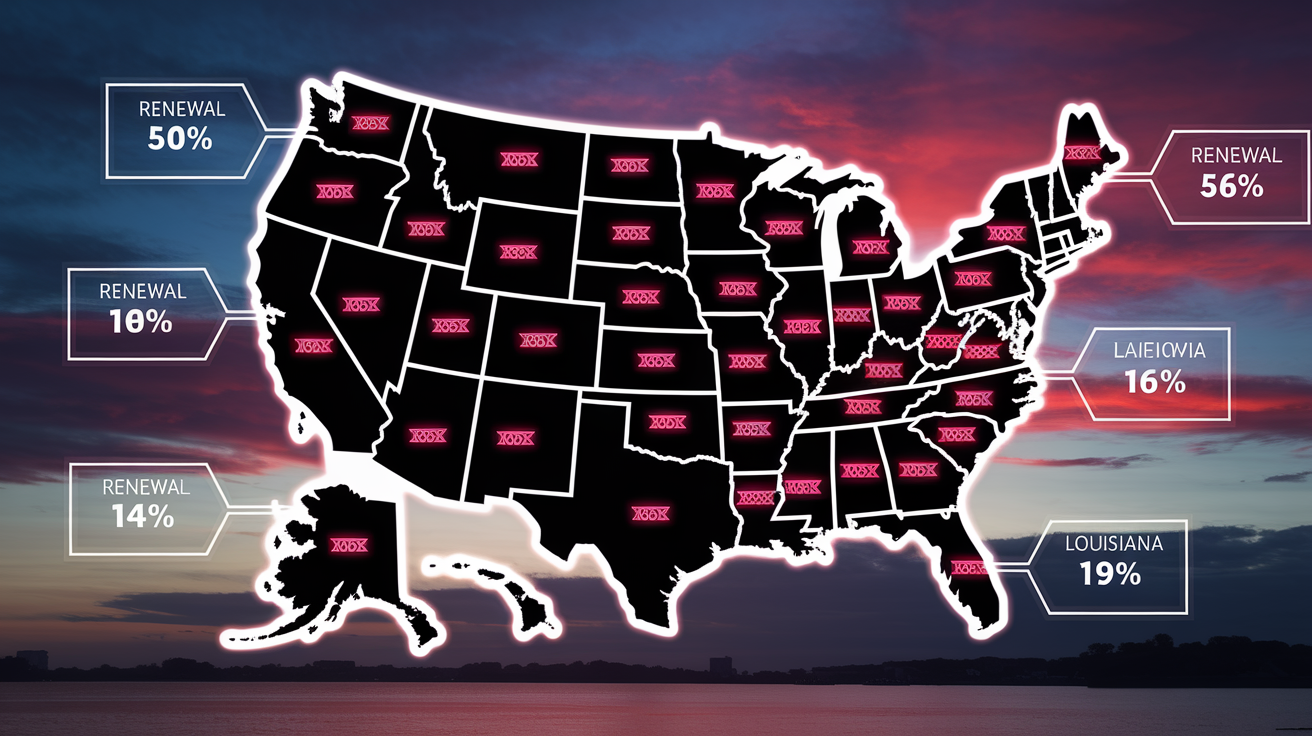
Maryland auto insurance rates rose an average of 55% from 2022 to 2023, driven by insurer underwriting losses, rising accident severity, and regulatory approval of large rate filings after years of suppressed increases. A driver paying $1,000 in 2022 faced a renewal around $1,550 in 2023 in that statewide average. Individual increases varied by insurer and ZIP code.
Washington, D.C. saw average auto rate increases of 52% in the same period, and Washington state posted a 49% average increase. Both markets experienced similar pressures: elevated theft, higher repair costs, increased uninsured motorists, and regulatory rate approvals after prolonged insurer losses.
Minnesota homeowners in hail-prone areas saw double-digit rate increases after the 2023 hail storms caused over $1 billion in insured losses. Some policyholders in the Twin Cities metro reported renewals 20 to 40% higher than the prior year, especially for policies with lower deductibles or roofs nearing replacement age.
California and Florida (both high-theft states for vehicles) have seen sustained auto rate pressure. California’s regulatory environment delayed many insurer rate filings, leading to sharp increases when approvals finally came through. Florida’s combination of high theft, fraud, and catastrophic weather has kept auto and homeowners rates among the nation’s highest, with annual increases in the 10 to 30% range common for many policyholders.
Louisiana homeowners faced sharp increases and mass non-renewals after repeated hurricane seasons. Some coastal policyholders saw premiums double or triple when forced into the state’s insurer of last resort (Louisiana Citizens) or when private insurers re-entered the market at much higher rates. Wind/hail deductibles in coastal zones often run 2 to 5% of the dwelling coverage, meaning a $300,000 home carries a $6,000 to $15,000 deductible for hurricane damage.
Michigan auto insurance rates decreased an average of 18% after the state reformed its no-fault system in 2019, capping personal injury protection benefits and allowing drivers to opt out of unlimited medical coverage. Before the reform, Michigan had the nation’s highest average auto premiums (over $2,600 per year). Post-reform, the average dropped closer to $2,100, though rates for drivers who kept unlimited PIP remained high.
Idaho saw an 11% average decrease in auto rates, and Missouri saw an 11% decrease in 2024–2025 after a 37% spike the prior year. These declines reflected improved insurer loss ratios after earlier rate corrections and, in Missouri’s case, regulatory pressure to moderate increases.
Flood insurance under Risk Rating 2.0 has produced sharp individual increases even as the program moves toward “full-risk” pricing. A coastal Virginia homeowner with a $250,000 home in a high-risk zone saw her annual NFIP premium rise from $1,200 to $1,416 (18%) in year one, then to $1,671 in year two, and projected to $1,972 in year three (a cumulative 64% increase over three years). The annual cap is 18% per policy, but it compounds. Over ten years, an 18% annual increase turns a $1,200 premium into approximately $5,200.
Private flood insurers operating outside the NFIP have repriced policies even faster. A Florida homeowner with a private flood policy saw a renewal jump from $800 to $1,600 in a single year after the insurer’s reinsurance costs spiked and the carrier re-evaluated coastal exposure. The policyholder had filed no claims. The increase was purely reinsurance-driven.
Practical steps to reduce or contest an increase

Shop and compare before your renewal takes effect. Get at least three quotes from different carriers. Use the same coverage limits, deductibles, and driver/vehicle details for each quote so you’re comparing apples to apples. Online quote tools, independent agents, and direct-to-consumer carriers all offer quotes. Comparison shopping is the single most effective way to avoid paying more than necessary.
Ask your insurer for the specific reason your rate went up. Call the customer-service number on your renewal notice and request a detailed explanation. Ask whether the increase is from a statewide rate filing, a change to your individual rating (accident, credit, address), or a portfolio repricing. Ask for the reference number of the rate filing and check the public filing with your state insurance department if you want to verify the math.
Raise your deductible if you can afford the out-of-pocket cost. Increasing your auto deductible from $500 to $1,000 typically saves 5 to 10% on your premium. Raising your homeowners deductible from $1,000 to $2,500 can save 10 to 15%. Run the math: if the annual savings is $150 and the deductible increase is $1,500, you break even after ten claim-free years. If you rarely file claims, the higher deductible pays off.
Bundle policies where it makes sense. Combining auto and home (or auto and renters) with the same carrier often unlocks a discount of 5 to 25%. Compare the bundled price against separate best-in-class quotes for each product. Sometimes bundling saves money. Sometimes buying from two different carriers is cheaper. Check both.
Remove or adjust drivers and vehicles on your policy. If a teen driver moved out, graduated, or got their own policy, remove them from yours. If you sold a car, delete it. If you retired and now drive 5,000 miles per year instead of 15,000, update your mileage estimate. Incorrect information inflates your premium.
Complete a telematics or usage-based insurance program if you’re a low-mileage or safe driver. Programs like Snapshot (Progressive), SmartRide (Nationwide), DriveEasy (Geico), or RightTrack (Liberty Mutual) monitor your driving and offer discounts (typically 5 to 30%) for safe habits. If you brake smoothly, avoid hard turns, and drive mostly during the day, you’ll likely qualify. If you commute in rush hour and brake hard, you might not.
Ask about available discounts and verify you’re getting all you qualify for. Common auto discounts include good driver, defensive driving course, multi-car, paid-in-full, paperless billing, homeowner (even if you don’t bundle), good student (for teens with a B average or better), and vehicle safety features (anti-lock brakes, airbags, anti-theft systems). Homeowners discounts include multi-policy bundle, claims-free, newer home, security system, fire/smoke alarms, gated community, and wind-resistant or impact-resistant features.
Improve your risk profile over time. Maintain a clean driving record (one at-fault accident can raise your auto rate 20 to 50%). Avoid filing small claims. Paying a $1,000 repair yourself can prevent a 10 to 25% premium increase that lasts three to five years. Improve your credit. A 50-point score increase can cut your premium 5 to 15% in states that use credit scoring.
Correct errors and rating mistakes. Review your policy declarations page (the summary of coverages, limits, and drivers). Make sure your address, vehicle usage, annual mileage, and listed drivers are accurate. A wrong ZIP code, an incorrect “business use” flag, or a driver who hasn’t lived with you in years can inflate your rate by 20 to 50%. Call your insurer and request corrections in writing.
File a complaint with your state insurance department if an increase seems improper. State regulators review complaints, check the insurer’s rate filing, and verify that your premium matches the approved rate structure. If the insurer made an error, you’ll get a refund. If the increase is justified, the regulator will explain why. Complaints are free and typically resolved within 30 to 60 days.
Consider switching to a higher-rated or specialty insurer if you’ve had claims or incidents. Some carriers specialize in non-standard or high-risk drivers and offer better rates than mainstream carriers after an accident or DUI. If your current insurer raised your rate 40% after a claim, get quotes from carriers that focus on drivers with incidents. You might find a 20% increase instead.
Review and adjust your coverage annually. Dropping collision and comprehensive on a car worth less than $3,000 might save $300 to $600 per year. Increasing liability limits from state minimums to $100,000/$300,000/$100,000 might cost an extra $100 to $200 but dramatically reduces your lawsuit exposure. Tailor your coverage to your current assets and risk tolerance, not what you bought five years ago.
What to expect at renewal and when you shop

Renewal notices arrive 20 to 45 days before your policy expires. The notice includes your new premium, coverage summary, effective date, and payment options. Some states require the insurer to explain why your rate changed. Others don’t. Read the notice carefully and compare it to your current declarations page to spot changes.
Your premium can change at renewal for reasons unrelated to your driving or claims. Statewide rate filings, inflation adjustments, catastrophe losses in your region, and changes in the insurer’s loss experience all affect your renewal price. You’re not being singled out. The entire risk pool in your state or ZIP code is repricing.
You can cancel and switch anytime, but switching at renewal avoids mid-term cancellation fees and prorated refunds. Most insurers charge no penalty for canceling at renewal. If you cancel mid-term, you get a prorated refund of the unused premium, but some carriers charge a small cancellation fee (often $25 to $50). Switching at renewal is cleaner.
When you shop for new coverage, expect to answer detailed questions about your driving history, vehicle usage, annual mileage, coverage preferences, prior insurance, and claims history. Insurers will also check your credit-based insurance score (where legal), pull your motor vehicle report, and verify your address. Answer honestly. Misrepresentation can void your coverage or lead to claim denials.
Quotes are estimates until you bind coverage. The final premium might differ slightly if the insurer finds additional information during underwriting (an unreported driver in your household, a different VIN, or a recent ticket). Review the final declarations page before your first payment to confirm the premium and coverage match what you were quoted.
Switching carriers doesn’t hurt your credit or driving record. Insurers check your credit as a “soft inquiry” (no impact) and pull your motor vehicle record directly from the state. Shopping around is invisible to other lenders and doesn’t affect your insurance score.
Loyalty discounts are often smaller than the savings you get by switching. Some carriers offer a small loyalty discount (2 to 5%) after you’ve been with them for a few years. But if a competitor offers a 20% lower rate, the loyalty discount doesn’t close the gap. Shop every six months or at least annually to ensure you’re not overpaying.
Not all insurers operate in every state or ZIP code. Some carriers sell only in certain regions. Others write in all 50 states but price aggressively in some markets and pull back in others. If an insurer quotes you a much higher rate than competitors, it’s often a soft way of saying “we don’t want this risk right now.”
Expect different rates from every carrier. The same driver, vehicle, and coverage can produce quotes ranging from $800 to $2,400 per year. Insurers weigh rating factors differently. One carrier might penalize a 22-year-old male driver heavily. Another might price age less aggressively and focus on mileage. Another might offer a telematics discount that cuts 20% off the base rate. The only way to find the lowest price is to compare multiple quotes.
How long rate increases last and when surcharges drop off

At-fault accident surcharges typically last three to five years, depending on the insurer and state. An accident in January 2024 will usually affect your rate through renewals in 2025, 2026, and 2027, then drop off in 2028. Some insurers remove the surcharge after three years if you stay claim-free. Others keep it for five. Check your state’s regulations and your insurer’s underwriting rules.
Moving violations and speeding tickets usually add a surcharge for three years from the conviction date (not the ticket date). A speeding ticket in March 2024 affects your rate through early 2027, then falls off. Major violations like DUI or reckless driving can affect your rate for five to ten years and may trigger non-renewal or force you into high-risk insurance pools.
Comprehensive claims (theft, vandalism, weather damage, hitting an animal) generally produce smaller surcharges than at-fault accidents, often 5 to 15% instead of 20 to 50%. The surcharge duration is similar: three to five years. Some insurers offer “accident forgiveness” or “minor incident forgiveness” programs that waive the first surcharge if you’ve been claim-free for a certain period (often three to five years).
Homeowners claims can affect your rate for three to seven years, depending on the insurer. A single claim might add 10 to 20% to your premium for three years. Multiple claims can double your rate or lead to non-renewal. Some insurers track claims through industry databases (like CLUE, Comprehensive Loss Underwriting Exchange) and may surcharge or decline you based on claims filed with previous carriers. The record follows you, not the property.
Credit-based insurance score changes take effect as soon as the insurer re-checks your credit, which usually happens at renewal. If your credit improves, your rate can drop at the next renewal. If it deteriorates, your rate can rise. Improvements take one to six months to show up in your credit file, so fix credit errors and pay down debt well before your renewal date if you want the benefit.
Rate filings and portfolio repricing are permanent until the next filing. If your insurer raises the base rate 12% statewide, that 12% stays in place until the insurer files a new rate (which could be an increase, a decrease, or no change). Your individual premium will change over time as your rating factors change (age, claims, credit, mileage), but the base-rate increase is baked in.
The bottom line: rate increases are normal, but extremes signal it’s time to shop
Insurance premiums go up most years for most people. Inflation in repair costs, medical costs, and replacement costs flows into premiums. Catastrophe losses, rising theft, more uninsured drivers, and elevated claim severity all push rates higher. A 3 to 10% annual increase in a stable market is routine. A 15 to 30% jump signals something changed, either in your risk profile, your insurer’s book, or your state’s loss trends.
There’s no universal cap. The limit is whatever your state allows and your insurer can justify. Prior-approval states review increases before they take effect. File-and-use states review afterward. Regulators scrutinize large increases (often 10 to 20%+ thresholds), but they approve them when the data supports the filing.
Your individual rate reflects both the insurer’s base rate and your personal rating factors. A statewide 10% increase might hit you as a 5% increase if your credit improved and you raised your deductible, or as a 25% increase if you filed a claim and added a teen driver.
The most effective way to manage rising rates is to shop and compare every six months or at least annually. Carriers price the same risk differently. Loyalty rarely pays. Three quotes take about 30 minutes and can save you $300 to $1,000 per year. That’s a better return than almost any other half-hour task.
Adjust your coverage and deductibles to match your current financial situation and risk tolerance. Raising a deductible saves 5 to 15% annually. Dropping collision on an old car saves $300 to $600. Bundling saves 5 to 25%. Using a telematics program saves 5 to 30%. Small changes compound.
If your rate jumped and you don’t know why, call your insurer and ask. Request the specific rating factors that drove the increase. Ask for the rate-filing reference number. Check your state insurance department’s website for public filings and verify the increase matches the approved rate. If it doesn’t, file a complaint.
Expect premiums to keep rising as long as claim costs, repair costs, and catastrophe losses keep rising. Insurers aren’t charities. They price to cover expected losses plus overhead and profit. When losses exceed premiums (which happened industry-wide in 2022), insurers file for increases. The question isn’t whether rates will go up. The question is whether you’re paying the lowest rate available for the coverage you need.
Final Words
We went straight into what makes premiums move: insurer losses, inflation, your claims and credits, and state rules that limit increases. You learned how insurers calculate hikes, common gotchas, and which documents to ask for.
Next, check your policy’s premium history, state caps, and any tiered or promotional pricing before you renew. Compare a few quotes and get written answers on rate triggers.
If you’re asking how much can insurance rates increase per year, remember rules vary by state — but you can use those checks to keep increases manageable and protect your wallet.
FAQ
Q: What is the 80% rule for homeowners insurance?
A: The 80% rule for homeowners insurance says you should insure your home for at least 80% of its replacement cost; if you insure less, the insurer can reduce claim payouts proportionally for a loss.
Q: How much will insurance rates increase in 2026?
A: Insurance rates in 2026 will vary by state, insurer, and policy type; expect modest average increases driven by inflation and severe-weather losses, with bigger hikes in high-claim areas—check your insurer or state regulator.
Q: How much does a $1,000,000 insurance policy cost?
A: The cost of a $1,000,000 policy depends on type, age, health, and term; for example, a healthy 35-year-old might pay about $30–$60 per month for a 20-year term policy, while whole life costs much more.
Q: How much is homeowners insurance on a $400,000 house?
A: Homeowners insurance on a $400,000 house typically runs about $1,000–$3,000 per year, depending on location, rebuild cost, deductible, coverage choices, and claims history—coastal or wildfire-prone areas cost more.