





Think you can wait until renewal to shop after a surprise rate hike? That’s a costly mistake.
A one-day lapse can spike future premiums, trigger lender penalties, or leave you on the hook after an accident.
This guide gives a tight, step-by-step plan to switch insurers after a rate increase without coverage gaps: what to do in the first 48 hours, how to compare true apples-to-apples quotes, which documents to have ready, and the exact questions to ask before you cancel.
Follow it and avoid last-minute surprises.
Immediate Steps to Take When Facing a Rate Increase

Most auto policies renew every six or twelve months, and your premium usually changes at renewal. Annual increases often fall between 4% and 6%, driven by claims you filed, tickets on your record, coverage upgrades you asked for, inflation, or regional loss trends. Not just arbitrary insurer greed.
Here’s what to do in the first 48 hours after you see a rate hike on your renewal notice:
-
Check your renewal date. Renewal notices usually arrive 30 to 45 days before the policy expires, giving you a tight window to compare quotes and switch.
-
Pull your current declarations page. You need to know your exact coverage limits, deductibles, and discounts to make apples-to-apples comparisons.
-
Ask your current insurer why the rate went up. Request a line-by-line explanation. Sometimes they’ll catch errors (duplicate fees, incorrect mileage, discounts not applied) and fix them on the spot.
-
Confirm your driving record. Pull your motor vehicle report to see if tickets or accidents you thought were removed are still on file. Errors happen and can be disputed.
-
Gather required documents for quotes. Driver’s licenses, VINs, Social Security numbers, proof of prior coverage, and any discount documentation (defensive driving certificate, student report card, military ID).
-
Start comparison shopping immediately. Waiting until the week before renewal leaves little room to review policies, ask questions, or handle slow underwriting.
Before you jump ship, call your current insurer and ask if they can lower your rate. Some carriers will apply a “loyalty discount” or remove old surcharges if you ask directly, especially if you’ve been a customer for three or more years. However, insurers rarely match a competitor’s quote the way cable companies do. You’re usually better off switching if you find a legitimate price difference.
Switching makes the most sense when the increase is 10% or more, when you’ve shopped recently and know you can do better, or when your insurer’s service has declined. Switching just because you’re annoyed by a 3% bump may cost you more in the long run. Bundling discounts, accident forgiveness, and prorated refunds can outweigh a small price difference.
Align your shopping with renewal timing. If your policy renews on May 15, start comparing quotes around April 15. Switching mid-policy is legal, but you might forfeit discounts, trigger cancellation fees, or lose a prorated refund if your insurer doesn’t handle mid-term exits cleanly.
Comparison Strategies to Find a Better Insurer After a Rate Hike

Shopping for cheaper insurance only works if you compare identical coverage. If you lower your liability limits or raise your deductible to make one quote look cheaper, you’re not actually saving. You’re just buying less protection.
Start by requesting quotes from at least three companies using the exact same limits and deductibles listed on your current declarations page. Online comparison tools claim to pull quotes from 100 or more insurers, but most feed you into a handful of national brands that pay for leads. To get real market breadth, combine an aggregator site with direct quotes from regional carriers and independent agents who represent multiple insurers.
When comparing quotes, evaluate these five elements:
Coverage limits and deductibles. Confirm liability, uninsured/underinsured motorist, collision, comprehensive, and personal injury protection match your current policy.
Discounts applied. Verify safe-driver, good-student, multi-policy, homeownership, telematics, and automatic-payment discounts are listed on the quote, not just assumed.
Customer service and claims handling. Check J.D. Power regional studies, NAIC complaint indexes, and online reviews. A low premium from a company known for denying claims is a bad trade.
Financial strength ratings. Use A.M. Best, Fitch, or Standard & Poor’s to confirm the insurer can pay claims. Anything below an A– rating raises red flags.
Effective date flexibility. Some insurers can activate coverage the same day. Others need 48 hours or more, which affects your ability to avoid a gap.
Common comparison-site mistakes include accepting pre-filled discount boxes without verifying eligibility, skipping the fine print on exclusions and limits, and trusting the “lowest price” result without reading customer reviews or checking financial stability.
| Coverage Element | Why It Matters | Typical Impact on Price |
|---|---|---|
| Liability limits (e.g., 100/300/100 vs. state minimum) | Higher limits protect your assets if you cause a serious accident; state minimums rarely cover actual medical bills or property damage. | Doubling liability limits usually adds 10–20% to the premium, but protects you from six-figure lawsuits. |
| Deductible (e.g., $500 vs. $1,000) | Lower deductible means less out-of-pocket at claim time; higher deductible lowers monthly cost but requires more cash on hand. | Raising your deductible from $500 to $1,000 can cut collision and comprehensive premiums by 15–30%. |
| Bundling (home/renters + auto) | Multi-policy discounts reward you for placing multiple policies with one insurer, but make sure the bundled price beats two separate best-in-class quotes. | Bundling typically saves 5–25% on auto premium, but check total cost across both policies. |
Required Documents and Information Needed to Switch Insurers

New insurers need proof you’re not a liar, a ghost, or a serial fraudster. That means paperwork. Have these seven items ready before you request quotes:
Driver’s licenses for every driver on the policy, even if they only use the car occasionally. Insurers check names, birthdates, and license status to price risk.
Vehicle Identification Numbers (VINs), one per vehicle. The VIN determines theft rates, repair costs, and safety ratings, all of which affect pricing.
Current policy declarations page. Shows your existing coverage limits, deductibles, and discounts. This becomes your baseline for comparison.
Proof of prior coverage, especially if you’re switching mid-policy or moving from another state. Continuous coverage signals responsibility and can lower rates.
Social Security numbers. Used for soft credit checks (in most states) and claims history lookups. No SSN usually means higher quotes or outright denial.
Payment method. Bank routing/account number or credit card. Most insurers require automatic payment to activate the policy, and auto-pay often unlocks a 3% to 5% discount.
Discount documentation. Defensive driving certificates, student transcripts showing a 3.0+ GPA, military ID, homeownership deed, professional association membership card, or proof of a bundled policy.
Proof of prior coverage is critical. If you can’t document continuous insurance for the past 12 months, many insurers will assume you’re high-risk and charge accordingly. Some states limit how far back insurers can look at your coverage history. California, for example, restricts the use of prior insurance gaps in pricing.
Soft credit checks are standard in most states and won’t hurt your credit score. Hard pulls only happen if you finance the premium over time, which some carriers allow. California, Hawaii, Massachusetts, and Michigan ban the use of credit scores in pricing, so your SSN is used only for identity verification and claims lookups in those states.
Skipping or delaying any of these documents will slow down your quote or force the insurer to use default assumptions. Usually higher premiums. Have everything digital and ready to upload or email within minutes.
Key Principles for Avoiding Coverage Gaps or Penalties

One day without insurance can cost you hundreds of dollars in higher future premiums, legal exposure, and lender penalties. Even if you never drive the car during that gap, state regulators and insurers treat lapses as red flags. Evidence of irresponsible behavior or fraud risk.
Never cancel your old policy before your new policy is active. “Active” means you’ve paid the first premium, received a policy number, and confirmed the exact effective date and time in writing. Some policies activate immediately. Others take 24 to 48 hours. If your old policy ends at 12:01 a.m. on March 15, your new policy must start at 12:01 a.m. on March 15 or earlier. Overlapping coverage for a few hours is fine and won’t double-charge you. Insurers prorate refunds down to the day.
Mid-term cancellations can trigger fees. Some insurers charge a flat $25 to $50 fee for canceling before the renewal date. Others penalize you by keeping a portion of the unused premium instead of issuing a full prorated refund. Before you cancel, call your current insurer and ask three questions: Is there a cancellation fee? Will I receive a prorated refund? Do I need to submit written notice, or can I cancel by phone?
Get everything in writing. Verbal confirmations mean nothing if the old insurer claims you’re still on the hook for unpaid premiums or if the new insurer denies your effective date. Request email confirmations of the new policy activation and the old policy cancellation, including the refund amount and the date it will be processed. Keep these emails for at least 12 months in case billing disputes arise.
| Risk | Cause | Prevention |
|---|---|---|
| Coverage lapse (even one day) | Canceling old policy before new policy starts, or assuming payment cessation = cancellation | Bind new policy first, confirm effective date/time in writing, then cancel old policy with written notice |
| Surprise cancellation fees or lost refunds | Mid-term cancellation without checking insurer’s fee schedule or refund policy | Ask current insurer about fees and refund calculation before canceling; request written confirmation of both |
Missing a final payment to your old insurer, because you assumed the refund would cover it, or because you stopped auto-pay too early, can damage your credit and trigger collections. Confirm the final balance and refund timeline before you cancel, and make sure you don’t owe anything after the cancellation date.
Step-by-Step Timeline for Switching After a Rate Increase
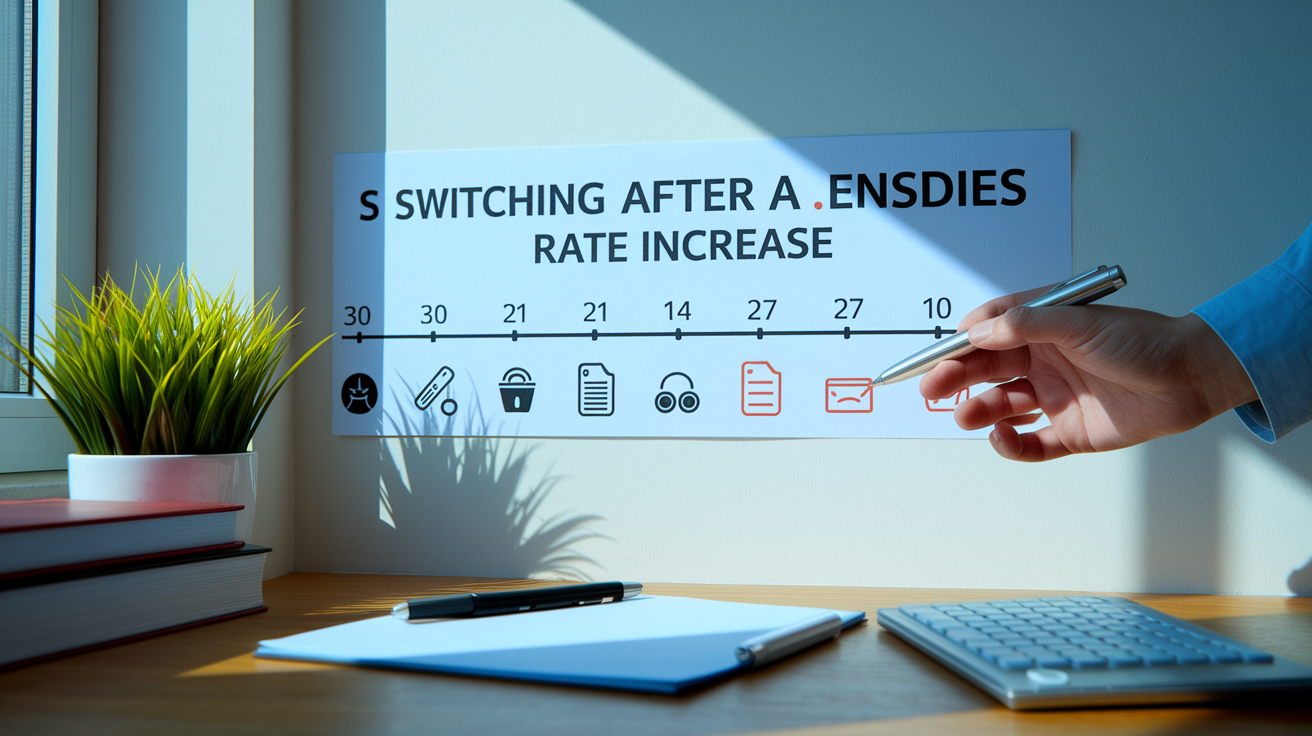
Switching insurers is mostly a paperwork and timing game. If you sequence the steps correctly, the whole process takes two to four weeks and costs you nothing but time. Here’s the day-by-day breakdown.
Start shopping 30 days before your renewal date. Renewal notices usually arrive 30 to 45 days in advance, giving you a narrow window. Pull your current declarations page, note your coverage limits and deductibles, and request quotes from at least three insurers using identical coverage. Keep all quotes in one spreadsheet or folder so you can compare pricing, discounts, and effective-date options side by side.
Days 30 to 21 before renewal: Gather documents (driver’s licenses, VINs, proof of prior coverage, discount paperwork) and submit quote requests to three or more insurers using comparison sites, direct websites, or independent agents.
Days 20 to 14 before renewal: Review quotes for identical coverage and applied discounts. Check financial ratings and customer reviews. Confirm effective date flexibility and required activation timeline with your top two choices.
Days 13 to 7 before renewal: Call your current insurer to ask about cancellation fees, prorated refund calculations, and whether written notice is required. Request a final policy review to ensure all discounts are applied and no billing errors exist.
Days 6 to 3 before renewal: Finalize your choice. Confirm the new insurer’s effective start date aligns with or precedes your old policy’s end date. Verify all discounts are listed on the new policy.
Days 2 to 0 (purchase day): Pay the first premium to activate the new policy. Request and download proof of insurance (policy number, declarations page, digital ID card). Confirm activation in writing via email or policy portal.
Same day or next business day (cancellation day): Contact your old insurer to cancel effective on the same date the new policy starts. Obtain written confirmation of cancellation, refund amount, and refund processing date.
Within 7 days after switch: Notify your lender or lessor (if applicable) and update your state DMV or registration if required. Keep proof of new coverage in your vehicle and a digital copy on your phone.
Sample Cancellation Phone Script
Call your old insurer’s customer service line and say:
“I’d like to cancel my auto policy, number [policy number], effective [date]. My new policy with [new insurer] starts on [same date] at 12:01 a.m. Can you confirm there are no cancellation fees, calculate my prorated refund, and send me written confirmation of the cancellation and refund by email?”
Ask the representative to repeat the cancellation date, refund amount, and refund method (check, direct deposit, or credit to your payment method). Note the representative’s name, the call date and time, and any reference or confirmation number. If they say written notice is required, ask where to send it and whether email is acceptable.
Sample Cancellation Email Template
If your insurer requires or allows written cancellation, send an email with this structure:
Subject: Request to Cancel Auto Policy [Policy Number]
Body:
I’m writing to request cancellation of my auto insurance policy, number [policy number], effective [date] at 12:01 a.m. My new coverage with [new insurer] begins on the same date. Please confirm:
- The cancellation effective date and time.
- The prorated refund amount and processing timeline.
- Any cancellation fees or outstanding balances.
Please reply with written confirmation within two business days. Thank you.
[Your signature and contact information]
Attach a copy of your new policy’s declarations page or proof of coverage if the insurer requests it. Keep the sent email and the insurer’s reply in a dedicated folder for at least 12 months.
Retain all confirmations (new policy activation, old policy cancellation, and refund receipt) until you’ve verified the refund hits your account and the old insurer shows a zero balance. Billing errors happen, and written proof is the only way to fight them.
Legal, State-Specific, and Claims Considerations When Switching

State insurance regulations vary widely, and a few rules can dramatically affect your switch timing, pricing, and legal risk. Driving without insurance is illegal in nearly every U.S. state, and even a brief lapse can trigger fines, license suspension, or higher future premiums.
California, Hawaii, Massachusetts, and Michigan ban insurers from using credit scores to set auto insurance rates. If you live in one of these states, your credit history won’t affect your premium, and you don’t need to worry about multiple quote requests triggering rate increases. In all other states, insurers use soft credit checks during the quote process, which don’t hurt your score, but final activation may involve a hard pull if you finance the premium.
Claims from incidents that occurred under your old policy remain the responsibility of that insurer, even after you switch. If you were rear-ended two weeks before your renewal and file the claim after switching, your old insurer still handles it. However, that claim will appear on your CLUE report and affect pricing with your new insurer at the next renewal. Switching immediately after an accident doesn’t erase the claim from your record. It just exposes you to higher rates sooner because the new insurer will discover it during underwriting.
Key state-specific rules to check before switching:
Use of prior insurance history. California limits how insurers may factor gaps in prior coverage. Other states allow insurers to charge significantly more if you can’t prove continuous coverage for the past 12 months.
Cancellation notice requirements. Some states require insurers to allow 10 to 30 days’ notice for cancellation. Others permit immediate cancellation as long as you provide written confirmation.
Proof-of-insurance laws. Most states require you to carry proof of coverage in your vehicle at all times. Digital ID cards are accepted in many states, but check your DMV rules.
Lender and lessor notification. If your car is financed or leased, your contract likely requires you to notify the lender within 10 to 30 days of any insurance change. Failure to update can trigger forced-placed coverage at two to three times your normal premium.
DMV and registration updates. If you’re switching after moving to a new state, you typically have 30 to 90 days to update your registration and insurance to meet the new state’s minimum coverage requirements.
Switching with an open claim is allowed but not recommended. Stay in contact with your old insurer until the claim is fully settled and you’ve received final payment or confirmation of denial. Switching mid-claim can complicate communication, delay settlement, and create confusion about which policy applies, especially if the accident date falls near your switch date.
Continuity of coverage matters beyond just avoiding lapses. Insurers reward long-term customers with better pricing, accident forgiveness, and vanishing deductibles. Switching every six months to chase the lowest premium can label you a “rate shopper,” signaling higher risk and resulting in higher quotes over time. A good rule: switch when the savings justify the effort, but don’t switch just because you can.
When Staying With Your Current Insurer Might Be Better Than Switching

Sometimes the devil you know is cheaper than the devil you don’t. Switching insurers after a rate increase can backfire if you lose valuable perks, trigger fees, or expose yourself to higher future pricing.
Stay with your current insurer if you’ve earned accident forgiveness or vanishing deductibles. Accident forgiveness typically kicks in after three to five years of claim-free driving and prevents your first at-fault accident from raising your premium. Vanishing deductibles reduce your collision or comprehensive deductible by $50 to $100 per year of safe driving, capping at zero. Both perks reset when you switch, meaning your new insurer will treat your first accident like everyone else’s by raising your rate 20% to 40% at the next renewal.
Bundling discounts can outweigh a lower stand-alone auto quote. If you’re saving 15% to 25% on both home and auto by bundling with your current insurer, switching just your auto policy may cost you more in total. Run the math: add up the new auto premium plus your unbundled home premium, then compare it to your current bundled total. If the difference is less than $200 per year, the hassle and risk of switching probably aren’t worth it.
Here are four scenarios where staying put makes more sense than switching:
You recently filed a claim or got a ticket. Your current insurer won’t raise your rate until renewal, but switching immediately exposes the new insurer to that incident during underwriting, often resulting in a higher quote than you’d get by waiting.
You qualify for loyalty discounts that vest over time. Some insurers offer tiered discounts that increase after three, five, or ten years. Switching restarts the clock at zero.
Your bundled home or renters policy offers better coverage or lower replacement cost. If your current insurer provides superior home coverage or a lower deductible than competitors, breaking the bundle to save $15 per month on auto may leave you underinsured.
You’re in a high-risk category. If you have a DUI, multiple accidents, or poor credit (in states that allow credit-based pricing), specialty insurers often offer better long-term pricing than switching between standard carriers every renewal.
Loyalty does matter to insurers, even if they don’t advertise it. Staying with one company for three or more years signals stability and lower fraud risk, which can result in better claims handling, faster approval, and premium forgiveness options. Switching every six to twelve months to chase the lowest price can mark you as a transactional customer, leading insurers to offer you only their baseline rates and exclude you from premium loyalty programs.
Questions to Ask Prospective Insurers Before You Switch

Before you hand over your payment information, confirm the details that matter. These eight questions separate a legitimate better deal from a pricing trap.
What is the exact effective date and time of coverage, and how will I receive proof? Confirm the policy starts before your old one ends, and ask whether proof of insurance is available immediately via email or app.
Which discounts are applied to this quote, and what documentation do you need to finalize them? Verify safe-driver, good-student, multi-policy, homeownership, telematics, and automatic-payment discounts are listed and confirmed, not just assumed.
Does this policy require a telematics device or app, and how does it affect my rate if I decline? Some “discounts” are actually mandatory monitoring programs. Opting out can raise the base rate or disqualify you from the advertised price.
How do you handle claims, and what is your average claim settlement timeline? Ask about first-notice-of-loss response time, whether you choose your own repair shop, and whether they use aftermarket or OEM parts for repairs.
What are your financial strength ratings, and where can I check your complaint history? Request the insurer’s A.M. Best rating and NAIC complaint index score. Anything below A– or a complaint ratio above the state average is a red flag.
Are there any cancellation fees or penalties if I cancel before the next renewal? Confirm in writing whether mid-term cancellation triggers fees, and whether you’ll receive a prorated refund or forfeit a portion of unused premium.
How is my credit score used in pricing, and will this quote trigger a hard credit inquiry? Clarify whether your state allows credit-based pricing and whether final activation requires a hard pull that could affect your credit score.
What payment options are available, and is there a discount for automatic payments or paying in full? Some insurers charge 3% to 5% more if you pay monthly instead of in full. Others waive fees if you enroll in auto-pay.
Ask these questions over the phone or via secure message through the insurer’s portal before you finalize the purchase. If an agent or representative refuses to answer or gives vague responses (“we’ll discuss that later”), walk away. Transparency before the sale predicts transparency after a claim.
Final Words
You’ve got immediate steps, comparison tactics, a documents checklist, timing guidance, legal flags, and negotiation tips to handle a renewal hike.
Act fast: shop 30 days before renewal, get at least three identical quotes, and line up proof of prior coverage to avoid gaps and surprise charges.
Use this plan to decide whether to negotiate or move. Following the steps for how to switch insurers after rate increase helps you avoid lapses and get a fairer price. You can do this.
FAQ
Q: What is the best way to switch insurance companies?
A: The best way to switch insurance companies is to compare identical quotes from at least three insurers about 30 days before renewal, bind the new policy before cancelling the old, and get written confirmation of start date and refunds.
Q: What is the 80 20 rule in insurance?
A: The 80 20 rule in insurance means the insurer pays 80% of covered costs while you pay 20% (coinsurance) after meeting the deductible, which affects your out‑of‑pocket on larger claims.
Q: Can I switch insurance companies whenever I want?
A: You can usually switch insurance companies whenever you want, but avoid coverage gaps, watch for midterm cancellation fees, and time the change around renewal to prevent higher future premiums.
Q: Why do some insurance companies raise rates more than others after an accident?
A: Some insurance companies raise rates more than others after an accident because their underwriting rules, accident‑forgiveness policies, claim‑rating algorithms, and state regulations differ; fault, severity, and your driving history also matter.