





What if a single slip at a craft fair or an unlabeled ingredient could hit you with a $15,000 bill?
Handmade sellers often think a tidy booth and careful work are enough, but claims add up fast.
General liability insurance steps in for injuries, property damage, and legal defense, while product liability and property coverage plug the common gaps.
This post explains what standard policies cover, where they fall short for soaps, candles, and kids’ toys, who needs extra protection, and the three checks to do before you buy.
Core Coverage Basics for Handmade Businesses Seeking Liability Protection

General liability insurance for handmade business owners protects you when someone gets hurt or something gets damaged because of your business. When you’re selling at craft fairs, pop-up markets, or online, people interact with your booth, your products, sometimes even your workspace. A customer trips over your electrical cords and fractures an ankle. Medical bills, lost wages, legal defense? That can hit $15,000 to $40,000 without breaking a sweat. Or maybe a ceramic mug you made shatters and cuts a buyer’s hand deep enough to need stitches, and now they’re talking lawsuit. General liability steps in to cover medical expenses, legal fees, and settlements when someone else is injured or their property is damaged because of what you do.
Product liability for handmade goods is often rolled into general liability coverage, but a lot of policies offer limited “products/completed operations” protection. That might not fully address the risks of selling food, skincare, candles, or children’s items. If a batch of handmade soap contains an unlabeled allergen and causes severe skin reactions, you’re not just looking at medical claims. You’re facing lawsuits alleging inadequate warnings or manufacturing defects. For makers who sell items that contact skin, burn, or get used by children, a separate or beefed up product liability endorsement is often the smarter move. Some insurers bundle product liability into GL. Others make you add it explicitly.
Homeowner insurance policies exclude inventory you plan to sell, tools you use to produce goods for sale, and business related liability. If your garage floods and destroys $800 worth of candle supplies and finished inventory ready for the next market, your home policy won’t cover it. If a customer slips on your driveway while picking up a custom order and sues you, home insurance typically denies the claim because the injury happened during a business transaction.
Common handmade business claim scenarios covered by general and product liability insurance:
- Customer slips on water near your booth at an outdoor market, breaks a hip, files a lawsuit for medical bills and lost income.
- Allergic reaction to jewelry metal or skincare ingredient leads to emergency room visits, dermatology treatments, a claim alleging failure to warn.
- Candle design flaw causes a house fire. Wax spills over the container edge, ignites nearby curtains, results in tens of thousands in property damage.
- Accidental damage to venue property. You spill paint or dye on a boutique owner’s couch during a product drop off, and they demand reimbursement.
- Manufacturing defect in a handmade toy. Small parts detach and pose a choking hazard, prompting a parent’s lawsuit even before any injury occurs.
Liability Risks Handmade Sellers Face at Markets, Online Shops, and Pop‑Ups
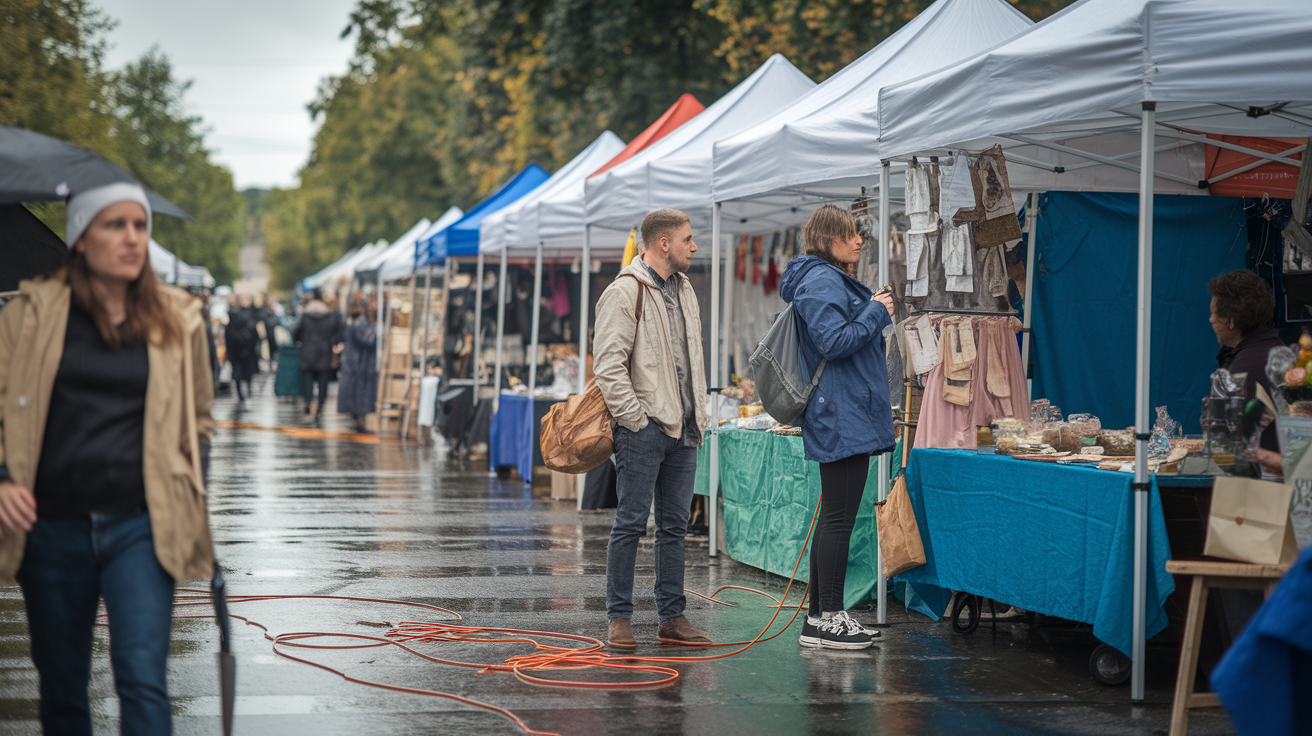
In person selling exposes makers to booth hazards, crowd flow issues, and event organizer requirements. Craft fairs and farmers’ markets often mandate proof of liability insurance before you’re allowed to set up. Many venues require at least $1 million in general liability coverage and ask to be named as an additional insured on your Certificate of Insurance. Trip and fall accidents are the most common booth related claim: extension cords, uneven tent stakes, product displays that tip over, wet floors after rain. A customer browsing your table bumps a hot glue gun, burns their hand, holds you responsible. Even if the claim is groundless, your insurer covers investigation and legal defense, which can cost thousands before the case is dismissed.
Online handmade shops face different liability triggers. Shipping damage can force you to issue refunds, turning a sale into a net loss. If the buyer also claims the broken item injured them (shattered glass cutting a hand during unboxing), you’re facing both a refund and a potential injury claim. A buyer alleges that your handmade skincare product caused a rash and posts photos online, threatening legal action unless you pay medical bills. If you sell food products, a customer claims foodborne illness and demands compensation. Even digital products like PDF sewing patterns can trigger professional liability claims if a buyer injures themselves following your instructions and alleges the pattern contained unsafe guidance.
Six liability triggers unique to handmade and craft businesses:
- Booth setup accidents. Unstable shelving, trailing cords, or canopy poles that collapse and injure passersby.
- Product allergen exposure. Unlabeled ingredients in soaps, lotions, or food items causing allergic reactions ranging from mild rashes to anaphylaxis.
- Flammable or heat related risks. Candles, incense, or battery operated items that overheat, ignite, or cause burns.
- Choking hazards in handmade toys. Small parts, buttons, or eyes that detach and endanger young children.
- Transit and shipping damage. Fragile ceramics or glass items breaking in transit, with buyers claiming injury from sharp edges during unboxing.
- Venue property damage. Accidental spills of dye, resin, or paint onto floors, walls, or furnishings at markets, co-working studios, or pop-up spaces.
Product Liability Concerns for Handmade Goods and When Extra Coverage Is Needed
Product liability insurance covers harm caused by items you’ve sold, whether the injury happens immediately or months later. It responds to three categories of defects: production flaws (a single batch of soap mixed with the wrong pH), design defects (a candle container that cracks under normal heat), and inadequate warnings or instructions (failing to label “contains tree nuts” on a skincare bar). A customer uses your handmade bath bomb, suffers a severe skin reaction due to an unlabeled essential oil, sues for medical bills, missed work, and emotional distress. Product liability pays for your legal defense, settlements, and judgments up to your policy limit. Even if you followed your usual process and weren’t aware of the flaw, the policy typically responds as long as the defect wasn’t intentional or already known and ignored.
Handmade goods with elevated liability risk include anything that contacts skin, burns, is ingested, or gets used by children. Skincare products, soaps, cosmetics can trigger allergic reactions or chemical burns if ingredients are mislabeled or formulations change without updated warnings. Candles and incense pose fire hazards if wicks are too large, containers crack, or instructions fail to warn against leaving them unattended. Handmade toys must meet federal safety standards for small parts, lead content, and flammability. Selling a stuffed animal with button eyes that detach and choke a toddler can result in lawsuits even if no injury occurred, because the risk itself violates safety rules. Food products carry contamination, allergen, and labeling risks that can lead to illness claims and regulatory fines.
Labeling, packaging, and safety instructions are legal requirements that directly affect your liability exposure. If your product contains common allergens (nuts, dairy, soy, specific metals like nickel), failing to disclose them on the label can make you liable for allergic reactions even if the ingredient itself is safe for most users. If your candle label doesn’t include burn time limits, wick trimming instructions, or a warning to keep away from flammable materials, a house fire might be deemed your fault for inadequate warnings. Packaging also matters. Fragile ceramics shipped without adequate cushioning can break in transit, causing cuts during unboxing, and courts may find you liable for foreseeable shipping damage.
| Risk Category | Example Hazard | Needed Coverage Type |
|---|---|---|
| Skin contact products | Allergic reaction to unlabeled essential oil in handmade lotion | Product liability with ingredient disclosure requirements |
| Flammable items | Candle container cracks, wax ignites nearby curtains | Product liability with fire hazard warnings and testing |
| Children’s toys | Button eye detaches from stuffed animal, poses choking risk | Product liability meeting CPSC small parts standards |
| Food and ingestibles | Homemade jam causes foodborne illness due to improper canning | Product liability with food safety compliance and labeling |
Comparing Small Business Liability Options for Artisans and Handmade Sellers

General liability, product liability, and business personal property coverage serve distinct purposes, and many makers need all three to fully protect their operations. General liability covers third party injuries and property damage that occur at your booth, workspace, or during business interactions. Someone slips at your market stall, you accidentally damage a venue’s floor, or a customer claims your marketing materials defamed a competitor. Product liability covers injuries or damage caused by items you’ve sold after they leave your hands. A buyer’s child chokes on a bead from your jewelry, or your handmade cleaning solution damages a customer’s countertop. Business personal property (often called inland marine coverage when it includes goods in transit) protects your inventory, tools, and equipment whether they’re in your home studio, your car on the way to a fair, or your booth during an event. If your vehicle is broken into and $1,200 worth of finished goods are stolen, or a storm collapses your tent and destroys your display, this coverage reimburses you for the loss.
Bundled small business policies package general liability, product liability, and sometimes property coverage into a single premium, simplifying management and often reducing cost compared to buying each separately. A Business Owner’s Policy (BOP) typically combines GL and property. Some insurers add product liability as an automatic inclusion, while others require you to request it. For makers who sell both in person and online, who work from a home studio, and who carry inventory to multiple events each month, a bundled policy ensures you’re covered across all sales channels without gaps. Monthly or annual payment options let you match coverage to your cash flow, and many platforms now issue instant Certificates of Insurance online, which you’ll need to gain entry to most craft fairs and pop-up markets.
State availability and underwriter rules vary widely. Some insurers exclude high risk product categories (food, cosmetics, children’s items) or limit coverage in states with strict liability laws. Policies are underwritten by third party insurance carriers, and quoted prices on comparison sites are estimates. Your actual premium depends on your location, sales volume, product type, claims history, and the specific underwriting guidelines of the carrier willing to cover your business. Before purchasing, confirm that your state permits the policy, that your products aren’t excluded, and that your typical sales venues (home studio, farmers’ markets, online platforms) are all covered under the policy’s territory and operations definitions.
Four factors influencing your policy choice for handmade liability insurance:
- Annual sales volume. Higher revenue often triggers higher premiums because it implies more customer transactions and greater claim exposure.
- Product type and risk profile. Selling scented candles or skincare costs more to insure than selling knitted scarves, due to fire and allergen risks.
- Event frequency and travel. Makers who vend at 20 fairs a year face more transit and booth setup liability than those who sell only online or from a single retail location.
- Inventory value and tooling. $5,000 in raw materials and equipment requires higher property limits than $500, directly affecting your property premium.
Coverage Limits, Deductibles, and Pricing Factors for Handmade Liability Policies

Insurers calculate premiums for maker liability based on your revenue, product categories, claims history, and geographic location. A soap maker in California selling $30,000 annually with no prior claims might pay $400 to $700 per year for $1 million in general and product liability, while a candle maker in Texas selling the same amount could pay $500 to $900 due to higher fire claim frequency in that region. Your materials matter. Jewelry made with nickel or lead containing components costs more to insure than sterling silver, because nickel allergies are common and lead triggers regulatory liability. If you teach workshops or offer classes in addition to selling products, insurers may add a professional liability surcharge or require a separate endorsement, since instructional activities introduce new injury risks (a student burns themselves with your heat tool, or injures their hand following your technique).
Choosing proper limits starts with realistic claim scenarios, not just the minimum required by a craft fair. Many venues mandate $1 million per occurrence and $2 million aggregate, which is often the base offering from small business insurers. But a single product liability lawsuit alleging long term health effects from an allergen or chemical exposure can easily exceed $1 million when you add medical bills, lost income, pain and suffering, and legal defense costs. If you sell higher risk items (anything flammable, ingestible, or used by children), consider $2 million per occurrence. If you vend at large festivals with thousands of attendees, aggregate limits of $3 million or higher protect you if multiple incidents occur in a single policy year. Deductibles for liability coverage are often $0 or very low ($250 to $500), because the insurer wants to control claims from the start. Property coverage (for your inventory and tools) typically carries deductibles of $500 to $2,500, which you choose based on how much loss you can self fund.
Five deductible and limit considerations for handmade sellers:
- Match your aggregate limit to total annual exposure. If you vend 15 events with 500 to 2,000 attendees each, multiple slip and fall or allergen claims in one year are possible.
- Set per occurrence limits above worst case medical costs. A severe allergic reaction requiring hospitalization, specialist care, and missed work can generate $50,000 to $100,000 in damages.
- Choose a property deductible you can afford to pay immediately. If $1,000 of inventory is stolen and your deductible is $1,000, you receive nothing. A $500 deductible nets you $500.
- Consider umbrella or excess liability if you sell nationally or online. Higher visibility increases claim risk, and umbrella policies add $1 to $5 million on top of your base limits.
- Review limits annually as revenue grows. Doubling your sales should prompt a review, because claim frequency often scales with transaction volume.
Real World Liability Claim Scenarios for Handmade Businesses
A retired woodworker sets up at an outdoor spring market. Mid afternoon, a customer trips over the woodworker’s extension cord, falls hard, fractures her hip. She’s transported by ambulance, undergoes surgery, misses eight weeks of work. Her medical bills total $22,000, and she hires an attorney who demands $40,000 to settle for medical costs, lost wages, and pain. The woodworker’s general liability policy covers the legal defense and settles for $35,000. Without insurance, the maker would face bankruptcy.
A soap maker sells a lavender goat milk bar at a farmers’ market. Three weeks later, a buyer develops painful contact dermatitis and learns she’s severely allergic to an essential oil the maker didn’t list on the label. She incurs $1,200 in dermatology bills, misses work, threatens to sue for negligence and failure to warn. The maker’s product liability coverage pays the medical bills and a small settlement, and the insurer’s legal team negotiates a resolution for $4,500 total. Far less than the $25,000 the buyer initially demanded, and the maker avoids a public lawsuit that could damage their reputation online.
A candle maker ships a soy candle in a ceramic vessel. The package is dropped during delivery, the vessel cracks, and when the buyer lights the candle two days later, melted wax leaks through the crack and ignites the wooden table underneath, causing $8,000 in smoke and fire damage to the buyer’s home. The buyer files a claim alleging defective design and inadequate packaging. The maker’s product liability insurer investigates, determines the crack resulted from shipping impact (not a design flaw), but agrees to a $6,000 settlement to avoid prolonged litigation. The maker’s legal defense alone would have cost $10,000.
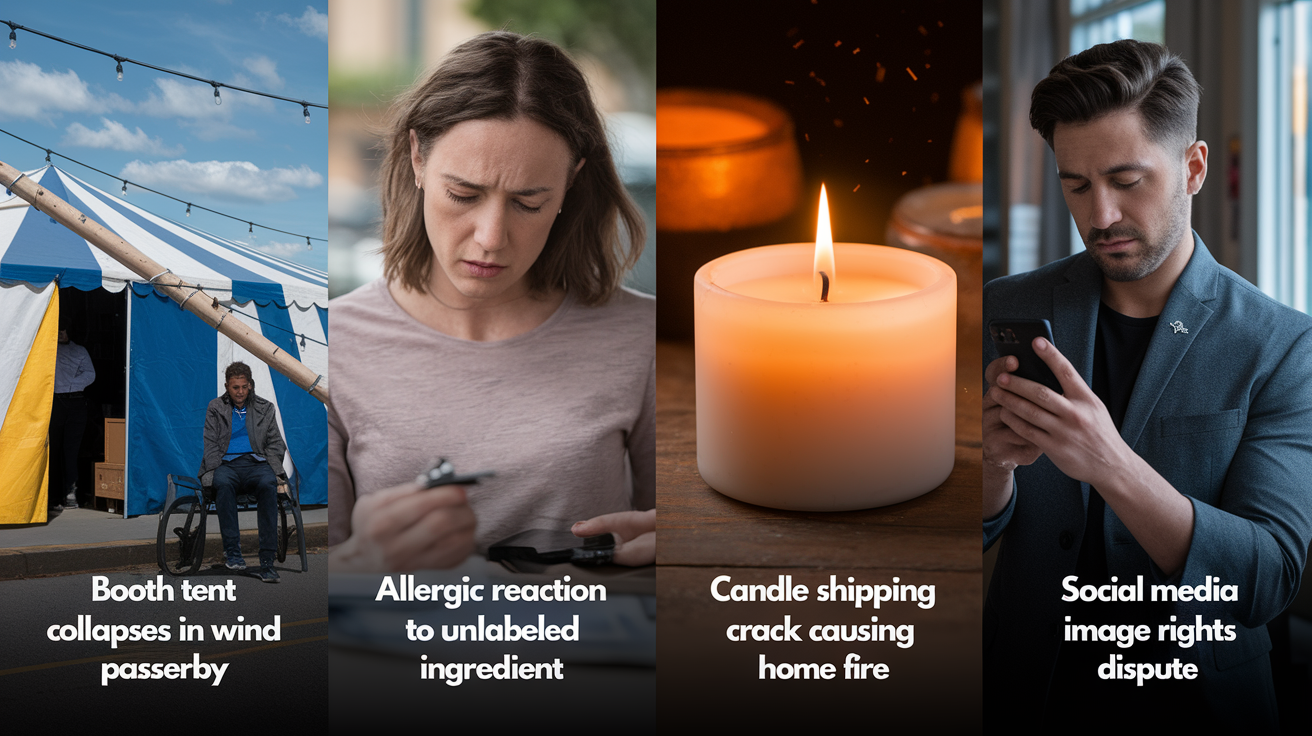
Four true to life liability events and which coverage responds:
- Booth tent collapses in wind, pole strikes a passerby and causes a concussion. General liability covers the injury claim, medical bills, and legal costs.
- Handmade earrings contain nickel, buyer suffers severe allergic reaction and scarring. Product liability responds, covering medical treatment and damages for failure to disclose allergen.
- Vehicle stolen with $1,500 of inventory inside on the way to a show. Business personal property or inland marine coverage reimburses the inventory loss (minus deductible).
- Customer claims your social media post used their photo without permission, demands $10,000. General liability’s “personal and advertising injury” coverage may respond, depending on policy wording.
Proof of Insurance, COIs, and Meeting Marketplace Requirements
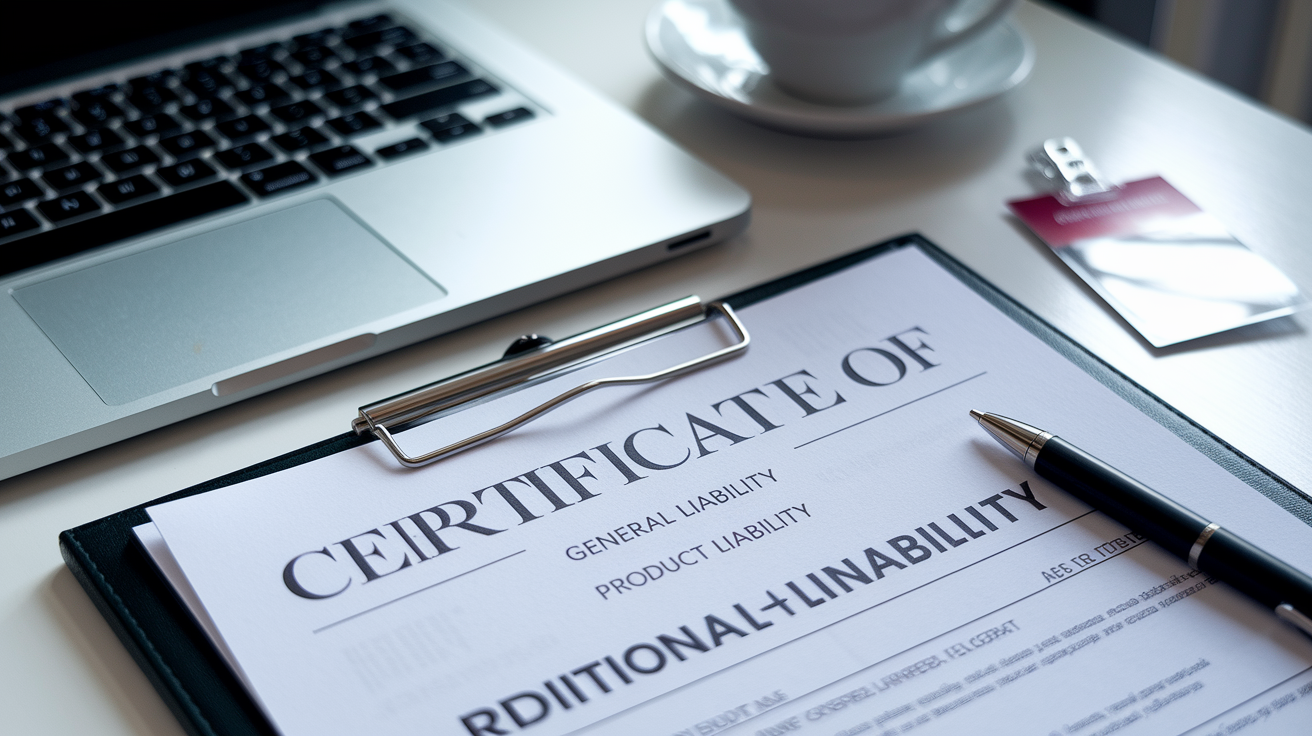
Most craft fairs, farmers’ markets, and pop-up venues require vendors to submit a Certificate of Insurance before you’re allowed to set up. The COI is a one page summary of your coverage. It lists your policy number, effective dates, coverage types (general liability, product liability, property), and your liability limits. Many events require you to name the venue, festival organizer, or property owner as an “additional insured,” which extends your liability coverage to protect them if they’re named in a lawsuit arising from your booth activities. For example, if a customer slips at your booth and sues both you and the festival organizer, your GL policy defends both parties (up to your limits) when the organizer is listed as an additional insured.
Online insurance platforms and traditional agents can generate COIs instantly or within 24 hours. When you purchase a policy, you typically gain access to a web portal where you can download a blank COI, add additional insureds, email the certificate directly to event coordinators. Some insurers charge a small fee ($25 to $50) to add an additional insured. Others include unlimited certificates at no cost. Always keep both a digital PDF and a printed copy of your COI in your vendor supplies. Event check in staff may demand proof on the spot, and you won’t always have cell service or printer access at outdoor markets.
Three key COI requirements for vendor participation at craft markets and pop-ups:
- Minimum liability limits. Most events require $1 million per occurrence and $2 million aggregate. Some large festivals demand $2 million / $4 million.
- Additional insured endorsement. The venue or organizer must be named on the certificate, and your policy must include an additional insured clause (not all base policies do automatically).
- Coverage territory and effective dates. Your policy must be active on the event date and must cover the event’s location (some policies exclude certain states or international venues).
Home Studio, Workshop, and Inventory Protection for Handmade Entrepreneurs

Homeowner and renter insurance policies explicitly exclude business property and business related liability. If you store $2,000 worth of yarn, fabric, and finished knitted goods in your spare bedroom and a pipe bursts, flooding the room, your home policy will deny the claim because the items were held for sale. If you invite a client to your home studio to view custom orders and they trip on your staircase, your homeowner liability coverage will likely refuse to respond because the visit was a business activity. Even tools and equipment you use solely to produce goods for sale (kilns, sewing machines, laser cutters, 3D printers) are excluded under standard home policies.
Business personal property coverage (often included in a Business Owner’s Policy or added as inland marine coverage) protects inventory, raw materials, tools, and equipment whether they’re in your home, your vehicle, or your booth at an event. If a summer storm causes your garage to flood and destroys $1,200 in finished candles and $400 in fragrance oils and wax, business property insurance reimburses you for $1,600 minus your deductible. If your car is broken into outside a hotel the night before a big show and thieves steal $900 worth of jewelry, inland marine coverage pays the claim. Many policies also cover “goods in transit,” meaning your inventory is protected while being shipped to customers or transported between your studio and events. If a carrier loses or damages a $500 shipment of ceramics, you file a claim with your insurer rather than fighting with the shipping company.
As your business grows, update your property limits to reflect current inventory and equipment values. A maker who starts with $500 in supplies and gradually builds to $5,000 in raw materials, $3,000 in finished goods, and $2,000 in tools needs $10,000 in business property coverage, not the $1,000 minimum they bought at launch. Underinsuring guarantees you’ll face a gap after a loss. If you carry $3,000 in coverage but lose $8,000 in a studio fire, you receive only $3,000 minus your deductible, leaving you $5,000+ short and unable to restart production.
| Item Type | Common Risk | Coverage Needed |
|---|---|---|
| Finished inventory | Storm flooding garage, destroying completed products before a fair | Business personal property or inland marine |
| Raw materials and supplies | Fire in home studio, total loss of fabric, beads, oils, wax, clay | Business personal property with replacement cost endorsement |
| Tools and equipment | Sewing machine, kiln, or heat press stolen during break in | Business property with equipment coverage or scheduled items |
| Goods in transit | Shipment of ceramics damaged in carrier accident, customer demands refund | Inland marine or “goods in transit” endorsement |
Buying Liability Insurance for Handmade Businesses: Application, Quotes, and Documentation

Shopping for maker insurance starts with gathering basic business details: your annual revenue (or projected revenue for startups), a list of products you make and sell, your sales channels (online, in person markets, wholesale, consignment), and any additional activities like teaching workshops or renting studio space to other makers. Online platforms marketed to small businesses and crafters can generate quotes in under two minutes by asking a series of multiple choice questions (product categories, revenue bands, number of events per year, home studio or commercial location). Traditional independent agents take longer but offer more customization, especially if you have complex needs like selling both low risk (scarves) and high risk (candles, skincare) items, or if you’ve had prior claims that make standard platforms decline your application.
Comparing providers means evaluating not just price but also coverage breadth, exclusions, state availability, and claim service reputation. A $300 annual policy that excludes product liability or caps your business property at $1,000 is not comparable to a $500 policy that includes $1 million product liability and $10,000 property coverage. Read the policy’s exclusions section carefully. Some insurers exclude all food products, all cosmetics, or all items marketed to children, while others cover them with higher premiums or sub limits. Check online reviews and state insurance department complaint ratios to assess how quickly and fairly the insurer pays claims. A cheap policy from a carrier with a history of denying claims or delaying payments can cost you far more in the long run.
When you file a liability or property claim, documentation is critical. Take photos of your booth setup, your studio, your inventory, your packaging processes. If a customer alleges your booth was unsafe or your product was defective, visual proof of your standard practices strengthens your defense. Keep receipts for raw materials and finished goods, inventory lists with quantities and estimated values, records of any testing or certification (cosmetic safety assessments, CPSC toy testing, candle burn tests). If an injury or property damage occurs, photograph the scene immediately, collect witness contact information, write down exactly what happened while it’s fresh, and report the incident to your insurer within 24 to 48 hours. Most policies require “prompt notice,” and delays can jeopardize coverage.
Six questions to ask an insurance provider specific to handmade businesses:
- Does your general liability policy automatically include product liability, or is it a separate add on? (Some GL policies include limited products/completed operations. Others exclude product liability entirely.)
- Are my specific product categories excluded or subject to sub limits? (Confirm that candles, cosmetics, food, children’s items, or other high risk goods are covered without carve outs.)
- Does business personal property coverage apply when inventory is in my vehicle or at an event, or only at my listed studio location? (Many base policies cover only a fixed address. You need inland marine or “off premises” coverage for goods in transit.)
- Can I add workshop or instructional liability if I teach classes or post tutorials? (Professional liability or a teaching endorsement may be necessary.)
- What is your claims process, and how quickly do you issue COIs when I add an additional insured? (Ask for average response times and whether you can generate COIs online instantly.)
- Will my premium increase if I file a small claim, and do you offer claim free discounts? (Understanding rate impacts helps you decide whether to file minor losses or pay out of pocket.)
Risk Reduction Strategies to Minimize Liability for Handmade Sellers
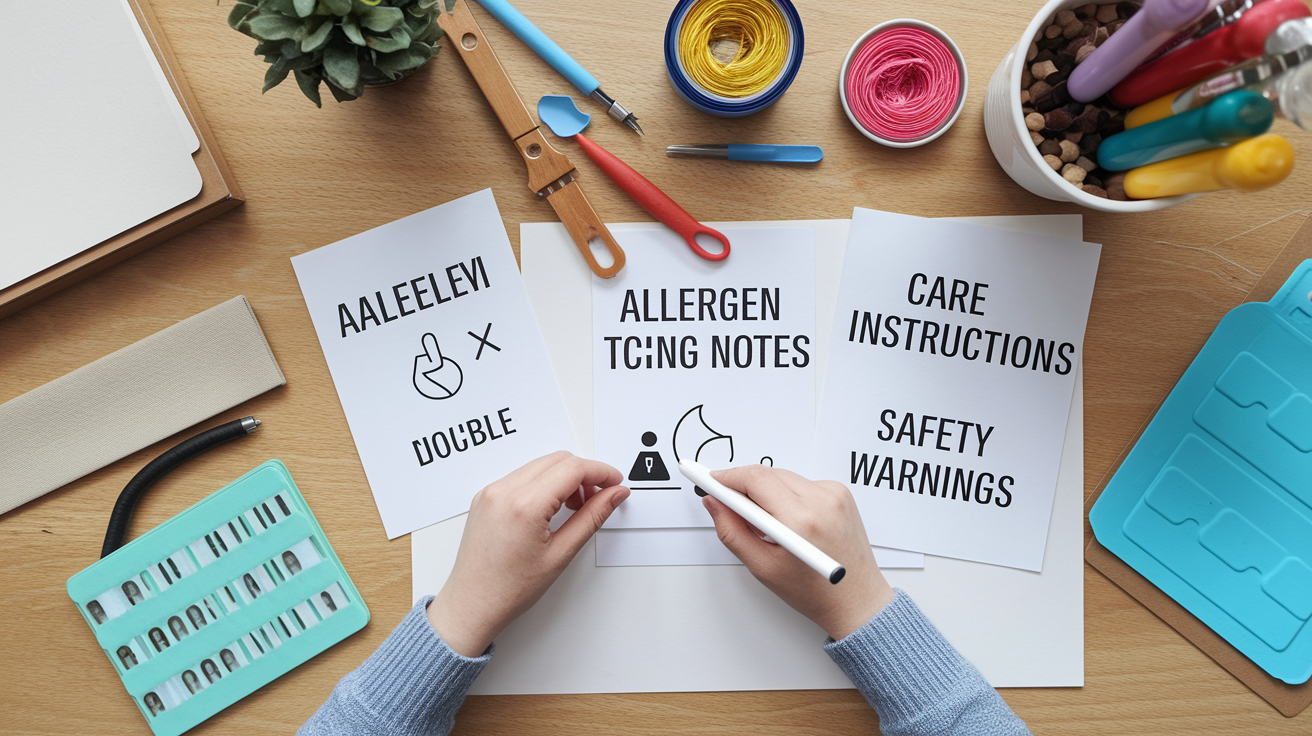
Proper labeling is your first line of defense against product liability. List every ingredient in descending order by weight, highlight common allergens (nuts, dairy, soy, nickel, essential oils known to cause reactions), include clear use and safety instructions. For candles, specify burn time, wick trimming, warnings to keep away from flammable materials and never leave unattended. For children’s items, include age recommendations and choking hazard warnings if small parts are present. If your product requires assembly or has specific care instructions, print them on the packaging or include a printed insert. Courts often view failures to warn as negligence, and a $2 label can prevent a $20,000 lawsuit.
Booth and workspace safety directly reduces slip, trip, and fall claims. Tape down all electrical cords with brightly colored gaffers tape, arrange tables and displays to create clear walking paths, use stable, weighted bases for any vertical displays or signage. If you’re setting up outdoors, stake tent legs securely and add sandbags or weights rated for wind speeds common in your area. Many market tent collapses happen because vendors underestimate wind loads. Inspect your setup after loading in and again mid day if weather changes. A small adjustment to a wobbly shelf can prevent a customer injury and a five figure claim.
Four liability mitigation strategies for handmade sellers:
- Conduct allergen and safety testing on new product formulations. Third party cosmetic safety assessors and candle burn test labs cost $100 to $500 but provide documentation that you took reasonable care, which courts and insurers value during claims.
- Use disclaimers and care instructions on packaging and receipts. “Handmade item, slight variations normal; not intended for children under 3; wipe clean with damp cloth only” sets expectations and limits misuse liability.
- Photograph your booth setup and products at each event. Timestamped images prove you used proper safety measures and accurate labeling, countering false claims.
- Maintain an incident log. Record every customer complaint, near miss, or minor issue (a customer mentions an earring clasp feels loose, a candle label smudged in transit). Patterns help you fix problems before they become claims.
Scaling Liability Coverage as Your Handmade Business Grows
Update your liability and property limits whenever you add new product lines, expand to new sales channels, or cross revenue milestones. A maker who starts selling $10,000 annually at local markets and grows to $50,000 with an online shop, wholesale accounts, and national craft shows has quadrupled their customer base and geographic exposure. Your claim risk grows proportionally, and your original $1 million liability limit may no longer be adequate. If you begin selling higher risk products (adding candles to a previously textiles only line, or launching a skincare range alongside your jewelry), notify your insurer immediately and request a quote for the expanded coverage. Failing to disclose new product categories can result in claim denials.
Annual policy reviews before renewal let you adjust limits, add endorsements, capture discounts for claim free years. Many insurers offer 5 to 10% discounts if you’ve gone 12 to 24 months without a claim, and bundling multiple policies (GL, property, cyber liability, commercial auto) with one carrier often unlocks multi policy discounts of 10 to 25%. Use your renewal notice as a prompt to reassess your inventory value, count the number of events you plan to vend in the coming year, estimate your revenue growth. Providing accurate updated information ensures you’re neither overinsured (wasting premium dollars) nor underinsured (facing gaps when you file a claim).
Four growth trigger events that require updated coverage limits:
- Launching an online store or expanding to a national e-commerce platform. Online sales increase your customer count and geographic reach, raising product liability exposure and requiring confirmation that your policy covers sales in all 50 states.
- Hiring your first employee or contractor. You’ll need workers’ compensation insurance (required by law in most states) and may need to increase your general liability limits to cover employee actions.
- Securing a wholesale account or consignment relationship with a retailer. Retailers often require $2 million or higher liability limits and demand to be named as additional insureds on your COI.
- Moving from a home studio to a commercial space or shared maker studio. Commercial leases typically mandate specific liability and property coverage, and your landlord will require proof of insurance naming them as additional insured and loss payee.
Final Words
Start here: you’ve got the essentials—what general liability will (and won’t) cover, when product liability matters, why homeowner policies often leave you exposed, and the common claim scenarios at markets and online.
You also learned what to check when shopping: limits, deductibles, COI needs, inventory protection, and simple risk controls that actually reduce claims.
Take one practical step now: get a quote, confirm your limits, and add the right general liability insurance for handmade business so you can sell with more confidence.
FAQ
Q: How much does a $1,000,000 general liability insurance cost? How much should general liability insurance cost for a small business?
A: A $1,000,000 general liability policy typically costs $300–$1,200 per year for small businesses, depending on sales, product risk, location, and event frequency. Higher-risk products or high sales push costs up.
Q: Do I need public liability insurance to sell crafts?
A: You need public liability insurance to sell crafts if you sell at markets, pop-ups, or have customers visit your space, since venues often require a COI. Hobby-only sellers with tiny sales may not need it.
Q: What type of insurance do crafters need?
A: Crafters typically need general liability plus product liability; add business property or inland marine for inventory and tools, and consider product-recall or professional liability where relevant. Check venue COI requirements.