





Think your policy change is instant?
It isn’t, and that gap can leave you exposed if a claim happens.
Whether a change goes active the same day, within 24 hours, or not until your next billing cycle depends on what you’re changing, whether you pay the premium difference, and if the insurer needs extra paperwork or underwriting.
Read on to see realistic timelines for auto, home, health, and life policies, the red flags that slow updates, and five quick steps to get changes confirmed fast.
Effective Timelines for Insurance Policy Changes

Most insurance policy changes take effect immediately, within 24 hours, or at your next billing cycle. It depends on what you’re changing and whether the insurer needs to review anything. Simple administrative updates like changing your mailing address, updating a phone number, or adding a vehicle to your auto policy usually go live the same day you request them, as long as you pay any required premium difference on the spot. These immediate changes don’t alter the risk profile your insurer agreed to cover, so there’s nothing for them to reconsider.
Other updates post within 24 hours or wait until your next billing cycle starts. If you adjust your deductible, remove a driver, or add a discount you just became eligible for, many insurers process the change within one business day and apply the premium adjustment on your next monthly or annual bill. Next billing cycle timing is common for changes that reduce coverage or lower your premium. Insurers don’t see urgency in reducing their own exposure. Expect these updates to show up anywhere from tomorrow to 30 days out, depending on where you are in your billing month.
Several factors control which timeline applies to your request:
Type of change – administrative edits (address, contact info) versus coverage modifications (limits, deductibles, drivers)
Payment status – whether you pay the premium difference immediately or wait for the next invoice
Documentation completeness – missing paperwork delays approval
Insurer workload – high call volume or system upgrades can slow processing
Changes that increase your insurer’s risk or require a fresh underwriting look take longer. Adding a teenage driver, raising your liability limits by a large margin, or increasing life insurance coverage usually triggers a review that runs 2–14 days for straightforward cases. If the insurer needs to verify driving records, order a home inspection, or request medical records, you’re looking at 7–30 days before the update is fully active. Complex underwriting scenarios can stretch 30–90 days. Like adding a high value vehicle with a salvage title or requesting a six figure life insurance increase.
Factors That Influence How Quickly Policy Updates Become Active

Insurers process policy changes by evaluating whether the update shifts the risk they’re taking on. If you’re asking to raise coverage limits, add a driver, or increase your dwelling amount, the company runs a quick risk assessment. Does this person’s driving record look clean? Does the added vehicle fall within acceptable underwriting guidelines? Does the new coverage level require manager approval or inspection? Internal routing determines whether you wait an hour or a week. Whether your request lands with a front line rep who can approve it on the spot or gets escalated to an underwriting team. High volume periods (renewal season, after major storms) slow everything down because underwriters are buried in requests.
Documentation, state rules, and payment conditions also control timing. Most states require written notice for cancellations or nonrenewals, commonly 10–30 days, but they don’t impose the same deadlines on mid term endorsements. Insurers set their own processing schedules. If your change requires proof (a new driver’s license, vehicle registration, property appraisal, medical exam results), the clock doesn’t start until the insurer has everything in hand. Payment holds up activation too. If you don’t pay the additional premium immediately, many carriers won’t finalize the update until your next billing cycle or until payment clears. Watch for insurers that auto charge your card on file. They usually process faster than ones waiting for a mailed check.
How Timing Differs by Insurance Type

Auto Insurance
Auto policy updates are the fastest across the board. Adding or removing a vehicle, updating a driver’s information, or adjusting your liability limits typically takes effect the same day if you make the change online or over the phone and pay any premium difference immediately. Most insurers issue a digital endorsement or binder within minutes, and you can download proof of insurance on the spot. Removing a driver or vehicle can be instant, but the refund usually appears on your next billing cycle. Don’t expect a check to arrive overnight.
Changes that require underwriting review take 24–72 hours. If you’re adding a driver with a recent DUI, switching to a commercial use classification, or adding a high value collector car, the insurer will pull records and assess the risk before approving the endorsement. Expect 1–3 business days for these situations, and you may get temporary coverage via a binder while underwriting wraps up.
Homeowners Insurance
Most homeowners endorsements post within 24–72 hours. Like raising personal property limits, adding scheduled items (jewelry, cameras), or changing your deductible. These are treated as low risk adjustments, and insurers process them quickly as long as you don’t trigger an inspection requirement. If you’re just bumping coverage by 10–20 percent or adding a rider for a $3,000 engagement ring, approval is usually automated or handled by a service rep without underwriting involvement.
Bigger changes slow the process. Requesting a major increase in dwelling coverage, adding a separate structure (detached garage, pool house), or switching to replacement cost coverage for an older home often requires an inspection or property appraisal. These reviews take 7–30 days depending on inspector availability and insurer backlog. Until the inspection clears, the change sits in pending status, and your declarations page won’t update.
Life Insurance
Beneficiary updates are the fastest life insurance change you can make. Most insurers process them the same day or within 24 hours once they receive your signed form. This is pure administrative work with no underwriting involved. You submit the updated beneficiary designation, the insurer records it, and you get a confirmation letter or email showing the new effective date.
Coverage increases and most policy modifications require underwriting, and that’s where timelines stretch. If you want to raise your death benefit, convert term coverage to permanent, or add a rider, the insurer will review your health status, possibly order medical records, and may require a paramedical exam. Simple increases (no exam, under a certain threshold) can clear in 7–14 days. Full underwriting with lab work and an attending physician statement runs 30–60 days. Complicated medical histories or older applicants can push the process past 90 days.
Health Insurance
Health insurance changes follow enrollment rules more than processing speed. If you’re adding or removing a dependent outside of open enrollment, you need a qualifying life event (marriage, birth, loss of other coverage), and the effective date is usually the date of the event or the first of the following month. Processing takes 24 hours to a few days, but the rules dictate when coverage actually starts. Plan changes during open enrollment take effect January 1 (or your plan’s renewal date) regardless of when you submit the request, as long as you meet the enrollment deadline.
Mid year plan changes that don’t involve a life event are rare and often restricted. Some employer plans allow changes during the year if you move to a new service area or experience a significant cost increase, but expect 10–30 days for the insurer to review and approve the request. State marketplace plans are stricter. Most lock you in until the next enrollment period unless you qualify for special enrollment.
How to Speed Up Insurance Policy Change Approvals
Preparation eliminates most delays. Insurers process complete requests first and route incomplete ones to a holding queue until you provide missing information. If you know you’ll need to add a driver, gather the person’s driver’s license number, date of birth, and recent driving history before you call. If you’re increasing coverage, have your payment method ready and confirm your insurer can charge it immediately rather than waiting for your next billing cycle.
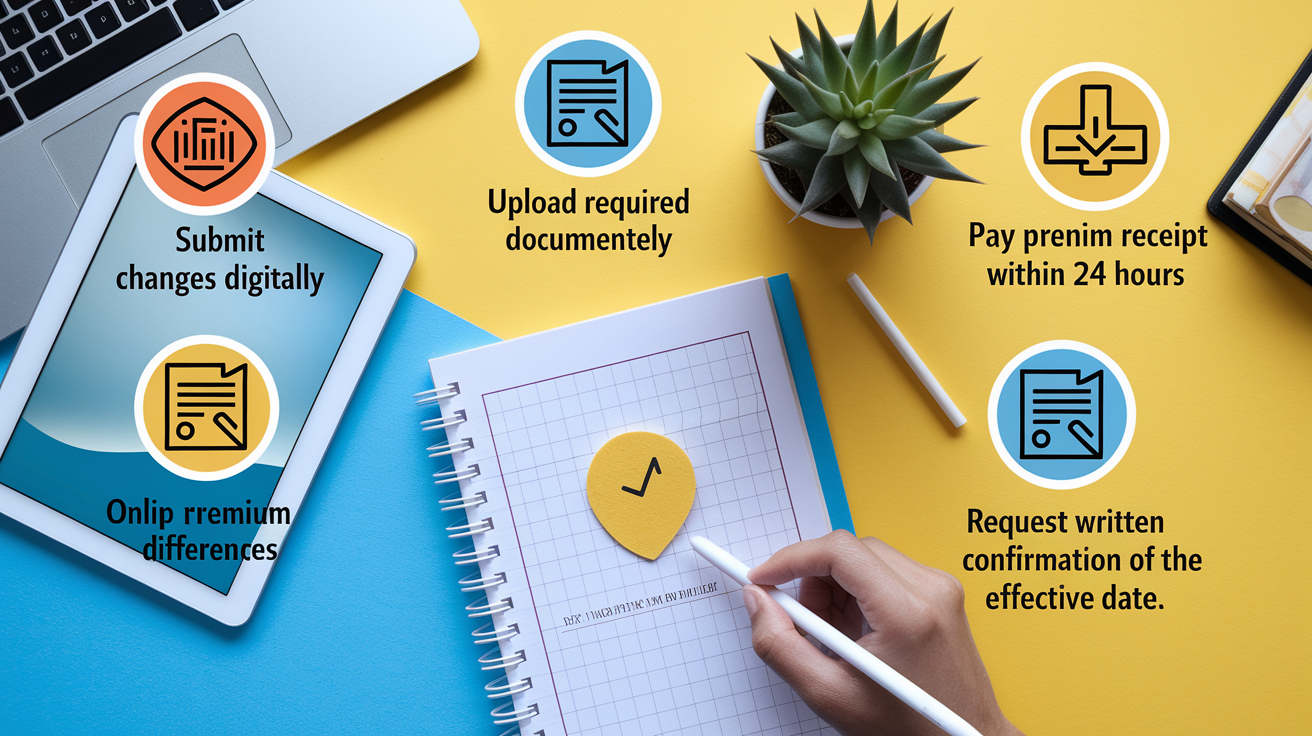
Five steps that cut approval time:
Submit changes digitally. Online portals and mobile apps process faster than phone requests, which are faster than mailed forms.
Upload required documents immediately. Don’t wait for the insurer to ask. Attach the vehicle registration, inspection report, or proof of discount eligibility with your initial request.
Pay premium differences on the spot. Authorize the charge or transfer when you submit the change. Payment delays endorsement finalization.
Confirm receipt within 24 hours. Check your email or app for a confirmation number and follow up if you don’t see one by the next business day.
Request written confirmation of the effective date. Ask for an updated declarations page or endorsement showing the exact date and time your change goes live. Verbal assurances don’t protect you if a claim comes in before the system updates.
Final Words
Most policy changes kick in fast — sometimes immediately, sometimes within 24 hours, or on the next billing cycle. We ran through those timelines, what slows updates, how timing differs by insurance type, and practical steps to get changes approved faster.
If you want a straight answer: how long does it take for insurance policy changes to take effect? It depends — immediate to 24 hours for simple edits, a billing-cycle delay for payment-tied updates, or 2–14 (up to 30) days when underwriting is needed. Get your docs ready and ask for written dates. You’ll avoid surprises.
FAQ
Q: What to do if insurance won’t cover Wegovy?
A: If insurance won’t cover Wegovy, appeal and ask your doctor for a medical-necessity letter and prior authorization; if that fails, try the manufacturer’s assistance program, alternatives, or an external review.
Q: How long does it take for an insurance policy to take effect?
A: How long it takes for an insurance policy to take effect depends on the change: some start immediately, others within 24 hours, next billing cycle, or after underwriting review (commonly 2–14 days).
Q: Can I get life insurance with lupus?
A: You can get life insurance with lupus, but approval, rates, and waiting periods depend on disease severity, treatment stability, and medical records; expect higher premiums or limited options, so compare specialized carriers.
Q: What is the 80% rule in home insurance?
A: The 80% rule in home insurance requires you insure at least 80% of your home’s replacement cost to avoid reduced claim payments; underinsuring can leave you paying a share of large-loss repairs.