





Think your home or business insurance will cover damage from radiation?
Think again.
Most modern policies include a nuclear hazard exclusion that can wipe out claims for reactor meltdowns, dirty bombs, delayed radiation sickness, and contamination-related business losses.
That single sentence can turn an expensive disaster into your out-of-pocket problem.
This article explains what insurers actually exclude, the common wording tricks that lead to denied claims, who is most at risk, and three practical checks to do before you sign or renew.
Core Explanation of Nuclear Hazard Exclusion Insurance in Modern Policies
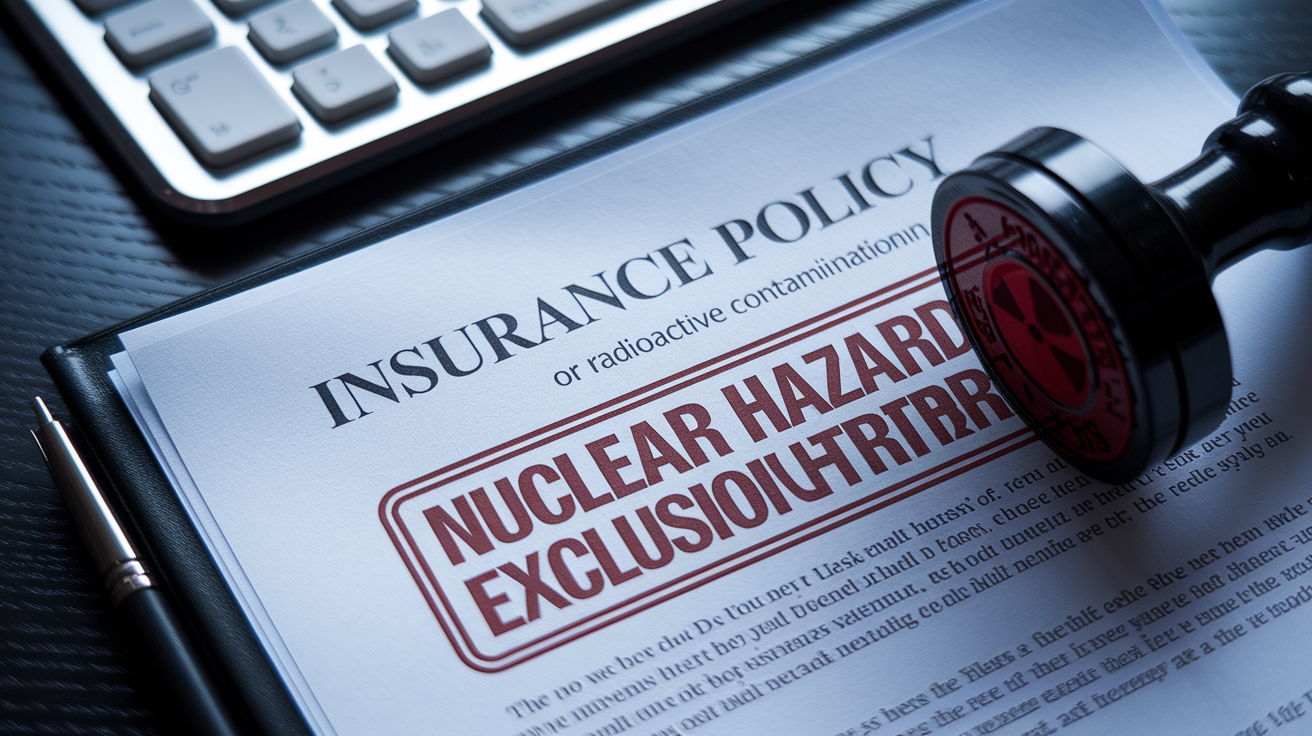
A nuclear hazard exclusion insurance clause removes coverage for bodily injury, property damage, and business losses caused by nuclear reactions, radiation, or radioactive contamination.
You’ll find this exclusion in nearly every homeowner’s policy, commercial property contract, general liability plan, and life insurance document. Insurers write it broadly enough to shut down claims from reactor meltdowns, nuclear weapon detonations, delayed radiation sickness, and contamination from dirty bombs. The wording applies whether you live next door to a power plant or thousands of miles from wherever the radiation started.
Standard policies read something like this:
“Loss resulting from nuclear reaction, radiation, or radioactive contamination, all whether controlled or uncontrolled or however caused, or by any weapon of war employing atomic or nuclear fission and/or fusion or other like reaction or radioactive force or matter.”
That one sentence wipes out an enormous range of losses. The exclusion came together decades ago when insurers realized nuclear incidents create catastrophic, industry-breaking losses that traditional underwriting can’t handle. The Price-Anderson Act built a separate nuclear liability system with structured tiers—$375 million in private insurance per reactor, plus a second-tier industry pool of $111.9 million per reactor—to manage nuclear facility claims. For more on the structure of Insurance coverage for nuclear accidents, see the government framework that replaced conventional insurance for nuclear energy risks.
Your policy excludes these nuclear-related events:
- Direct radiation exposure from nuclear weapon detonations or reactor accidents
- Delayed radiation sickness that shows up days or weeks after you were first exposed
- Property contamination from radioactive fallout, spent fuel, or nuclear waste
- Business interruption losses from nuclear contamination or evacuation orders
- Terrorism or sabotage involving nuclear material, including dirty bombs and cyber-triggered reactor failures
Interpretation of Nuclear Exclusion Clause Language and Real-World Coverage Gaps

The phrase “nuclear reaction, radiation, or radioactive contamination” sounds precise. But it leaves broad room for insurer interpretation.
Some policies add “whether controlled or uncontrolled,” which sweeps in medical radiation equipment failures, industrial radiography accidents, and peaceful nuclear energy use alongside weapons and catastrophic events. Other policies narrow the clause to “weapons of mass destruction” or “war involving nuclear material,” creating gray areas when radiation exposure happens during civil unrest, cyberattacks on reactors, or terrorism not classified as war.
A civilian working in a foreign country who dies from fallout after two regional nuclear powers exchange tactical strikes will likely face denial under “war, whether declared or undeclared” language. Even though the insured had no military role. A business owner whose property gets contaminated by a dirty bomb faces the same exclusion as a homeowner living downwind of a reactor breach. And when someone survives an initial radiation exposure but dies two weeks later from bone marrow failure, insurers routinely classify the death as “resulting from nuclear reaction,” triggering the exclusion.
| Exclusion Phrase | Practical Effect | Typical Policies | Notes |
|---|---|---|---|
| “Loss resulting from nuclear reaction, radiation, or radioactive contamination” | Denies all radiation-related claims, including delayed deaths and property contamination | Homeowners, commercial property, life | Broad wording covers remote exposure and non-military events |
| “Death caused by acts of war, terrorism, or weapons of mass destruction” | Applies to dirty bombs, sabotage, and tactical nuclear strikes; civilian bystander status doesn’t exempt | Life, AD&D | Gray area when cyber-triggered or civil-unrest-related |
| “Weapons of war employing atomic or nuclear fission and/or fusion” | Narrower: may exclude peaceful reactor accidents if wording requires weapon use | Older life policies, some group plans | Language from 1950s–1970s; interpretation varies by jurisdiction |
| “Radioactive contamination, all whether controlled or uncontrolled” | Catches medical equipment failures, industrial accidents, and controlled uses | Professional liability, property | Extremely broad; includes non-catastrophic radiation events |
Why Insurers Use Nuclear Hazard Exclusions

Nuclear incidents generate losses so large and so concentrated in time that they can bankrupt entire segments of the insurance industry overnight.
A single reactor meltdown or tactical nuclear detonation can produce hundreds of billions in property damage, business interruption, bodily injury liability, and environmental cleanup costs. Standard actuarial models rely on historical loss data and geographic diversification. Nuclear events offer neither. The industry has no credible way to price premiums that would both cover potential payouts and remain affordable to you.
Insurers exclude nuclear hazards from conventional policies and shift that exposure to government-backed nuclear liability programs and specialized pools. The Price-Anderson Act created a two-tier system in which private insurers provide $375 million in primary coverage per reactor, and a second-tier industry assessment contributes up to $111.9 million per reactor, totaling roughly $12.6 billion across 104 reactors. If both tiers are exhausted, Congress is directed to consider additional disaster funding. This structure allows the private insurance market to continue offering property and liability coverage for everyday risks without holding reserves sufficient to cover low-probability, extremely high-severity nuclear catastrophes.
The exclusion also protects insurers from ambiguous causation scenarios. When a reactor fails due to a cyberattack during civil unrest, was the loss caused by the cyber event, the unrest, or the nuclear contamination itself? Broad exclusion language removes those questions from coverage disputes. It shifts the burden to specialized nuclear liability frameworks and government intervention rather than leaving standard commercial and personal lines policies exposed to unpredictable claims litigation.
Nuclear Hazard Exclusion Insurance vs Government Nuclear Liability Systems
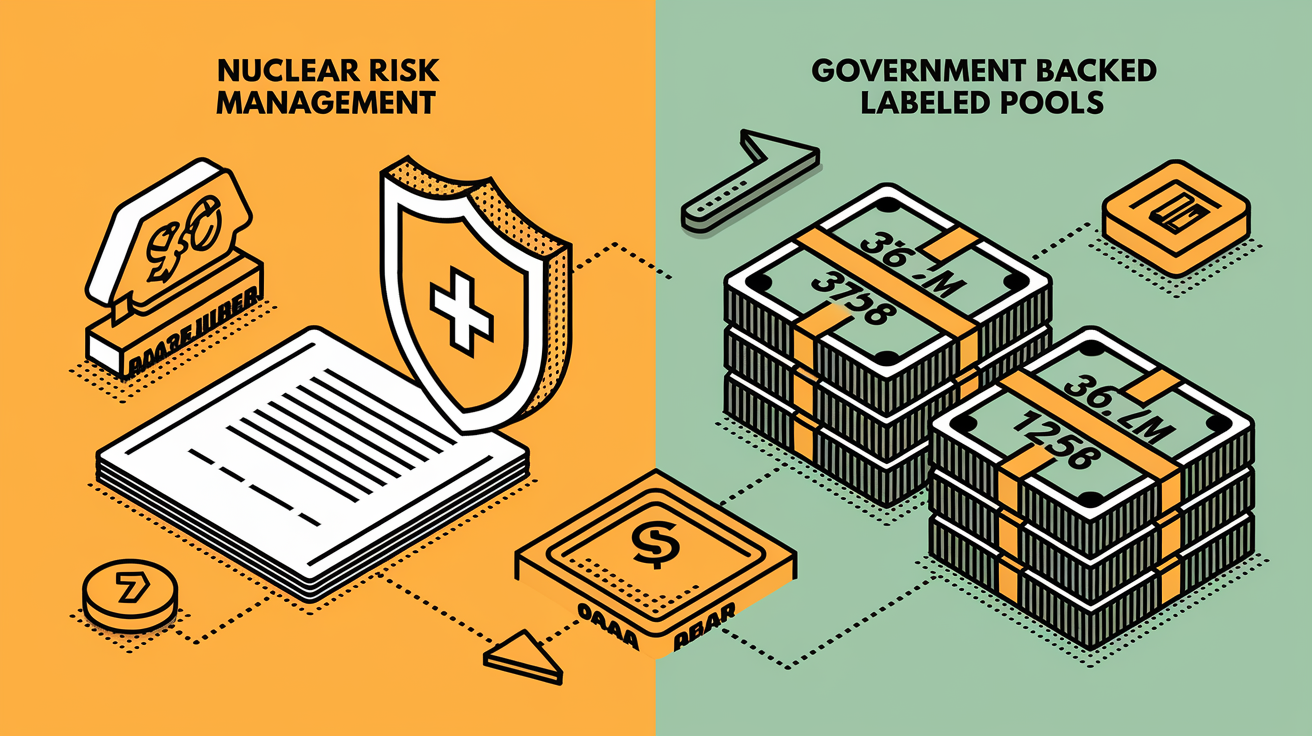
Standard insurance policies exclude nuclear risks. But government-backed frameworks provide structured, tiered coverage for nuclear facility incidents.
The key difference is that your homeowner’s or business policy removes nuclear losses entirely, while the Price-Anderson nuclear liability system establishes finite dollar caps and procedural rules for compensating victims of reactor accidents. If you’re injured by radiation from a covered nuclear facility, your claim gets handled under federal rules and paid from industry pools, not your personal insurance.
The Price-Anderson framework operates in two layers. The first layer provides $375 million in private insurance purchased by each nuclear plant operator, underwritten by a specialized pool. If claims from a single incident exhaust that limit, the second layer kicks in: every reactor owner in the United States is required to contribute up to $111.9 million per reactor. With 104 reactors in operation, that second-tier pool totals $12.6 billion. This structure worked after the 1979 Three Mile Island accident, where insurers paid approximately $71 million in public liability and litigation costs from the primary $140 million tier available at the time, plus a separate $300 million in property coverage to the plant operator. For more context on how these exclusions interact with nuclear liability pools, see the Broad Form Nuclear Energy Liability Exclusion.
Here’s how the system layers coverage and responsibility:
- First tier: $375 million per reactor from private nuclear liability insurers
- Second tier: Up to $111.9 million assessment per reactor, pooled across all U.S. reactors, totaling approximately $12.6 billion
- Congressional backstop: If both tiers are depleted, federal statute directs Congress to consider additional disaster relief funding
- Scope: Covers public liability from nuclear incidents at licensed facilities; doesn’t cover nuclear weapons, terrorism, or most non-facility radiation events
- Claim process: Managed under federal rules; you don’t file through personal property or liability policies
Situations Typically Denied Under Nuclear Hazard Exclusion Insurance

Insurers routinely deny claims when radiation exposure occurs but death or injury happens days or weeks later.
A person who survives the initial blast or release but develops acute radiation syndrome and dies two weeks later will see the claim classified as “resulting from nuclear reaction,” triggering the exclusion. The time gap doesn’t soften the denial. The insurer traces causation back to the nuclear event and applies the exclusion as written.
Terrorism involving nuclear material creates another common denial scenario. Dirty bombs, reactor sabotage, and cyberattacks that trigger radiation leaks often fall under both nuclear hazard and war/terrorism exclusions. Insurers pick the broadest applicable language and cite it. When a reactor fails during civil unrest and releases contamination, the claim may be denied under the nuclear exclusion, the civil authority exclusion, or both. Geographic distance offers no protection: a civilian living thousands of miles from a conflict zone between two nuclear-armed nations will face denial if fallout contaminates their property or causes illness. For examples of how these denials play out in life insurance, see Death by Nuclear Event: Will Life Insurance Still Pay?.
Courts sometimes reverse denials when exclusion language is vague, causation is unproven, or the insurer applies the clause beyond its intended scope. But most policyholders accept the denial without legal review.
Here are six circumstances where nuclear-related claims are commonly denied:
- Delayed radiation deaths: Surviving the initial exposure but dying from radiation sickness within days or weeks
- Remote civilian exposure: Living far from a nuclear facility or conflict zone but suffering contamination from fallout or atmospheric drift
- Dirty bomb terrorism: Property damage or bodily injury caused by conventional explosives dispersing radioactive material
- Cyber-triggered reactor failures: Radiation leaks caused by cyberattacks on plant control systems
- Civil unrest-related contamination: Reactor damage or waste-storage breaches occurring during riots, insurrections, or government collapses
- Military or government service: Deaths or injuries to service members, federal employees, or contractors in roles that trigger war or government-service exclusions, including under SGLI, FEGLI, and VGLI policies
How “Broad Form” Nuclear Exclusions Really Work (And Their Limits)

Despite the intimidating title, the “Broad Form” Nuclear Energy Liability Exclusion endorsement is narrower than it sounds.
The exclusion removes coverage only when all of these conditions are met: the nuclear material must be located at a nuclear facility owned or operated by or on behalf of the insured, or it must be discharged from such a facility; the material must be contained in spent fuel or waste; and the insured must have possessed, handled, used, processed, stored, transported, or disposed of that spent fuel or waste. If any single element is missing, the exclusion doesn’t apply.
This language was designed to carve out the subset of nuclear risk that belongs under specialized nuclear energy liability policies, not to exclude every radiation-related claim. A business whose property is contaminated by fallout from a distant reactor meltdown doesn’t meet the “owned or operated by the insured” condition. A homeowner exposed to radiation from a dirty bomb doesn’t meet the “spent fuel or waste” requirement. The endorsement targets facility operators and waste handlers, not the general public.
The exclusion applies only when these four elements align:
- Nuclear facility connection: The material is at a facility you own, operate, or control, or it was discharged from such a facility
- Spent fuel or waste: The radioactive material is classified as spent nuclear fuel or nuclear waste, not fresh fuel or other radioactive substances
- Insured handling: You possessed, handled, used, processed, stored, transported, or disposed of the material (each verb is a separate potential trigger)
- Causal link: The bodily injury or property damage resulted from the hazardous properties of that specific nuclear material
Alternatives and Workarounds for Nuclear Hazard Exclusion Insurance

Standard market options for reducing nuclear risk exposure are limited.
A small number of insurers will consider manuscript endorsements that narrow the exclusion or restore coverage for specific low-level radiation risks, such as medical imaging equipment failures or industrial radiography accidents. But these endorsements are rare and typically require underwriting approval on a case-by-case basis. Most policyholders can’t buy back nuclear coverage at any price.
For entities that own, operate, or contract with nuclear facilities, the only practical coverage comes from nuclear liability pools and government-backed programs. These programs were created precisely because private insurance markets can’t support the risk. Businesses exposed to nuclear contamination as third parties—such as neighboring property owners or supply-chain vendors—generally have no insurable solution and must rely on the Price-Anderson liability framework or seek contractual indemnity from the facility operator.
| Option | Where Available | Advantages | Limitations |
|---|---|---|---|
| Manuscript endorsement narrowing exclusion | Specialty insurers for low-level radiation equipment (medical, industrial) | Restores coverage for specific, non-catastrophic radiation risks | Rare; doesn’t cover nuclear weapon or reactor incidents |
| Nuclear energy liability pool (Price-Anderson tier) | Licensed nuclear facility operators only | Provides tiered coverage up to $12.6 billion | Only covers public liability from facility incidents; not available to general policyholders |
| Environmental impairment liability with limited nuclear buyback | Some environmental policies for specific industrial sites | May cover low-level contamination from handling or storage | Sublimits are low; excludes large-scale or catastrophic events |
| Contractual indemnity and hold-harmless clauses | Negotiated in vendor, lease, or service agreements with nuclear facility operators | Shifts liability to the party controlling the nuclear risk | Only as strong as the indemnitor’s financial ability to pay; may be uninsured itself |
Claim Handling, Proof of Loss, and Dispute Strategies for Nuclear-Related Claims

When an insurer denies a claim citing the nuclear hazard exclusion, the burden falls on you to prove the exclusion doesn’t apply or was applied incorrectly.
Courts have overturned denials when exclusion language is ambiguous, when the insurer can’t establish a direct causal link between the nuclear event and the loss, or when you weren’t engaged in war-related or nuclear-facility-related activities as defined in the policy. Timing evidence is critical: if death or injury occurred weeks after the initial radiation exposure, document the medical causation pathway and challenge the insurer’s interpretation of “resulting from” language.
Successful disputes often hinge on narrow factual questions. Was the radioactive material “spent fuel” or “waste,” or was it a different form of nuclear material? Was the contamination discharged from a facility you owned or operated, or did it originate elsewhere? Did you actually possess, handle, store, or transport the material, or were you a passive bystander? Each verb in the exclusion language creates a separate factual test. If the insurer can’t prove every element, the exclusion fails.
Legal representation for nuclear-related claim denials is often available on a contingency basis. You pay no fee unless the attorney recovers money. Given the complexity of exclusion interpretation and the high stakes, accepting a denial without legal review is rarely smart.
Follow these steps when facing a nuclear-related claim denial:
- Obtain the complete policy and all endorsements: Review the exact wording of the nuclear hazard exclusion, war exclusion, and any related terrorism or radioactive contamination clauses.
- Document radiation exposure timing: Record the date and time of the nuclear event, the date symptoms appeared, the date of diagnosis, and the date of death or maximum medical improvement.
- Preserve radiation measurement records: Obtain dosimetry reports, environmental monitoring data, medical radiation dose estimates, and any government or third-party contamination assessments.
- Establish causation with medical evidence: Secure physician statements, pathology reports, and expert opinions linking the injury or death to radiation exposure, especially for delayed-onset conditions.
- Map the policy exclusion elements to your facts: Compare the exclusion’s requirements (facility ownership, spent fuel/waste classification, insured handling) against the actual circumstances of your loss.
- Identify ambiguities in exclusion wording: Look for vague terms like “resulting from,” “caused by,” or “all whether controlled or uncontrolled” that may allow multiple interpretations.
- Challenge overbroad application: If the insurer applies the exclusion beyond its clear language—such as denying a bystander claim under a facility-operator exclusion—document the mismatch.
- Engage coverage counsel early: Nuclear-related denials often involve federal statutes, nuclear liability frameworks, and specialized policy forms; general claim advice isn’t sufficient.
Final Words
Standard policies carve out nuclear risks — “loss resulting from nuclear reaction, radiation, or radioactive contamination.” This post walked you through what that one line actually removes, how clause wording changes real claims, why insurers push exclusions, how Price‑Anderson fits, common denial triggers, Broad Form limits, alternatives, and how to document and dispute a denied claim.
Don’t sign blind. Read the exact exclusion, confirm any government or pool backstop, and get a written answer about your exposure.
Do that, and you’ll cut the chance of a nasty surprise with nuclear hazard exclusion insurance.
FAQ
Q: What is the nuclear exclusion in insurance?
A: The nuclear exclusion in insurance is a policy clause that removes coverage for loss from nuclear reaction, radiation, or radioactive contamination. Check your policy wording and get written clarification—this often causes claim denials.
Q: Is nuclear hazard covered by insurance?
A: The nuclear hazard is usually not covered by standard property or liability policies; insurers exclude accidents, fallout, and delayed radiation claims. For protection, pursue specialized nuclear liability programs or government-backed coverage.
Q: What is the exclusion zone for nuclear disaster?
A: The exclusion zone for a nuclear disaster is set by government authorities, not insurers; evacuation distances vary by incident. Insurance exclusions aren’t tied to miles—read your policy trigger language and official emergency maps.
Q: What two events are not covered under homeowners insurance?
A: Two events not covered under homeowners insurance are nuclear-related losses and acts of war; standard policies typically exclude loss from nuclear reaction, radiation, radioactive contamination, and declared or undeclared war.