





Controversial: paying your renewal can mean you agreed to worse coverage, even if you missed the fine print.
When an insurer changes policy terms, they must give notice, set an effective date, and often treat your renewal payment as acceptance.
That can raise premiums, add exclusions, or hike deductibles practically overnight.
This post shows what happens immediately, what rights states usually give you, and the three practical options you have: accept, negotiate, or switch, plus what to check right now to avoid a nasty surprise.
Understanding Immediate Effects When Insurance Companies Change Policy Terms

When your insurer tells you terms are changing, the clock starts ticking right away. You’ll typically get a notice labeled “Notice of Change in Policy Terms” or something similar, usually tucked in with your renewal bill. The effective date on that notice? That’s when the new rules take over. Until then, your current policy stays put under the original language.
The legal effect is straightforward. Once you’ve gotten proper notice and the effective date hits, the insurer can enforce the new terms if you accept them. And here’s the thing: acceptance often happens without you doing anything. Pay that renewal premium after getting the change notice, and most states treat your payment as agreement to the revised contract. The insurer has to give you notice before making changes, but the timeline and format? That varies by state and policy type.
The immediate practical hit is both financial and protective. Your monthly or annual cost might jump. Your out of pocket responsibility when you file a claim could increase. Coverage limits might shrink, or something you thought was covered might now be carved out completely. You’re staring down a decision deadline: accept the new terms, try to negotiate something better, or cancel and switch insurers before renewal kicks in.
What happens immediately:
Premium adjustments. Your rate may climb, sometimes dramatically, even if your claims history and personal situation haven’t changed at all.
Coverage shifts. Benefits you counted on, like rental car reimbursement or certain medical treatments, might vanish entirely.
New limits. The dollar cap on what the insurer will pay per incident or per year could drop.
New documentation requirements. The insurer might now demand proof of income, itemized receipts, or advance authorization before they’ll approve claims.
Deductible adjustments. The amount you pay before coverage starts may rise, boosting your share of every loss.
Renewal decision deadlines. You usually get only the notice period (often 30 days) to decide whether to stay, switch, or negotiate before the new terms lock in.
Typical Insurance Policy Changes and How They Affect Coverage

Insurers tweak policies for all sorts of reasons, but the changes tend to fall into a few predictable buckets. Premium increases are what you’ll notice first. You might see a 10%, 25%, or even 55% spike in your annual cost without a single claim or violation on your record. Coverage limit reductions slash the maximum dollar amount the insurer will pay. A homeowner policy that once covered $300,000 for structure damage might drop to $250,000. Added exclusions carve out entire categories of loss (flood, mold, earthquakes, specific medical procedures) that were previously covered or at least not explicitly blocked.
Deductible changes push more cost onto you before the insurer pays anything. A health plan might bump your deductible from $1,500 to $3,000, meaning you’re funding the first $3,000 of care every year. Endorsements and riders can add or strip away optional benefits, like roadside assistance on an auto policy or “back to day one” coverage on short term income protection. Some changes are procedural: new prior authorization requirements for certain health treatments, mandatory appraisals before home repairs, or caps on benefit payments as a percentage of income instead of a flat dollar maximum.
| Change Type | Typical Effect on Policyholder |
|---|---|
| Premium increase | Higher monthly or annual cost; same coverage now costs more, straining budget or forcing downgrade. |
| Coverage exclusion added | Previously insurable loss now uncovered; out of pocket if that event occurs. |
| Limit reduction | Lower maximum payout; may leave you underinsured if property value or medical costs exceed new cap. |
| Deductible increase | Greater upfront cost per claim; you pay more before insurance kicks in. |
| New authorization or proof requirement | More paperwork, delays, and risk of denial if you can’t provide documentation quickly. |
| Benefit calculation change (e.g., flat dollar to % of income) | Payout may shrink, especially if your income fluctuates or is difficult to document. |
| Deferment period added or extended | Longer wait before benefits begin; you fund your own losses for weeks or months before the insurer pays. |
Legal Requirements and Notice Rules for Policy Term Changes

State laws control how and when insurers must tell you about term changes. Most states require written notice delivered to your last known address, either by regular mail, certified mail, or electronic delivery if you opted in. The notice usually has to carry a specific title (Florida statute section 627.43141 mandates the exact phrase “Notice of Change in Policy Terms”) and must spell out what’s changing, when the change takes effect, and how you can respond. The insurer can’t just update the policy document on its website and claim you were informed.
Notice timelines vary depending on the type of insurance and whether the change happens mid term or at renewal. Common deadlines include:
- 30 days before renewal for most property, auto, and health renewals when coverage terms or premiums change.
- 10 to 30 days for mid term cancellation or nonrenewal, depending on the reason (nonpayment often allows shorter notice; other reasons require longer).
- Immediate or next day notice when the insurer discovers fraud or material misrepresentation.
- 45 to 60 days in some states for cancellation of homeowners or dwelling fire policies, particularly if the property is in a high risk area.
- Same day or advance filing with the state regulator in jurisdictions that require the insurer to submit the notice form for approval or certification before use.
Proof of mailing isn’t always mandatory, but insurers should keep records. Florida law allows United States Postal Service proof or registered mail, though neither is required. The insurer can use any method it can later demonstrate. If the insurer can’t prove it mailed the notice, it might not be able to enforce the change.
Consequences of Invalid or Late Notice
If the insurer fails to provide the required notice, or delivers it too late, the original policy terms usually stay in effect until proper notice is given. That means your old premium, old deductible, and old coverage limits keep applying, even if the insurer tries to charge you more or deny a claim under the new exclusion. State regulators can step in when they get complaints about improper notice. They may order the insurer to honor the prior terms, refund premiums, or pay claims that would have been excluded under the invalid amendment. Sometimes the regulator will fine the insurer or require it to retrain staff and revise its notice procedures.
You can start a dispute by documenting the notice problem and filing a complaint with your state insurance department. Preserve the envelope, note the postmark date, and compare it against the effective date on the notice. If the gap is shorter than your state’s minimum, the change may be unenforceable. If you never received the notice, check your insurer’s records and your own mail logs. An attorney can figure out whether the insurer’s failure amounts to a breach of contract or bad faith, especially if you got hurt by relying on coverage you thought was still active.
Mid Term Changes vs. Renewal Changes: What Policyholders Must Know
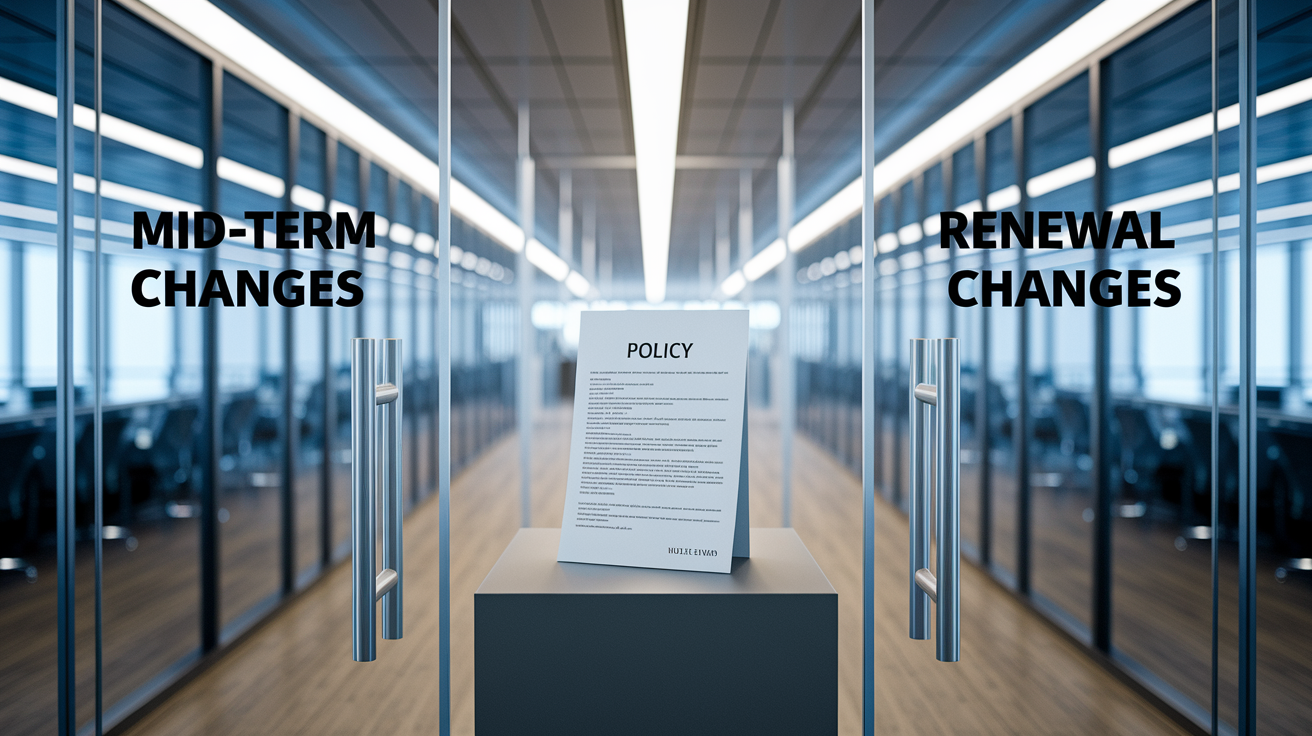
Most policy modifications happen at renewal, not partway through the policy term. Renewal is the natural breakpoint when both parties can renegotiate or walk away. The insurer sends a renewal offer with new terms, and you decide whether to accept by paying the renewal premium. If you do nothing or pay, the new contract begins. If you cancel or switch, the old policy expires and no new coverage starts with that insurer.
Mid term changes are less common and usually need a specific trigger. Nonpayment is the classic example. Miss a premium due date, and the insurer can cancel coverage with short notice, often 10 to 15 days. Discovery of fraud or material misrepresentation allows immediate or very short notice cancellation. Some policies include endorsement request provisions that let you add or remove coverage mid term by mutual agreement, but the insurer can’t unilaterally impose a mid term change without contractual authority or a statutory exception. If the insurer tries to raise your premium or add an exclusion halfway through the year without your consent and without a triggering event, that change is probably invalid.
The difference matters because your options and timelines shift. At renewal, you’ve got time to shop for alternatives before the old policy expires. Mid term, you might face an urgent coverage gap if the insurer cancels without enough lead time for you to lock in a replacement. Renewal changes are also easier to challenge. You can simply refuse to renew and move on. Mid term changes that violate notice rules or lack contractual authority are usually unenforceable, but proving the violation and getting the insurer to back down often means filing a complaint or hiring counsel.
How to Review, Compare, and Understand Amended Insurance Policy Terms

Start by placing the old policy and the new notice side by side. Go line by line through the declarations page, the coverage sections, the exclusions, and the conditions. Mark every difference: premium amounts, deductibles, limits, covered perils, excluded losses, and procedural requirements like proof of loss deadlines or mandatory appraisals. Pay special attention to dollar figures and percentage caps. A shift from “unlimited” to “capped at 60% of earnings” is a major cut in protection, even if the premium stays flat.
Note the effective date and any explanation the insurer provided. If the notice cites “increased claims activity” or “regulatory changes,” verify the claim by checking recent news, your state insurance department’s bulletins, or industry reports. If the insurer offers no reason, request a written explanation. Insist on written communication so you’ve got a paper trail. Preserve every version of your policy, every notice, every email, every letter. Note the dates and content of phone calls, including the representative’s name and ID number.
Review checklist:
Obtain both the current policy and the amended version in full, not just the summary or declaration page.
Compare premium, deductible, coverage limits, exclusions, and conditions section by section.
Identify the effective date and confirm it complies with your state’s minimum notice period.
Request and save a written explanation for each change, especially premium increases or new exclusions.
Document all communications with date, time, method (phone, email, mail), and the insurer representative’s details.
Organize a file with the original policy, the notice, the amended policy, claim history, payment records, and correspondence for quick reference during disputes or regulatory complaints.
Options If You Disagree With the Insurance Policy Changes

If the new terms are unacceptable (premium too high, coverage too thin, exclusions too broad), you’ve got several paths forward. First, try negotiating. Call or write the insurer and ask for alternatives: a different deductible that lowers the premium, restoration of a removed benefit, or a phase in period for the increase. Insurers sometimes offer tiered plans or optional endorsements that can bridge the gap. If negotiation fails, consider canceling before the renewal effective date and switching to another insurer. Compare quotes from at least three carriers, ideally through an independent broker who can show you options across multiple companies.
If you believe the change violates state law or the policy contract, file a complaint with your state insurance department or commissioner. Explain the issue clearly: improper notice, retroactive exclusions, unauthorized mid term changes, or failure to justify a rate hike. Attach copies of the old policy, the notice, and any correspondence. The regulator will investigate and may order the insurer to correct the problem, refund premiums, or honor the prior terms. Regulatory complaints are free and often resolve issues faster than litigation.
If the stakes are high or the insurer refuses to comply, seek legal guidance. An insurance attorney can review the contract, state statutes, and case law to determine whether the insurer breached its obligations or acted in bad faith. Legal remedies may include:
- Injunction to block enforcement of the new terms until a court resolves the dispute.
- Declaratory judgment confirming that the old terms remain in effect due to improper notice.
- Breach of contract damages if you suffered financial harm by relying on the original policy.
- Bad faith damages if the insurer knowingly imposed unlawful changes, denied valid claims, or failed to investigate your objections.
- Attorney fees and costs in states that award them to prevailing policyholders in insurance disputes.
When Legal Action May Be Appropriate
Legal action makes sense when the financial exposure is large, the insurer’s conduct is clearly wrongful, and informal remedies have failed. Examples? A homeowner facing foreclosure because the insurer canceled coverage mid term without proper notice, leaving the property uninsurable and the mortgage in default. Or a business that lost income protection benefits due to a retroactive exclusion the insurer added after the claim event. Breach of contract claims require proof that the insurer violated the policy’s plain language or failed to meet statutory notice requirements. Bad faith claims require evidence that the insurer knew or should have known its actions were improper, acted with deliberate indifference to your rights, or imposed unreasonable delays and denials to pressure you into accepting unfavorable terms.
Statutory protections vary by state but often include prohibitions on unfair claim practices, mandatory notice periods, and disclosure rules. An attorney can identify which laws apply and whether the insurer’s conduct triggers penalties beyond simple contract damages. Litigation is slow and expensive, so it’s usually the last resort. But the threat of a well founded lawsuit can prompt settlement negotiations or regulatory enforcement that resolves the dispute without trial.
Effects on Claims: Pending, Active, and Future Claims Under Changed Terms

A pending claim (one filed before the effective date of the term change) is generally governed by the old policy. If you submitted a claim for a covered loss on June 1 and the insurer amended the policy to exclude that loss category effective July 1, the insurer must still process your June 1 claim under the original terms. Retroactive application of exclusions or limits is typically unlawful and can trigger bad faith liability. The insurer can’t rewrite history to avoid paying a claim that was covered when the loss occurred.
Active claims in process are likewise protected. If the claim is open, the adjuster is investigating, and payments are ongoing, the new terms don’t apply unless the policy explicitly allows mid claim amendments (rare and often unenforceable). Future claims for losses that occur after the effective date of the change are subject to the new terms. If the amended policy excludes mold and you discover mold damage three months later, that claim will be denied under the new exclusion, even if the old policy would have covered it.
| Claim Scenario | Effect of Term Change |
|---|---|
| Claim filed before effective date of change | Processed under original policy terms; new exclusions or limits don’t apply retroactively. |
| Claim filed after effective date, loss occurred before | Usually covered under old terms if loss date predates change; confirm with policy language and state law. |
| Claim filed and loss both after effective date | Governed by amended terms; new exclusions, limits, and conditions fully apply. |
| Active claim with ongoing payments | Payments continue under original terms; mid claim amendments are typically unenforceable. |
| Claim denied, appeal pending when change takes effect | Appeal evaluated under terms in force at time of loss, not at time of appeal decision. |
Documentation is critical. Save copies of claim forms, adjuster reports, correspondence, and payment records. Note the date of loss, date of first notice to the insurer, and the effective date of any term changes. If the insurer tries to apply new exclusions or limits to an old claim, respond in writing with proof that the loss predated the change. Cite the policy’s effective date language and any applicable state statutes. If the insurer persists, file a complaint with your regulator and consult an attorney.
Why Insurers Change Policy Terms: Underwriting, Risk, and Regulatory Drivers

Insurers adjust terms when their loss experience, cost structure, or regulatory environment shifts. A surge in claims is the most straightforward trigger. If an insurer writes short term income protection and unemployment claims spike during a recession, the company may raise premiums, add deferment periods, or cap benefits to stop losses. Similarly, a homeowner insurer that faces repeated mold or water damage claims in a region may add exclusions for those perils to reduce future exposure.
Regulatory mandates force changes even when the insurer’s risk profile is stable. New state laws may require insurers to cover certain treatments, add consumer protections, or revise notice procedures. When Florida passed section 627.43141 in 2011, insurers had to adopt the formal “Notice of Change in Policy Terms” and adjust their renewal processes. Model laws from organizations like the National Association of Insurance Commissioners can prompt multi state revisions when individual states adopt the recommendations. Reinsurance costs also matter. If the insurer’s reinsurer raises rates or tightens terms, the primary insurer may pass those costs and restrictions onto policyholders through higher premiums, new exclusions, or reduced limits.
Internal underwriting changes reflect evolving risk classifications. Advances in data analytics, credit scoring, and telematics allow insurers to segment policyholders more precisely. A driver who was once in a broad “good driver” class might be recategorized into a higher risk tier based on new information, triggering a rate increase. A homeowner in a zip code newly classified as high wildfire risk may see exclusions or non renewal. These changes are legal if they follow actuarial standards and comply with state anti discrimination laws, but they can feel arbitrary to policyholders who haven’t filed claims or changed their circumstances.
Examples of Policy Changes Across Auto, Health, and Homeowners Insurance

Auto insurers commonly reduce or eliminate rental reimbursement coverage, raise collision and comprehensive deductibles, or add exclusions for specific drivers or uses. One insurer might remove rental coverage entirely, forcing you to pay out of pocket for a rental car after an accident. Another might increase your collision deductible from $500 to $1,000, doubling your upfront cost if you hit another vehicle. Some policies now exclude coverage when the vehicle is used for rideshare or delivery services unless you purchase a commercial endorsement.
Health plans frequently change provider networks, add prior authorization requirements, or impose new benefit limits. A plan that once allowed specialist visits without referral might require primary care approval first, delaying care. A drug that was previously covered without restrictions might now require step therapy (trying cheaper alternatives before the insurer pays for the preferred medication). Annual or lifetime caps on certain treatments, though limited by federal law for essential benefits, can still appear in supplemental or short term plans.
Homeowners insurers add exclusions for flood, mold, sinkhole, earthquake, or wind/hail damage in high risk areas. They raise deductibles for specific perils, such as a separate percentage deductible for hurricane damage, that can reach 5% or 10% of the dwelling’s insured value. Some insurers lower coverage limits for detached structures, personal property, or additional living expenses, leaving you underinsured if your home becomes uninhabitable after a loss.
Examples include:
Auto: removal of rental reimbursement. You now pay $40 per day for a rental car after an accident, a cost that can exceed $1,000 over a month long repair.
Auto: collision deductible increase. Your out of pocket jumps from $500 to $1,000, adding $500 to every at fault accident or comprehensive claim.
Health: new prior authorization rule. Your insurer now requires approval before covering an MRI, delaying diagnosis and treatment by days or weeks.
Health: network change. Your longtime specialist is dropped from the network; continuing care means paying out of network rates that triple your cost sharing.
Homeowners: mold exclusion added. Mold damage from a slow leak is no longer covered; remediation costs of $10,000 to $50,000 are entirely your responsibility.
Homeowners: wind/hail deductible raised to 5% of dwelling value. On a $300,000 home, you now pay the first $15,000 of storm damage before insurance covers a cent.
When to Seek Professional Help: Advisors, Regulators, and Attorneys

Brokers and independent agents can help you understand term changes and shop for better alternatives. When one insurer raised premiums 55% and cut benefits mid term on short term income protection policies, brokers contacted affected customers in advance, explained the changes, and sourced competitive quotes from other carriers. Some policyholders canceled; others switched to policies with better terms at similar or lower cost. Brokers earn commissions from insurers, but independent brokers represent multiple companies and can show you options your current insurer doesn’t offer.
State insurance regulators enforce compliance with notice rules, rate filings, and consumer protection laws. If your insurer fails to provide proper notice, applies terms retroactively, or refuses to explain a rate increase, file a complaint with your state’s insurance department or commissioner. Include all documentation: the old policy, the notice, correspondence, and a clear summary of the issue. Regulators investigate complaints, order corrective action, and track patterns of misconduct. They publish consumer guides and bulletins that explain your rights and the insurer’s obligations, often available on the department’s website.
Attorneys are necessary when the dispute involves significant money, complex legal questions, or insurer bad faith. An insurance lawyer can review the contract, assess whether the insurer violated state statutes or the policy’s plain language, and advise on litigation strategy. Consumer protection statutes in many states award attorney fees to prevailing policyholders, making it financially feasible to challenge wrongful denials or unlawful term changes. If the insurer’s conduct is egregious (deliberate misrepresentation, refusal to investigate, or retaliatory cancellation after a complaint), bad faith damages can exceed the underlying policy limits, providing a strong incentive for the insurer to settle.
Final Words
You get a notice — new terms usually land at renewal. Read the change, note the effective date, and watch the deadline to accept or reject.
If the notice is improper, the old language may still apply. Compare old and new line by line, check premiums, limits, and claims effects. Decide: negotiate, switch, or file a complaint.
Bottom line: what happens when insurance company changes policy terms is usually predictable — notice, an effective date, and clear options. Act fast, keep records, and you’ll avoid most surprises.
FAQ
Q: Which insurance company has the most complaints?
A: The insurance company with the most complaints varies by year, state, and line of business; use the NAIC complaint index or your state insurance department to compare complaint rates and volumes.
Q: What is the 90 day rule for insurance?
A: The 90 day rule for insurance refers to a common waiting or probation period before coverage or specific benefits begin; exact application depends on policy type and state—check your policy or ask the insurer.
Q: What’s the biggest mistake people often make when dealing with an insurance claim?
A: The biggest mistake people often make when dealing with an insurance claim is assuming coverage without reading the policy; common errors are poor documentation, missed deadlines, and accepting quick lowball offers.
Q: How much does a $1,000,000 term life insurance policy cost?
A: A $1,000,000 term life insurance policy costs roughly $20–$300 per month depending on age, health, smoking status, and term length (e.g., $30–$50/month for a healthy 35‑year‑old non‑smoker, 20‑year term).