




Think that cheap policy will protect you?
It might leave you paying tens of thousands after a serious crash.
Auto insurance is a contract: you pay premiums and the insurer covers specific losses up to written limits.
This guide walks you through the main coverages — liability, collision, comprehensive — how deductibles and limits change what you actually pay, how claims play out, common gotchas, and the three checks to do before you sign so a claim doesn’t become a financial disaster.
Understanding the Basics of Auto Insurance

Auto insurance is a deal where you pay premiums every month (or every six months) and the insurer agrees to cover certain costs if you crash, your car gets damaged, or you hurt someone else while driving. The company takes on the financial risk of expensive repairs, hospital bills, and lawsuits, up to whatever limits are written in your policy.
Every state except New Hampshire requires you to carry at least some liability coverage. That’s because an at-fault driver can rack up tens or hundreds of thousands of dollars in damage from one serious crash. Without insurance, most people would be financially destroyed trying to pay those costs themselves. Beyond just meeting legal requirements, good coverage protects your own car, your medical bills, and your assets if someone decides to sue you.
Auto insurance policies are built from several different types of coverage. Each one protects against a specific risk. You pick the combination and limits that match what the law requires, what your car is worth, and how much financial exposure you’re willing to accept.
The core coverage types most drivers run into are:
Liability coverage pays for injury and property damage you cause to others when you’re at fault.
Collision coverage pays to fix or replace your vehicle after a crash, no matter who caused it.
Comprehensive coverage handles damage to your car from things that aren’t collisions, like theft, fire, vandalism, or bad weather.
Liability Coverage Explained

Liability coverage is the foundation of almost every auto policy. It pays for injuries and property damage you cause to other people when you’re legally responsible for an accident. This coverage splits into two parts: bodily injury liability and property damage liability. Bodily injury covers other people’s medical bills, lost wages, pain and suffering, and legal costs if they sue you. Property damage pays to fix or replace vehicles, fences, buildings, or whatever else you destroy in a crash.
State minimum liability limits are all over the map, but they’re usually written in a three number format like 25/50/25. That means $25,000 max paid to any one injured person, $50,000 max paid total per accident for all injuries, and $25,000 max for property damage. If you cause a crash that injures three people with $40,000 in combined medical costs and totals a $35,000 car, your 25/50/25 policy would pay $40,000 for the injuries (under the per-accident limit) but only $25,000 toward the car. You’d be personally on the hook for the remaining $10,000 in property damage.
Here’s how it can go wrong. You run a red light and T-bone another car. The driver breaks a leg and suffers neck injuries totaling $60,000 in medical bills. Your bodily injury limit is $25,000 per person. Your insurer pays $25,000, and you’re personally liable for the other $35,000. The injured driver can sue you for that difference, and a judgment can attach to your wages, bank accounts, and assets.
Collision Coverage Overview
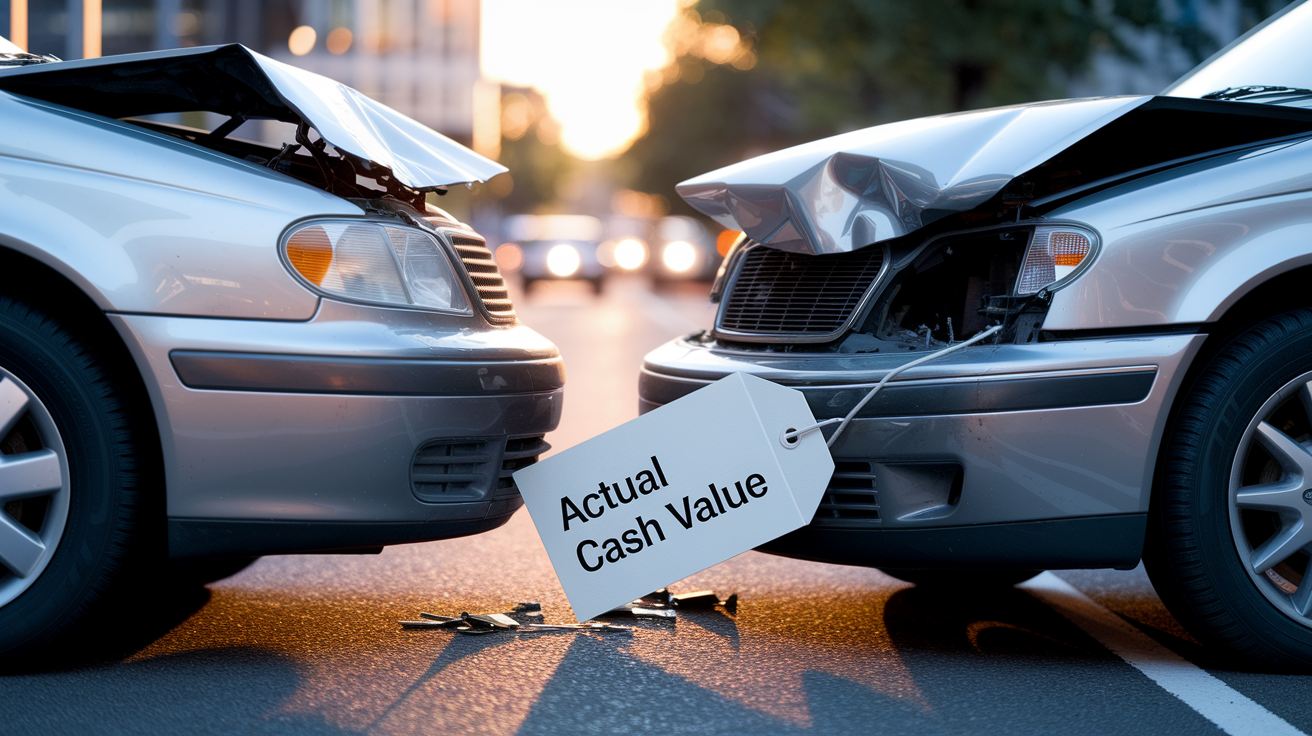
Collision coverage pays to fix or replace your vehicle when it’s damaged in a crash with another vehicle or object, no matter who caused it. If you rear-end someone, sideswipe a parked car, or get hit by an uninsured driver, collision coverage kicks in after you pay your deductible. Lenders and leasing companies almost always require this coverage because they need to protect the asset that secures your loan.
Unlike liability, collision protects your car, not someone else’s property. The insurer will pay up to the actual cash value of your vehicle minus your deductible. If your car is totaled (meaning repair costs exceed its depreciated value), the insurer pays the cash value, not what you originally paid or what you still owe on a loan.
Common situations where collision applies:
Hitting another vehicle in stop-and-go traffic. Striking a guardrail, pole, or tree after losing control. Getting hit by another driver, even if they’re at fault and you choose to file with your own insurer for faster service.
Comprehensive Coverage Overview

Comprehensive coverage handles damage to your vehicle from events other than collisions. It protects you when your car is stolen, vandalized, burned, flooded, or damaged by hail, falling branches, or hitting an animal. Comprehensive is sometimes called “other than collision” coverage, and it covers risks you can’t control through safe driving.
Like collision, comprehensive coverage comes with a deductible. If a deer runs into your car and causes $3,000 in damage and your deductible is $500, the insurer pays $2,500. Comprehensive claims usually have less impact on your future rates than at-fault collision claims because they don’t reflect risky driving behavior.
Typical comprehensive claims include theft of the vehicle or parts (catalytic converters, wheels), fire or explosion damage, vandalism like broken windows or keyed paint, and weather damage from hail, flood, or falling trees.
How Deductibles Work

A deductible is the dollar amount you pay out of pocket before your insurer pays anything on a covered claim. Deductibles apply to collision and comprehensive coverage, not to liability. When you file a claim, the insurer subtracts the deductible from the repair cost or payout and sends you the difference.
Choosing your deductible is a trade-off between monthly cost and upfront risk. If you pick a $250 deductible, your premium will be higher, but you’ll only pay $250 if you need repairs. If you choose a $1,000 deductible, your premium drops (sometimes by 10% to 25% depending on your profile and insurer), but you’ll owe $1,000 before insurance pays anything. Over time, the premium savings from a higher deductible can add up, but only if you can afford to cover that $1,000 right after a crash.
Pick a deductible you can pay in cash tomorrow without hardship. If a $1,000 surprise expense would force you to skip rent or max out a credit card, choose a lower deductible even though the premium’s higher. If you’ve got a solid emergency fund, a higher deductible lets you pocket the premium difference every month and self-insure smaller repairs.
Filing an Auto Insurance Claim

Filing a claim puts the insurer’s promise to the test. The process follows a standard sequence, though timelines and specific steps vary by company.
Report the incident promptly. Call your insurer’s claims line or file online as soon as it’s safe. Provide the basics: date, time, location, what happened, and whether anyone was injured. You’ll get a claim number.
Gather and submit documentation. Take photos of all vehicle damage, the accident scene, license plates, and any visible injuries. Collect the police report number, witness names and contact info, and the other driver’s insurance details. Submit everything to your adjuster.
Work with the adjuster. The insurer assigns an adjuster to inspect your vehicle, review repair estimates, and figure out what’s covered under your policy. The adjuster may ask follow-up questions or request more documentation.
Get repair estimates or a payout offer. For repairable damage, the insurer approves a repair shop or issues a check for the estimate minus your deductible. For a total loss, the insurer offers the vehicle’s actual cash value minus the deductible.
Accept the settlement or negotiate. Review the payout carefully. If you think the estimate’s too low or the total loss valuation is unfair, provide comparable vehicle listings or independent appraisals to support a higher amount.
Receive payment and complete repairs. Once you accept the settlement, the insurer issues payment directly to you or the repair shop. Minor claims may settle in days. Complex liability disputes can drag on for weeks or months.
For example, you back into a pole in a parking lot, causing $2,800 in damage. You file a claim the same day, submit photos within 24 hours, and the adjuster inspects your car two days later. The insurer approves the repair estimate and issues a check for $2,300 ($2,800 minus your $500 deductible) within a week. The shop fixes your car, and the claim closes.
Understanding Coverage Limits

Coverage limits define the maximum dollar amount your insurer will pay for a covered loss. Limits apply to liability coverage and sometimes to medical payments or uninsured motorist coverage. They don’t cap what you pay for collision or comprehensive. Those coverages pay up to your vehicle’s actual cash value minus the deductible.
Liability limits are usually expressed as split limits: three numbers separated by slashes. The first number is the per-person bodily injury limit, the second is the per-accident bodily injury limit, and the third is the per-accident property damage limit. If your policy reads 50/100/50, your insurer will pay up to $50,000 for any one person’s injuries, up to $100,000 total for all injuries in a single accident, and up to $50,000 for property damage.
When your limits are too low, you become personally responsible for the excess. If you cause an accident that injures two people with $75,000 each in medical bills and your per-person limit is $50,000, your insurer pays $50,000 to each victim and you owe $25,000 to each out of pocket. That’s $50,000 total that can be recovered through lawsuits, wage garnishment, or liens on your assets.
| Limit Type | Description |
|---|---|
| Per-Person Bodily Injury | Maximum paid to any one injured person in an accident |
| Per-Accident Bodily Injury | Maximum paid in total for all injuries in a single accident |
| Per-Accident Property Damage | Maximum paid for damage to vehicles, buildings, or other property in one accident |
Factors That Affect Premiums

Insurers calculate your premium by estimating how likely you are to file a claim and how expensive that claim might be. Every applicant gets scored using dozens of data points, and small differences in risk profile can swing your rate by hundreds of dollars per year.
Your driving record is the single largest factor. At-fault accidents, speeding tickets, DUIs, and other violations signal higher risk. A single at-fault accident can raise your premium 20% to 50%. A DUI can double or triple it. Insurers typically look back three to five years, so older incidents eventually roll off your record.
Age and experience matter because statistics show that young, inexperienced drivers crash more often. Drivers under 25 (especially teens) pay significantly higher premiums, sometimes 50% to 100% more than middle-aged drivers with clean records. Rates usually drop as you gain years of claim-free driving.
Your vehicle’s make, model, year, and safety features directly affect cost. Expensive cars cost more to repair or replace, so collision and comprehensive premiums rise. High-theft models increase comprehensive risk. Vehicles with strong crash-test ratings, anti-lock brakes, and anti-theft systems often qualify for discounts.
Where you live and how much you drive also shape your rate. Urban ZIP codes with heavy traffic, high theft rates, or frequent accidents cost more to insure than rural areas. Drivers who commute 30 miles each way face higher risk than those who drive 5,000 miles per year.
In most states, insurers also consider your credit history or insurance score. Statistically, people with lower credit scores file more claims, so insurers charge higher premiums. This practice is controversial, but it’s still legal in most places.
Key premium factors include your driving history (accidents, tickets, and violations in the past three to five years), age and experience (younger and newly licensed drivers pay more), vehicle type (cost to repair, theft rates, and safety features), location and mileage (urban vs rural, annual miles driven), and credit or insurance score (used in most states to predict claim likelihood).
Final Words
You now have the quick map: what auto insurance covers, how liability differs from collision and comprehensive, how deductibles and limits change your bill, and how claims play out.
Watch the fine print: low limits, high deductibles, lender requirements, and exclusions are where people get burned.
If you’re still wondering how does auto insurance coverage work, do three things: confirm limits match your risk, pick a deductible you can afford, and get written answers about repairs and rentals. Do that and you’ll be ready.
FAQ
Q: What does $100 k /$ 300k /$ 100k mean?
A: The $100k/$300k/$100k means liability limits — $100,000 per injured person, $300,000 per accident for bodily injury, and $100,000 for property damage, capping what the insurer pays.
Q: Can I drive my boyfriend’s car if I’m not on his insurance?
A: You can usually drive your boyfriend’s car if you’re not listed because the owner’s policy covers permissive drivers first, but check for exclusions, named-driver rules, and secondary coverage limits.
Q: Is it better to have a $500 deductible or $1000?
A: Choosing a $500 versus $1,000 deductible depends on your cash and claim risk: $500 raises premiums but lowers out-of-pocket at a claim; pick $1,000 only if you can afford that cost.
Q: Do I really need comprehensive and collision?
A: Whether you need comprehensive and collision depends on your car and loan: lenders often require them for financed or leased vehicles; otherwise keep them if repair or theft risk justifies the premium.