





Think “full coverage” means your insurer will always pay? Think again.
Exclusions—those tiny, buried lines in your policy—can turn a claim into a bill you must pay yourself.
In this post I walk through the exclusions that most often lead to denied claims: DUI and illegal acts, business or rideshare use, unlisted drivers, wear and tear, and custom parts.
You’ll learn who is most at risk, the common gotchas insurers hide in the fine print, and three checks to do before you sign or renew.
Understanding Key Auto Insurance Policy Exclusions
An exclusion is a specific situation, event, or condition written into your auto insurance contract that the insurer won’t cover. While a coverage limit caps how much the company will pay on a covered claim, an exclusion means the claim won’t be paid at all. Even if you carry full coverage and pay your premium on time.
Exclusions appear in the policy’s Definitions, Exclusions, Conditions, and Endorsements sections, and they vary widely by state, carrier, and the type of coverage you buy.
Insurers use exclusions to manage risk, control costs, and prevent moral hazard. Covering intentional damage or business use under a personal policy would expose carriers to open‑ended liability and fraud, driving up premiums for everyone. The source material for this guide draws from a dataset of more than 83 million insurance rates and was updated as recently as January 14, 2026.
The most frequently encountered exclusions fall into a few predictable categories:
Intentional acts and illegal activity. Deliberate damage, filing false claims, or using your car to commit a crime voids coverage and can trigger criminal liability.
DUI and drug‑related incidents. Accidents while under the influence of alcohol or drugs are almost universally excluded and can result in policy cancellation.
Wear and tear and mechanical failure. Engine breakdowns, transmission failures, brake wear, rust, and tire wear are maintenance issues, not insured perils.
Unlisted or excluded drivers. Letting household members or high‑risk drivers operate your car without listing them can lead to outright claim denial.
Business, delivery, and rideshare use. Personal policies exclude for‑hire driving, deliveries, and transporting passengers for a fee unless you add a commercial or rideshare endorsement.
Racing, stunts, and high‑performance use. Track days, speed contests, and organized racing are considered too risky for standard auto coverage.
Liability Insurance Exclusions That Limit Third‑Party Protection

Liability coverage pays for bodily injury and property damage you cause to others, but it comes with a set of hard exclusions that can leave you fully exposed.
Intentional acts are the clearest example. Deliberately driving into a storefront to cause damage voids the policy, leaving you responsible for medical bills, property repairs, and any criminal penalties. Punitive damages awarded by a jury are also excluded under many liability policies. If a DUI crash results in $50,000 in compensatory damages (which the policy may cover up to your liability limit) plus a $20,000 punitive award, the punitive portion is your out‑of‑pocket responsibility.
Named‑driver exclusions and family‑member clauses further restrict liability protection. A named‑driver exclusion lets you remove a specific person (often a high‑risk household member) from coverage entirely, so any accident involving that driver triggers a denial. Family‑member exclusion clauses, allowed in some states, prevent passengers who are relatives from collecting on the driver’s liability policy. It’s a measure designed to prevent fraud.
Uninsured and underinsured motorist coverage can also carry exclusions. If the at‑fault driver was operating a vehicle without the owner’s permission or engaged in business use, your UM/UIM claim may be denied depending on state law and policy language.
| Exclusion Type | What’s Not Covered |
|---|---|
| Intentional acts | Deliberate collisions, fraud, or damage caused on purpose |
| Punitive damages | Jury awards for recklessness or gross negligence |
| Named‑driver exclusion | Accidents involving a specifically excluded household member |
Medical Payments (MedPay) and PIP Exclusions Drivers Often Miss
MedPay and personal injury protection (PIP) cover medical expenses and, in some states, lost wages for you and your passengers. But only in situations the policy defines as personal use.
Business use, racing, stunts, and driving without the owner’s permission all void MedPay. If you’re injured while using your vehicle as a residence (sleeping in it full‑time, for example), many policies exclude those injuries as well.
Worker’s compensation creates another common overlap. If you’re injured while performing a work task in your own vehicle, your employer’s worker’s comp policy is expected to cover the claim, so your auto MedPay will deny it. This becomes a problem when the lines blur. Delivering pizzas on the weekend for extra cash can fall into a gray zone where neither policy pays unless you carry a delivery endorsement or commercial coverage.
The five main MedPay and PIP exclusions to watch for are:
Injuries sustained while driving for business, delivery, or rideshare work.
Injuries during racing, stunts, or speed contests.
Injuries when operating a vehicle without the owner’s permission.
Injuries tied to using the vehicle as a residence.
Injuries already covered under worker’s compensation laws.
Collision and Comprehensive Exclusions for Vehicle Damage

Collision coverage pays to repair your car after it hits another vehicle or object, but it won’t pay for normal wear‑and‑tear, tire wear, mechanical breakdowns, or intentional damage. If your transmission fails because you never changed the fluid, that’s not a collision. It’s neglect.
Comprehensive covers non‑collision perils such as theft, vandalism, fire, and hail, yet it too has boundaries. Earthquakes and sinkholes are often excluded unless you buy supplemental coverage, and personal belongings inside the car aren’t covered by your auto policy at all. Those fall under renters or homeowners insurance.
Repossession and government seizure are also excluded. If your lender repossesses your vehicle or law enforcement confiscates it during an investigation, the insurer won’t compensate you for the loss. Catastrophic events such as nuclear accidents, war, and civil unrest are universally excluded, and some policies add terrorism exclusions depending on the carrier and state.
Aftermarket parts and custom modifications present another trap. Unless you declare the equipment and pay for a custom‑parts endorsement, the insurer will only reimburse factory‑installed equipment. A $3,000 custom stereo stolen during a break‑in may net you a $200 payout for the factory radio.
Common vehicle‑damage exclusions include:
Wear and tear, rust, corrosion, and deterioration.
Tire wear and routine maintenance failures.
Mechanical or electrical breakdown not caused by a covered peril.
Non‑permanent electronics and personal property.
Damage during prearranged racing or speed contests.
Repossession, government seizure, or confiscation.
Aftermarket and custom parts not listed on the policy.
Exclusions for Business, Delivery, and Rideshare Driving
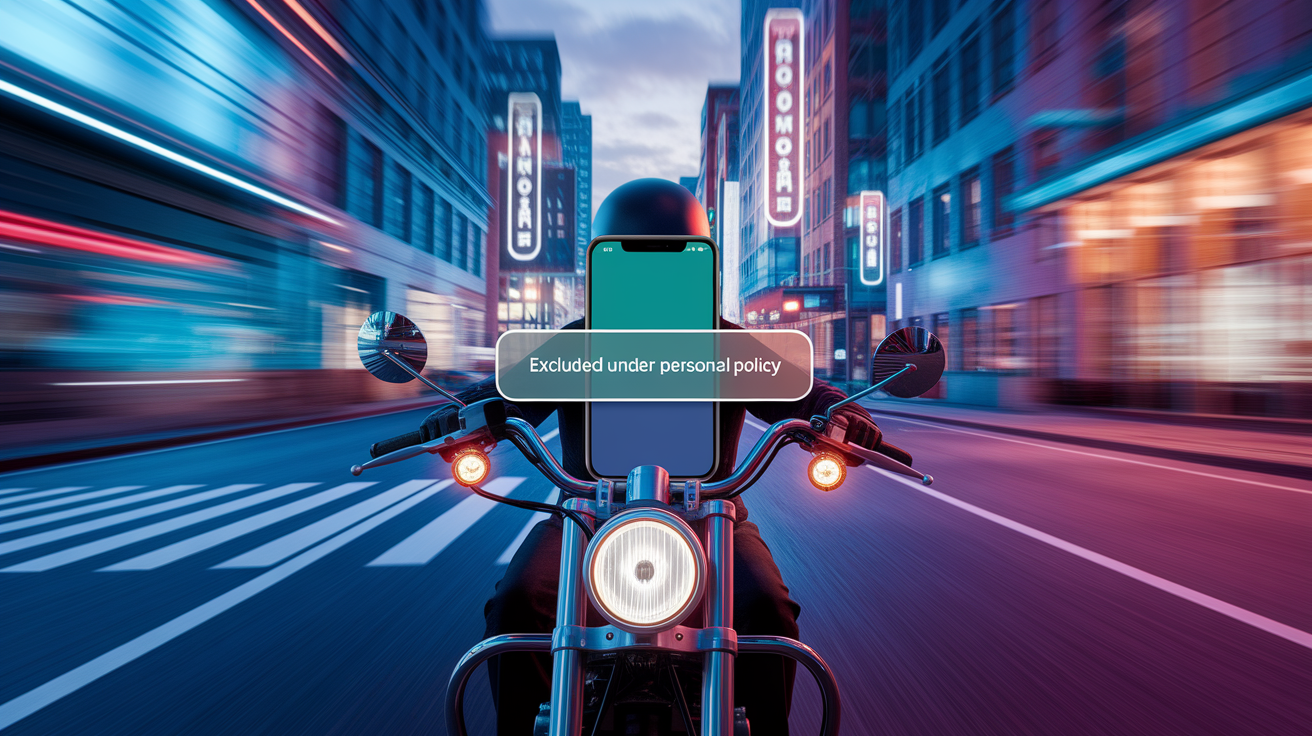
Personal auto policies are priced and underwritten for commuting, errands, and leisure. Not for work.
The moment you accept an order on DoorDash, turn on the Uber app, or haul tools to a job site, you cross into business use, and most personal policies exclude those trips entirely. The weekend pizza delivery driver who gets into an accident while carrying an order will face a claim denial unless the employer provides commercial coverage or the driver buys a delivery endorsement.
Rideshare presents a patchwork of gaps. Platform liability (Uber’s or Lyft’s insurance) may cover certain phases of a trip, but the periods when the app is on and you’re waiting for a ping often fall into a coverage void. Without a rideshare endorsement or a commercial policy designed for drivers, you can be left paying out of pocket for injuries and vehicle damage during those in‑between moments.
| Use Type | Coverage Status | Required Add‑On |
|---|---|---|
| Delivery (DoorDash, Uber Eats, Amazon Flex) | Excluded under personal policy | Commercial auto or delivery endorsement |
| Rideshare (Uber, Lyft) | Gap between personal and platform coverage | Rideshare endorsement or commercial policy |
| Contractor/tool hauling | Excluded as business use | Commercial auto policy or business‑use rider |
| Commercial fleet scenarios | Excluded entirely from personal policies | Dedicated commercial fleet insurance |
Auto Insurance Exclusions Related to Driver Status and Permissions

A named‑driver exclusion removes a specific person from all coverage under your policy. This is commonly used when a household member has a suspended license, a string of DUIs, or a high‑risk driving record that would otherwise make the policy unaffordable or uninsurable.
If that excluded driver gets behind the wheel and causes an accident, the insurer denies the claim in full. Even if you carry liability, collision, and comprehensive.
Household‑member exclusions work similarly but can apply automatically in some policies if a regular driver living at your address isn’t listed on the declarations page. The unlisted teen driver scenario is a classic denial trigger. Your 17‑year‑old borrows the car, crashes it, and the insurer denies the claim because the teen was a frequent, unlisted operator.
Permission is another bright line. Permissive use (coverage that extends to drivers you allow to borrow your car) has limits. If someone takes your vehicle without your consent, most policies exclude the loss entirely. State law and carrier rules determine how far permissive use stretches, and some insurers require written proof of permission or limit permissive use to named drivers only. High‑risk drivers can also trigger exclusions if they operate the vehicle regularly but were never disclosed during underwriting.
Auto Insurance Exclusions Based on Vehicle Type, Modifications, and Equipment

Standard personal auto policies cover four‑wheeled passenger vehicles used for personal transportation. Vehicles with fewer than four wheels (motorcycles, three‑wheelers, ATVs) require separate policies. Racing vehicles, even if street‑legal, are excluded the moment they’re used in a competitive or timed event. Off‑road vehicles and dune buggies fall outside the scope of most personal policies, and many carriers won’t offer collision or comprehensive coverage on salvaged or rebuilt titles.
Aftermarket modifications void coverage if you don’t declare them. A turbocharger, custom exhaust, upgraded wheels, lifted suspension, or enhanced lighting system all represent added value the insurer hasn’t priced into your premium. When damage occurs, the insurer reimburses only the factory‑installed equipment unless you bought a custom‑parts endorsement and provided receipts or an appraisal.
This is where people get burned. Installing $5,000 in aftermarket parts and receiving a settlement check that ignores every upgrade.
Common vehicle‑type and modification exclusions are:
Motorcycles, ATVs, and vehicles with fewer than four wheels.
Racing vehicles or cars used in competitive speed events.
Off‑road and recreational vehicles.
Salvaged or rebuilt title vehicles (collision/comprehensive often unavailable).
Unreported aftermarket exhaust, turbo, wheels, paint, or suspension upgrades.
Custom stereo, navigation, and lighting systems without a declared‑value endorsement.
Catastrophic and Extraordinary Peril Exclusions

War, nuclear radiation, contamination, and government seizure sit at the outer edge of auto insurance exclusions. These perils are considered uninsurable under personal policies because the losses would be systemic, unpredictable, and potentially unlimited.
Comprehensive coverage, which protects against many non‑collision risks, draws the line at war and nuclear events. Civil unrest and terrorism exclusions vary by carrier. Some policies explicitly exclude riots and acts of terrorism, while others remain silent or provide limited coverage.
Natural‑disaster exclusions also appear in comprehensive policies, though less uniformly. Earthquakes and sinkholes are often excluded unless you purchase a supplemental endorsement, particularly in high‑risk regions. Floods, on the other hand, are usually covered under comprehensive, but state and carrier differences mean you should confirm rather than assume.
Government confiscation (whether through civil asset forfeiture, impoundment during a criminal investigation, or other legal seizure) is universally excluded, leaving the insured responsible for retrieval fees and any unrecovered value.
How to Identify Exclusions in Your Auto Insurance Policy

Exclusions aren’t hidden. They’re listed explicitly in your policy documents. But most drivers never read past the declarations page.
To find them, start with the Definitions section, which explains terms such as “insured,” “occurrence,” “business use,” and “permissive use.” Then turn to the Exclusions section, usually a numbered or bulleted list that names every situation the policy won’t cover.
The Declarations page shows which vehicles and drivers are covered, what coverage types you purchased, your limits, and any endorsements or riders. If a vehicle you own isn’t listed there, collision and possibly liability for that vehicle are excluded.
The Conditions section outlines your duties after a loss, notice requirements, and cancellation terms. Endorsements modify the base policy (adding or removing coverage, adjusting exclusions, or changing limits) so read every attached endorsement carefully.
State law also shapes exclusions. Some states prohibit family‑member exclusion clauses, while others allow them. Territorial limits, permissive‑use rules, and UM/UIM definitions vary by jurisdiction, so confirm your state’s rules before assuming the exclusions match what you’ve read elsewhere.
| Section Name | What to Look For |
|---|---|
| Declarations page | Listed vehicles, named drivers, coverage types, limits, endorsements |
| Definitions | Meaning of “insured,” “occurrence,” “business use,” “permissive use” |
| Exclusions | Numbered list of specific situations not covered |
| Endorsements | Modifications that add, remove, or adjust coverage and exclusions |
| Conditions | Duties after loss, notice deadlines, cancellation terms |
Reasons Claims Are Denied Due to Exclusions

Late filing is one of the simplest denial triggers. Most policies require you to report accidents within a specific window (often 24 to 72 hours) and failing to meet that deadline can void the claim entirely, even if the loss is otherwise covered.
Exceeding policy limits isn’t technically an exclusion, but it produces the same result. The insurer pays up to the limit and you cover the difference out of pocket.
Unpaid premiums lead to policy lapses, and a lapse means no coverage at all. If your payment is three days late and you’re in an accident, the claim will be denied and you may face criminal penalties for driving uninsured.
The owned‑but‑unlisted vehicle scenario is a frequent denial. Bill owns a 2002 Volvo and a 2010 Prius, insures only the Volvo, then crashes the Prius while driving to work. Both vehicles may be excluded from the claim because the Prius was never listed on the declarations page.
Common denial reasons tied to exclusions include:
Filing the claim after the policy’s notice deadline expired.
Policy lapse due to missed or late premium payments.
Damage or liability exceeding the policy’s stated limits (you pay the overage).
Accident involving an unlisted vehicle you own, or an excluded/unlisted driver.
Add‑Ons, Endorsements, and Solutions to Reduce Exclusion Risks
Exclusions aren’t set in stone. Many can be removed or reduced through endorsements, riders, or a policy upgrade.
A rideshare endorsement covers the gaps between your personal policy and the platform’s liability during app‑on periods, while a commercial auto policy replaces the personal contract entirely and covers all business use, including delivery, courier work, and contractor driving.
Custom‑equipment endorsements let you declare aftermarket parts and lock in an agreed value, so if your upgraded stereo or custom wheels are stolen or damaged, the insurer pays the declared amount rather than the factory‑equipment baseline.
Mechanical breakdown insurance or an extended warranty fills the exclusion for non‑accident mechanical failures. Engine problems, transmission failures, and electrical issues that collision and comprehensive won’t cover.
Gap insurance addresses the exclusion between your vehicle’s actual cash value and what you owe on a loan or lease. If your car is totaled and the insurer pays $18,000 but you owe $22,000, gap insurance covers the $4,000 difference so you’re not stuck paying off a car you no longer own.
Temporary international coverage extends your territorial limits for trips to Mexico or other countries outside the standard U.S.‑and‑Canada zone.
Six key add‑ons and solutions are:
Rideshare or delivery endorsement. Covers business‑use gaps for app‑based drivers.
Commercial auto policy. Replaces personal coverage for full‑time business, contractor, or fleet use.
Custom‑equipment endorsement. Insures declared aftermarket parts and modifications.
Mechanical breakdown insurance. Covers non‑accident mechanical and electrical failures.
Gap insurance. Pays the difference between ACV and loan/lease balance after total loss.
Temporary international coverage. Extends territorial limits for travel outside the U.S. and Canada.
Final Words
You’re flipping through your declarations page and the exclusions section jumps out. This article showed what exclusions are, how they differ from coverage limits, and the common troublemakers: DUI, intentional acts, business use, wear-and-tear, unlisted drivers, and where to find that language.
We explained gaps in liability, MedPay/PIP, collision/comprehensive, rideshare, vehicle mods, and catastrophic perils — and why claims get denied.
If you only do three things: read your declarations, ask your agent about auto insurance policy exclusions that matter to you, and get needed endorsements in writing. Do that and your policy will actually protect you.
FAQ
Q: What are exclusions in car insurance, what are examples of exclusions in an insurance policy, and what is excluded in a personal auto policy?
A: Exclusions in car insurance are policy clauses listing what insurers won’t cover. Common examples: intentional acts, DUI or drug-related crashes, business/rideshare use, wear-and-tear or mechanical breakdowns, unlisted drivers, racing, and personal items.
Q: What not to say to the insurance adjuster?
A: You should avoid telling the adjuster anything that admits fault, guesses what happened, or reveals prior damage. Don’t admit texting or drinking, exaggerate injuries, or sign releases without reading them or getting legal advice.