




Think excluding a risky driver will save money with no downside?
Think again.
An excluded driver is someone on your household policy you’ve officially told your insurer will never drive your car.
If they drive and cause a crash, your insurer can deny every claim.
That can leave you to pay for damages, repairs, and legal bills.
This post breaks down how exclusions work, how much you might really save, the worst-case financial risks, state rule differences, and the key questions to ask before you sign.
Understanding Driver Exclusions in Auto Insurance Policies

An excluded driver is someone in your household you’ve asked your insurer not to cover. The exclusion gets written into a driver exclusion endorsement attached to your policy, usually with the person’s full name, date of birth, and how they’re related to you. Once it’s active, your insurer won’t provide liability, collision, or comprehensive coverage if that person drives your car. Even in an emergency.
This isn’t the same as removing a driver. When you remove someone, they’re typically still covered if they drive with your permission—like a college kid who lives out of state but comes home for the holidays. An excluded driver gets zero coverage. If they get behind the wheel and cause an accident, your insurer can deny the claim and leave you stuck with the full bill for damages, injuries, and legal fees.
Exclusions exist because insurers look at everyone in your household when they set your premium. If someone under your roof has a DUI, multiple crashes, or a suspended license, adding them as a rated driver can double or triple what you pay. Excluding them removes that surcharge. But it also removes every protection if they drive.
Here’s what happens when an excluded driver causes an accident:
- Your insurer denies the liability claim. You’re personally responsible for injury and property damage to others.
- Collision and comprehensive claims get denied too, so your own vehicle damage comes out of pocket.
- Your policy provides no legal defense. You pay for attorneys if someone sues.
- Uninsured motorist coverage may not apply to injuries inside your own car.
- Third parties injured in the accident can still sue you as the vehicle owner. Your home, savings, and wages may be at risk.
Why Drivers Get Excluded From Auto Insurance

Insurers price policies based on the riskiest household driver. If someone in your home carries a recent DUI, several crashes, or a pattern of violations, they trigger higher premiums for everyone on the policy. Exclusions let you opt out of that surcharge by formally promising that person will never drive your insured vehicles.
Common candidates for exclusion include unlicensed adults who no longer drive, elderly relatives with cognitive decline who’ve given up their keys, roommates who own their own cars, and adult children with multiple suspensions. Some families exclude a newly licensed teen while the child is learning on a separate, low-value car under another policy. In all these cases, the exclusion only works if you enforce it. One trip to the store in your vehicle can trigger a denied claim and a lawsuit.
The most common reasons people exclude drivers:
- To avoid adding a household member with a DUI or suspended license.
- To prevent a large premium increase when a young driver gets multiple tickets.
- To remove a household member who no longer drives or owns their own policy.
- To keep a roommate or elderly parent off a policy when they will never operate the insured vehicles.
Never exclude a teen away at college who will drive your car when home. Insurers expect you to list college students as occasional drivers and offer student discounts. Excluding them exposes you to denial when they come back for breaks and emergencies.
Premium Impact and Financial Effects of Auto Insurance Driver Exclusions

Excluding a high-risk driver typically reduces your household premium by 5% to 25%. The exact number depends on the excluded person’s record, your state, your insurer, and your policy limits. A driver with one recent DUI might raise your premium by $800 per year. Excluding them might save you $600. A driver with three crashes in two years might double your premium. Excluding them might cut that increase in half. Results vary, and some households see savings below 10%.
The trade-off is total loss of coverage if the excluded person drives. You lose liability coverage, so injuries and property damage to others come out of your pocket. You lose collision and comprehensive, so your own vehicle repairs are your responsibility. You also lose your insurer’s duty to defend you in court, which can cost tens of thousands in legal fees before a claim even reaches settlement.
Third parties injured by an excluded driver can still sue you as the vehicle owner. Some states impose vicarious liability on owners for damage caused by anyone driving with permission. Courts often interpret “permission” broadly. Keys left on a counter, a teenager grabbing the car for an errand. Even if you didn’t explicitly give permission, you may face a lawsuit and have no insurer to cover it.
| Factor | What Changes | Risk Level |
|---|---|---|
| Premium Savings | Reduction of 5%–25% depending on excluded driver’s risk profile and state rules | Low (benefit to you) |
| Coverage Loss | Zero liability, collision, comprehensive, or legal defense if excluded person drives | Severe (you pay everything) |
| Liability Exposure | You and excluded driver personally liable for damages; third parties can sue and collect from personal assets | Catastrophic (home, savings, wages at risk) |
Legal and Liability Consequences When an Excluded Driver Operates a Vehicle

If an excluded driver causes an accident, your insurer can deny every claim tied to that incident. The driver is effectively uninsured. You may be too. Depending on your state, the consequences can include license suspension for both you and the driver, vehicle impoundment, fines, and even jail time for allowing an uninsured person to operate your vehicle.
Many states require SR-22 or FR-44 filings after an uninsured driver incident. That means higher premiums and proof of insurance monitoring for three years. If someone is injured, they can sue you and the excluded driver directly. Without insurance, you’re paying for legal defense, settlements, and judgments from personal funds. Medical bills, lost wages, and pain claims can reach six or seven figures in serious accidents.
Passengers inside your vehicle at the time of the crash may also be left without coverage. Your policy’s medical payments or personal injury protection typically applies only when a covered driver is operating the vehicle. If the excluded person was driving, those passengers may have to rely on their own health insurance or sue you for their injuries.
There is one narrow exception. If the excluded person took your car without permission and you can prove theft (filed a police report, documented that keys were secured, showed you had no knowledge), some insurers will cover the accident as a stolen vehicle claim. This defense is difficult to establish if the excluded person lives in your household or had regular access to the keys.
| Scenario | Outcome |
|---|---|
| Excluded driver causes accident | Insurer denies liability, collision, comprehensive; you and driver are personally liable for all damages |
| Passenger in your car is injured | Medical payments or PIP coverage often denied; passenger may sue you directly |
| Vehicle taken without permission (theft) | If theft is documented and proven, insurer may cover accident; burden of proof is on you |
| Third party sues after accident | No insurer defense; you pay legal fees and any settlement or judgment from personal assets |
| State penalties for uninsured driving | Possible license suspension, vehicle impound, fines, jail time, SR-22 requirement for 3+ years |
State Rules and Underwriting Differences for Auto Insurance Driver Exclusions

Exclusion rules vary by state. Some states prohibit driver exclusions entirely, requiring insurers to cover all household members regardless of risk. Others allow exclusions but require signed consent forms, notarized affidavits, or specific disclosure language. A few states permit exclusions only when the excluded person has their own separate auto policy or is permanently unable to drive.
Insurer rules differ too. Some carriers won’t allow exclusions at all, preferring to price the risk into the premium. Others require the excluded person to purchase a non-owner policy or maintain proof of other coverage. Some insurers will exclude a driver only at renewal, not mid-term. They may require annual re-verification.
Before excluding anyone, verify these four factors:
- Check your state’s department of insurance website or statutes to confirm exclusions are legal and identify any procedures or forms required.
- Review your insurer’s underwriting guidelines. Call your agent or the carrier directly and request written confirmation of their exclusion policy.
- Confirm what documentation is required: signed exclusion request, affidavit, proof of alternate insurance, or notarized consent.
- Ask about exceptions. Some states carve out emergency situations, others do not. Some insurers allow temporary exclusions, most do not.
How to Add an Excluded Driver to an Auto Insurance Policy

Adding an exclusion starts with a formal request to your insurer or agent. You’ll need to provide the person’s full legal name, date of birth, driver’s license number (or confirmation they don’t have one), and relationship to you. Most insurers require a signed driver exclusion form or affidavit stating you understand the person won’t be covered if they drive.
The insurer reviews the request, verifies the household relationship, and issues a driver exclusion endorsement to your policy. That endorsement lists the excluded person by name and typically includes a statement that no coverage applies if that individual operates any vehicle insured under the policy. Processing time ranges from immediate (same day endorsement) to the next billing cycle or renewal, depending on the carrier and state.
Follow these five steps to request an exclusion:
- Contact your insurer’s customer service line or your agent and ask about driver exclusion procedures and eligibility.
- Complete the insurer’s driver exclusion request form, providing the person’s name, DOB, license status, and reason for exclusion.
- Sign and submit the form along with any required affidavits or supporting documents (proof of separate insurance, medical documentation if applicable).
- Review the exclusion endorsement when it arrives. Confirm the person’s name, the effective date, and the scope of the exclusion.
- Store a copy of the signed form, the endorsement, and any related correspondence in a secure file. You may need it if a claim or audit occurs.
How to Remove or Reinstate Auto Insurance Excluded Drivers

Reinstating an excluded driver requires permission from your insurer and a formal policy change. The insurer will treat it like adding a new driver. They’ll request a current driver’s license, run a motor vehicle report, review any recent violations or claims, and re-rate your policy. If the person’s record has improved (violations aged off, license reinstated, defensive driving course completed), the surcharge may be smaller than it was when you first excluded them.
Some insurers require a waiting period. If the exclusion was due to a DUI or multiple crashes, the carrier may ask for six months to three years of clean driving before they’ll reinstate coverage. Others allow reinstatement immediately but apply a high-risk surcharge. A few insurers will decline to reinstate the driver and recommend a separate policy instead.
The process typically takes anywhere from a few business days to the next renewal cycle. If reinstatement is urgent (someone’s work situation changed, a household member recovered from a medical issue), contact your insurer right away and ask if they can process it mid-term.
Common documentation required to reinstate an excluded driver:
- A written request or signed reinstatement form from the policyholder.
- Copy of the driver’s valid, active driver’s license.
- Updated motor vehicle report showing current violations and claims (insurer will usually pull this directly).
- Proof of completed corrective actions: defensive driving certificate, DUI program completion, SR-22 filing if required.
Alternatives to Driver Exclusions in Auto Insurance
Exclusions make sense only if the person will never drive your car. If there’s any chance they’ll need to (errands, emergencies, carpooling), pursue other options. The most common alternative is to add the person as a rated driver and offset the cost by shopping multiple carriers, raising your deductible, or bundling home and auto policies. Some insurers specialize in high-risk drivers and offer better rates than you expect.
Another option is a separate policy for the high-risk household member. If they own their own vehicle, insure it under their name with minimum limits and keep your household policy separate. If they don’t own a car, a non-owner auto policy provides liability coverage when they drive someone else’s vehicle, including yours. Non-owner policies are inexpensive (often $200–$500 per year) and satisfy legal requirements without inflating your household premium.
Telematics or usage-based programs can help too. If the high-risk driver commits to monitored, low-mileage driving, some insurers offer discounts that partially offset the surcharge. For drivers whose risk is tied to inexperience rather than recklessness (newly licensed teens), time and clean driving will eventually bring rates down.
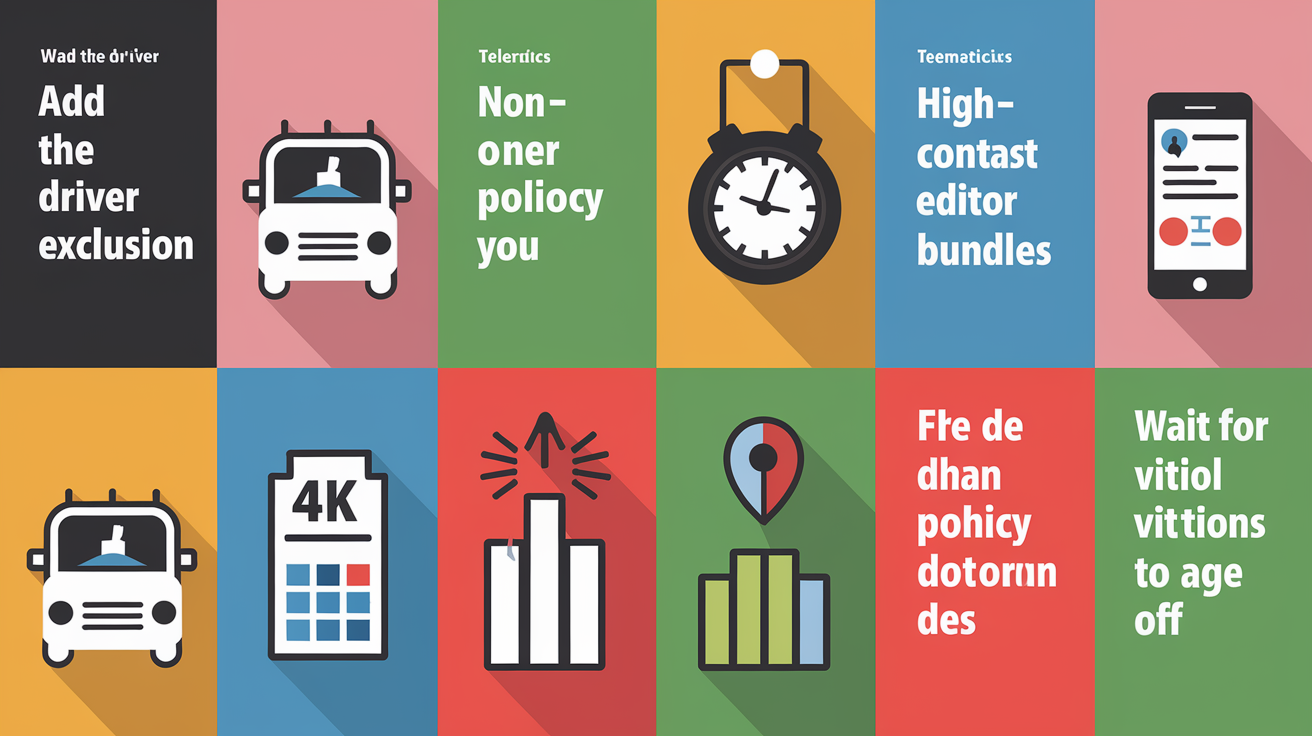
Six practical alternatives to driver exclusion:
- Add the person to your policy and shop three or more insurers to find the best rate with the new driver included.
- Purchase a separate non-owner policy for the high-risk household member to cover their liability when driving any vehicle.
- Enroll the driver in a telematics program that monitors behavior and rewards safe driving with discounts.
- Raise your deductible or lower your liability limits temporarily to reduce premium (only if you can afford the higher out of pocket risk).
- Bundle your auto policy with home, renters, or life insurance to unlock multi-policy discounts that offset the added driver cost.
- Wait for violations to age off the record (typically three to five years) and then add the driver when their surcharge is lower.
Real-World Scenarios Involving Excluded Drivers on Auto Insurance
A family excludes their 19 year old to avoid a $2,400 annual surcharge after the teen gets two speeding tickets and an at-fault accident. Six months later, the teen borrows the car to pick up dinner, runs a red light, and crashes into another vehicle. The insurer denies coverage. The family pays $18,000 out of pocket for the other driver’s car and medical bills, plus $12,000 to repair their own vehicle. The injured driver also sues for long-term medical costs. The family’s homeowner’s insurance steps in to cover legal defense, at the cost of a claim on that policy and higher future premiums.
In another case, a policyholder excludes an elderly parent with early stage dementia who no longer drives. The exclusion works well until a houseguest accidentally leaves keys on the counter. The parent takes the car to the grocery store, causes a minor fender bender in the parking lot, and the insurer denies the claim. Because it’s a low-speed incident with no injuries, the out of pocket cost is manageable ($4,500 for repairs). But the insurer non-renews the policy at the end of the term, citing the excluded driver incident and the risk of future violations.
Exclusions also affect other household drivers. If one family member is excluded and another covered driver causes an unrelated accident, some insurers view the household as higher-risk overall and raise everyone’s rates or decline renewal. The exclusion itself signals to underwriters that the household includes a problem driver, which can make it harder to find affordable coverage later.
| Scenario | Action Taken | Outcome |
|---|---|---|
| Teen excluded, later drives and crashes | Family excludes 19 year old; teen borrows car for errand and causes accident | Insurer denies claim; family pays $30,000+ out of pocket; injured party sues; homeowner’s policy covers defense but future premiums rise |
| Elderly parent excluded, drives during confusion | Parent with early dementia excluded; keys left accessible; parent drives and causes minor crash | Insurer denies $4,500 repair claim; insurer non-renews policy; family struggles to find replacement coverage |
| Other household driver causes unrelated accident | Exclusion in place; covered driver has separate at-fault crash | Insurer views household as high-risk; raises rates or declines renewal at end of term |
Best Practices and Expert Recommendations for Managing Driver Exclusions
(((alt-img10)))
Experts recommend excluding a driver only when you’re certain they’ll never operate your vehicle and when you’ve exhausted every other way to reduce your premium. Before signing an exclusion form, get written quotes showing your premium with and without the exclusion. Compare that savings to the potential cost of one denied claim. In most cases, the risk outweighs the reward.
Document everything. Keep signed copies of exclusion requests, the endorsement itself, and any correspondence with your insurer. Confirm the effective date in writing and check your policy declarations page each renewal to make sure the exclusion is still listed correctly. If the excluded person’s circumstances change (they move out, they get their license reinstated, they complete a DUI program), contact your insurer immediately to discuss reinstatement or removal.
Use this five-item checklist before finalizing a driver exclusion:
- Verify that your state allows driver exclusions and review any consent or disclosure requirements with your state’s department of insurance.
- Request a written premium quote with the exclusion in place and compare it to quotes from at least two other insurers that would add the driver as rated.
- Confirm in writing what happens if the excluded person drives: will your insurer deny all claims, cancel your policy, or pursue legal action?
- Assess whether the excluded person might ever need to drive in an emergency (medical, childcare, weather) and whether you can realistically enforce the exclusion.
- Consult an insurance agent or attorney if the excluded person has a history of taking vehicles without permission or if household boundaries are unclear.
Final Words
In the action, we defined excluded drivers, showed how exclusions appear on endorsements, and explained why households or insurers use them. We ran through premium effects, legal and liability pitfalls if an excluded person drives, state rule differences, and the steps to add or remove an exclusion.
We also looked at realistic alternatives, sample scenarios, and a short checklist so you understand real costs, not just the sticker price.
If you’re deciding about excluded drivers on auto insurance, check state rules, get written quotes both ways, and document everything. You can avoid costly surprises.
FAQ
Q: Does having an excluded driver affect insurance?
A: Having an excluded driver affects your insurance by removing coverage whenever that person drives; it can lower premiums but creates a major claim-denial risk and can leave you facing lawsuits and big out-of-pocket bills.
Q: How to remove excluded driver from car insurance?
A: To remove an excluded driver, contact your insurer and request reinstatement; provide proof (valid license, clean driving record, defensive-course completion) and expect insurer approval or a wait until renewal.
Q: What states don’t allow excluded drivers?
A: States that don’t allow excluded drivers vary; some ban or tightly limit exclusions. Check your state insurance department or ask carriers directly, because rules and enforcement differ by state.
Q: What does “excluded driver” mean?
A: An excluded driver means a named person specifically barred from coverage on the policy; if they drive the insured vehicle, the insurer generally will not pay liability, collision, or comprehensive claims.